
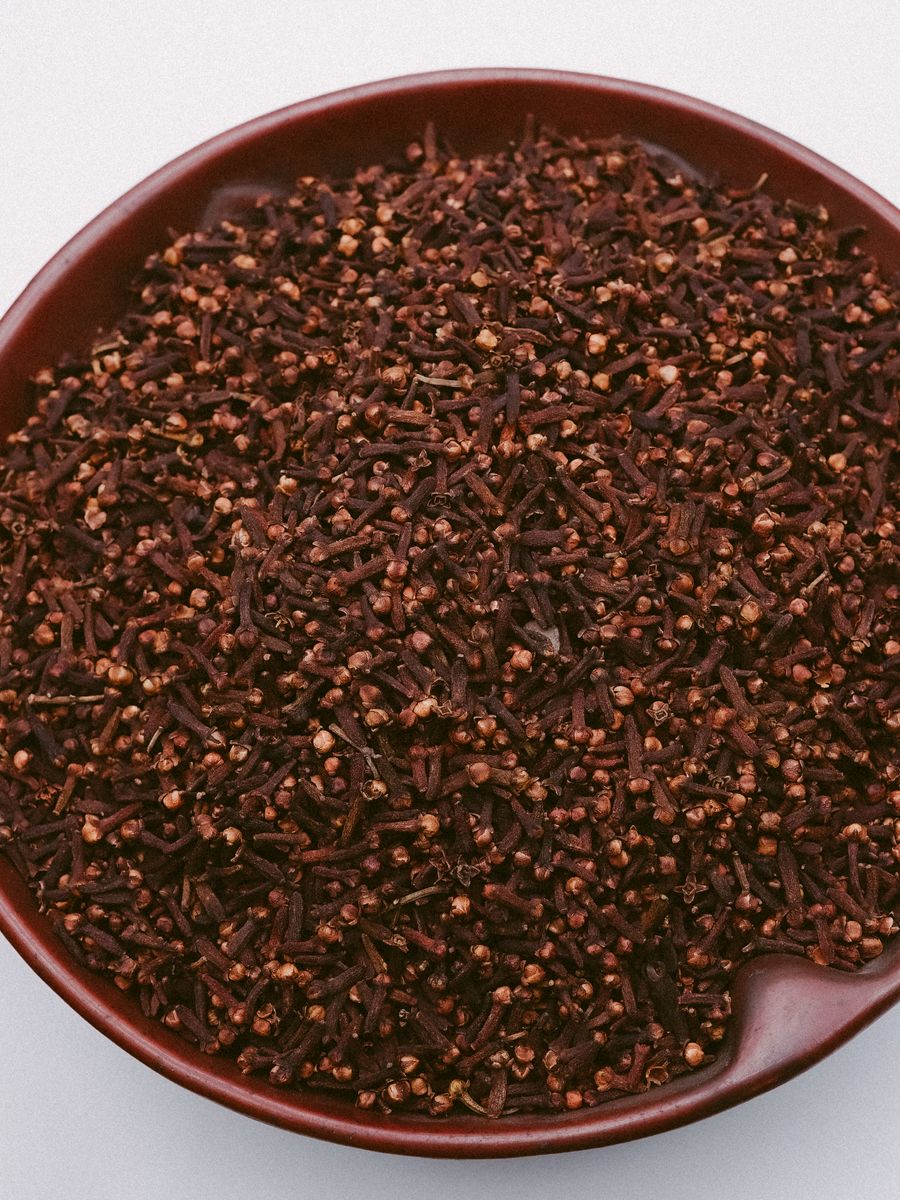

Quick facts
- Botanical name
- Syzygium aromaticum (syn. Eugenia caryophyllata)
- Family
- Myrtaceae (the myrtle family — also eucalyptus, guava and allspice)
- Also known as
- Laung / lavang (Hindi), grambu / karayampoo (Malayalam), kirambu (Tamil); historically "chicken-tongue spice" in ancient China
- Native to
- The Maluku Islands (the Moluccas / "Spice Islands") of eastern Indonesia — Ternate, Tidore, Bacan, Makian and Moti
- Heartland
- World production today centres on Indonesia, Madagascar, Tanzania (Zanzibar/Pemba) and Sri Lanka; in India, the Western Ghats homesteads of Kanyakumari, Tenkasi, the Nilgiris, Idukki and the high ranges
- Part used
- The dried, unopened flower bud (whole or ground)
- Flavour
- Warm, sweet and intensely aromatic with a sharp, woody bite and a tongue-tingling, mildly numbing finish
- Key aroma
- Eugenol — typically 72-90% of clove bud oil — supported by eugenyl acetate and β-caryophyllene
- Top grades
- Hand-picked superior (CG1), clean (CG2) and standard (CG3) under ISO 2254; in India, the GI-tagged "Kanniyakumari Clove" is prized for unusually high (~21%) volatile-oil and ~86% eugenol content
01Overview
What is clove?
Clove is one of the few spices that is, botanically, a flower that never got to open. Each bud is the unopened blossom of an evergreen tropical tree, Syzygium aromaticum, picked at the precise moment its head flushes pink and then dried in the sun until it hardens into the familiar nail-shaped, dark-brown spice. (The English word "clove" comes from the Latin clavus, a nail — and a clove really does look like a tiny hand-forged nail.) Crush one between your fingers and the smell that floods out is almost entirely the work of a single aromatic compound, eugenol, which makes up the lion's share of clove oil and gives the spice its warm, sweet, woody character and that unmistakable numbing tingle.
We want to be straight about where clove belongs, because the honesty matters more than the marketing. Clove is not native to India or the Western Ghats — its only true home is the Maluku Islands of Indonesia, the original Spice Islands, and the great producers today are Indonesia, Madagascar and Tanzania's islands of Zanzibar and Pemba. India is a small grower and a large consumer, importing much of what its kitchens use. But clove did put down roots in the shaded homesteads of the southern Western Ghats, and one Indian clove has earned something no port-name marketing can fake: a Geographical Indication. That clove grows in the same hills we farm.
02History & origin
From chicken-tongue aromatic to the spice that redrew the map
Clove's written history is astonishingly old. Chinese court records describe officials, as far back as the Han dynasty around the 3rd century BCE, holding cloves in their mouths to sweeten their breath before addressing the emperor — which is why early Chinese texts call clove the "chicken-tongue aromatic" (after the shape of the bud). For most of antiquity the spice travelled westward along trade routes while its source stayed a closely guarded secret.
That secret was a cluster of tiny volcanic islands in eastern Indonesia — Ternate, Tidore, Bacan, Makian and Moti — where, for centuries, the world's entire clove supply grew. When Europeans finally traced the trade to its root, clove became one of the most fought-over commodities on earth. The Portuguese reached the islands in the early 16th century; the Dutch East India Company (VOC), founded in 1602, then took control and enforced a brutal monopoly, even uprooting clove trees outside their designated islands to keep prices sky-high. For a time clove was quite literally worth its weight in gold.
The monopoly finally broke in the late 18th century, when the French administrator Pierre Poivre smuggled clove seedlings out of the Moluccas in 1770 and established them in Mauritius, the Seychelles and ultimately Zanzibar — which would become one of the great modern clove islands. Clove reached the homesteads of South India far later and on a far smaller scale, carried in on colonial spice networks, and settled comfortably into the shaded, high-rainfall gardens of the Western Ghats.

03Origin & terroir

India's only GI clove grows where we work
Here is the honest version of the AroWest story for clove. There is no ancient Indian clove dynasty, no "Malabar clove" that conquered the world. What India does have is one clove distinctive enough to win a Geographical Indication — the Kanniyakumari Clove, registered in 2020 as one of India's GI-tagged spices. And it grows in exactly the kind of country we farm: the densely wooded, high-altitude folds of the southern Western Ghats.
The Kanniyakumari clove is grown around Maramalai, Blackrock and Velimalai, in the Veerapuli Reserve Forest and Mahendragiri tracts of the Western Ghats, at roughly 400-900 metres. What makes it special is not a port name but the forest itself: good monsoon rain, sea mist drifting up from the coast and clean high-altitude sun. The GI documentation reports that these buds carry an unusually high volatile-oil content — around 21%, against a more typical ~18% — yielding roughly 86% eugenol. Drying slowly in cool mountain air, rather than racing it under fierce heat, helps lock that oil in. Stronger forest, stronger bud.
Most Indian clove — and Kanyakumari district alone supplies around 65% of the national crop — is not grown in monoculture plantations but tucked into homestead spice gardens, under the canopy of arecanut, jackfruit and other trees. These are agroforestry systems, the trees sharing shade and soil with their neighbours. That is the truthful AroWest angle: not a conquest story, but a quieter one — clove as a Western Ghats homestead tree, hand-picked bud by bud and sun-dried, from the one corner of India the spice ever truly made its own.
“Everyone sells cloves from somewhere famous. India's only GI clove grows in the Western Ghats — our hills.”
04Research & trade
Who studies & protects India’s clove
India grows only a little clove — but what it has is taken seriously: researched in the Western Ghats spice institutes and protected, in one case, by a Geographical Indication.
ICAR–Indian Institute of Spices Research (IISR), Kozhikode
India's national institute for spices research, in Kozhikode, Kerala. Its mandate crops include the tree spices — clove, nutmeg and cinnamon — alongside pepper, cardamom, ginger and turmeric, covering cultivation, crop protection and quality.
Spices Board of India
The Ministry of Commerce body (headquartered in Kochi) that regulates, promotes and sets quality standards for Indian spices, including clove, and maintains the official list of GI-tagged spices.
Kanniyakumari Clove — Geographical Indication
India's only GI-tagged clove, registered in 2020 for clove grown in the Western Ghats of Kanyakumari district, secured by the Maramalai and Blackrock Hill Planters Associations and noted for its high oil and eugenol content.
ICAR–AICRP on Spices
The All India Coordinated Research Project on Spices, coordinated from IISR Kozhikode — the country's largest spices research network, linking ICAR with state agricultural universities across many agro-climatic regions.
Sources: ICAR–IISR (Kozhikode), Spices Board of India and the Kanniyakumari Clove GI record — see references.
05Botany & cultivation
How & where it grows
Syzygium aromaticum is an evergreen tree of the myrtle family (Myrtaceae), the same family as eucalyptus, guava and allspice. Left alone it grows roughly 8-12 metres tall, with glossy, aromatic leaves and crimson flowers borne in clusters at the branch tips.
The spice is the flower bud, harvested before it opens. As a cluster matures, the pale green buds swell and the heads flush pink — that is the signal to pick. If left on the tree, each bud would open into a small crimson flower and then a berry (the so-called "mother of clove"), so harvest timing is everything: a day late and the bud's aroma is spent on blooming.
Clove demands a strictly tropical, humid climate with no real dry season — warm temperatures (roughly 20-30°C), generous rainfall and shade when young. This narrow climatic window is the single biggest reason it only thrives in select pockets of the Western Ghats and not across the wider Indian plains.
Trees are usually raised from seed in shaded nursery beds; the seed is short-lived and must be sown fresh. A young tree is slow to reward its grower — it typically takes several years to begin flowering and reaches full bearing later still, which is part of why genuine clove is never a casual crop.
Harvest is unavoidably manual. Each cluster is hand-picked so the delicate branch tips aren't damaged, the green stalks (clove stems) are separated out, and the buds are spread to dry in the sun for several days until they lose much of their weight and harden into the dark-brown spice — typically down to a moisture level safe for storage.
06Cultivation & agronomy
How it's grown
Clove is a slow, patient tree crop in India, grown almost entirely as a shaded homestead tree in the southern Western Ghats rather than in open plantations. It rewards the grower only after several years, but a well-tended tree then bears for decades.
Climate & soil
Clove needs a humid tropical climate with no harsh dry season: warm temperatures of roughly 20-30 C, well-distributed annual rainfall of about 1,500-3,000 mm, and shade in early years. In India it does best in the high-rainfall hills of the southern Western Ghats, such as parts of Kanyakumari, Tenkasi, the Nilgiris and Idukki, broadly from near sea level up to around 900 m. It prefers deep, well-drained, humus-rich loams or lateritic forest soils, ideally slightly acidic (about pH 5.5-6.5); waterlogging and strong dry winds are its main enemies.
Propagation & planting
Almost always raised from seed, because clove seed is short-lived (recalcitrant) and must be sown fresh, within a few days of collection, in shaded nursery beds or polybags. Use bold, fully ripe "mother of clove" fruits, sow with the broad end down, and keep beds moist and shaded; germination takes a few weeks. Seedlings are nursed under shade for about 18-24 months before transplanting to the field at the onset of the monsoon.
Crop calendar
Nursery (seed sowing)
Sow fresh ripe seed in shaded beds or polybags, typically June-August with the monsoon; keep moist and shaded. Seedlings stay in the nursery for about 18-24 months.
Field planting
Transplant healthy 1.5-2 year-old seedlings at the start of the rains (June-July in most of South India) into pits enriched with FYM and topsoil, under partial shade.
Vegetative / establishment (years 1-5)
Slow canopy growth needing regular shade, irrigation in dry spells, weeding and mulching; the tree is highly sensitive to drought and sun scorch in this phase.
First flowering / early bearing (around years 6-8)
Trees begin to flower and set the first small bud clusters; yields are modest and build up gradually over the next several years.
Bud development
Pale-green buds swell and the heads flush pink just before opening; in South India the main harvest window is roughly December-February (with some regional variation).
Harvest
Clusters are hand-picked when buds turn pink but are still closed, then de-stalked and sun-dried for several days until dark, hard and oil-rich.
In the field
- Spacing: Plant trees about 6-7 m apart (roughly 150-200 trees per hectare in pure stands), though in homestead gardens they are scattered under arecanut, jackfruit and other trees rather than in strict rows.
- Shade & shelter: Provide partial shade for the first 3-5 years using nurse trees or intercrops; mature trees tolerate more sun but still benefit from a sheltered, wind-protected site, as dry winds damage flowering.
- Irrigation: Keep soil moist but never waterlogged. Young trees especially need irrigation through dry months; mature trees benefit from a short, mild moisture stress before flowering to encourage bud set, but should not be left to wilt.
- Mulching: Mulch the basin with leaf litter, husk or organic matter to conserve moisture, moderate soil temperature and feed soil life - valuable on the sloping forest soils where clove is grown.
- Weeding & basin care: Keep basins weed-free, especially in early years, and lightly fork in organics; avoid deep digging that damages the shallow feeder roots.
- Harvest handling: Hand-pick whole clusters carefully so branch tips are not torn, separate the green stalks, and dry slowly in cool mountain sun rather than fierce heat to lock in the volatile oil.
07Variety guide
Every variety, in depth
Clove in India is a crop of forest gardens and homesteads rather than formal plantations, grown almost entirely from local seedlings in the high-rainfall Western Ghats. There are no widely released commercial varieties from ICAR or SAUs, though the Kanniyakumari Clove earned a Geographical Indication in 2019 for its exceptional oil strength. What India grows are landraces—old forest-adapted seedling selections—and botanical reference types, many shared with other clove-growing nations. This guide lists the real types you'll encounter, from the GI clove of Tamil Nadu to the Indonesian populations at the spice's centre of origin.
Kanniyakumari CloveKanyakumari Clove, GI Kanniyakumari Clove
Regional typeKanyakumari district, Western Ghats, Tamil Nadu (Maramalai, Blackrock Hill, Velimalai; Veerapuli Reserve Forest, Mahendragiri tracts) · Maramalai and Blackrock Hill Planters Associations / ICAR institutes · 2019 (GI registration)
Unusually high volatile-oil content (around 21%, against typical 18%) yielding approximately 86% eugenol. Slow sun-drying in cool mountain air at 400–900 m altitude locks in oil. The only Indian clove with an official Geographical Indication.
Full detailsLocal South Indian homestead typeKerala clove, Nilgiris clove (seedling population)
Traditional cultivarSouthern Western Ghats homesteads—Kanyakumari, Tenkasi (Tamil Nadu); Idukki, high ranges (Kerala); Nilgiris · Farmer selection, centuries of local cultivation · Pre-colonial, continuously maintained
Well adapted to local micro-climates and agroforestry systems under arecanut, jackfruit and other shade trees. Fresh seed from local trees used for propagation.
Full detailsZanzibar typeZanzibar clove, Tanzanian clove, Pemba type
Botanical typeZanzibar and Pemba islands, Tanzania (introduced from Mauritius/Seychelles via French trade, established in Zanzibar by 1812) · Commercial industry selection, no single breeder · Established 1812 onward in Zanzibar
Robust, reliable cropping; large, uniform buds. A dominant global trade standard—the benchmark for commercial clove. Higher yields than forest landraces under managed plantation conditions.
Full detailsPenang typeMalaysian clove, Penang clove
Botanical typePenang and Perak, Malaysia (introduced from Indonesia; first plantations at Balik Pulau, 1794) · Malaysian growers, British East India Company planters · 1794 onward (formal plantations established)
Noted as a distinct commercial type in Southeast Asian trade. Higher-yielding than some Indonesian forest types under managed conditions. A reference point for comparing Indian forest clove with modern commercial systems.
Full detailsSikotokSiketoke, Siacoke clove
Botanical typeMaluku Islands, Indonesia (the centre of origin) · Indigenous growers of the Spice Islands · Pre-colonial, continuously maintained
Part of the genetic diversity preserved at the centre of clove origin. Reportedly produces smaller buds with excellent oil quality. Important for understanding clove domestication and breeding.
Full detailsSiputihSiputih clove
Botanical typeMaluku Islands, Indonesia (Ternate region traditionally) · Indigenous growers of Ternate · Pre-colonial, continuously maintained
A white or pale-bud variant historically distinct from darker cloves; possibly a maturity stage or genetic variant. Rarely seen in modern trade; mainly of botanical interest.
Full detailsIdukki High-Altitude cloveIdukki type, High-ranges clove
Traditional cultivarIdukki district, Kerala high ranges (800–1200 m altitude) · Farmer selection and local adaptation · Continuous cultivation; origin date unknown
Grown at exceptionally high altitude within Indian clove zones, benefiting from cooler temperatures and constant mist. Slow bud maturation and drying in cool conditions may enhance oil retention.
Full detailsTenkasi-Puliyangudi cloveTenkasi type, Puliyangudi clove
Traditional cultivarTenkasi and Puliyangudi taluks, Tirunelveli district, Tamil Nadu (Western Ghats foothills) · Farmer selection, generations of local cultivation · Continuous cultivation; pre-modern origin
Grown in the foothills and lower slopes of the Ghats, with a distinct micro-climate between Kanyakumari and the Nilgiris. May develop different oil profiles due to local soil and weather patterns.
Full detailsNilgiris blue-mountain cloveNilgiri type, Ooty clove
Traditional cultivarNilgiris district, Tamil Nadu (high-altitude blue mountains, up to ~1000 m) · Farmer selection and plantation heritage · Continuous cultivation; colonial-era introductions adapted locally
Grown on the Nilgiri plateau at high altitude with cool temperatures and high rainfall. Slow growth and maturation may produce more concentrated buds, though yields are lower.
Full detailsMadagascar typeMadagascan clove
Botanical typeMadagascar (introduced from Zanzibar/Indian Ocean islands in early 19th century) · Commercial industry selection, no single breeder · Early 19th century onward
Madagascar is one of the world's top clove producers, with distinctive terroir-influenced buds. Different soil and climate from Zanzibar produce slightly different oil profiles. A reference type for comparing island-grown clove.
Full detailsSri Lankan typeCeylon clove, Sri Lanka clove
Botanical typeSri Lanka (introduced from Indonesia or Zanzibar in colonial era; cultivation established 19th century onward) · Sri Lankan growers and plantation industry · 19th century onward
Sri Lanka is a secondary but important clove producer with good yields and consistent quality. Grown under coconut and mixed shade in plantation systems. A reference type for tropical plantation clove.
Full detailsIndigenous Western Ghats mixed-homestead cloveAgroforestry clove, intercrop clove
Traditional cultivarThroughout Western Ghats (Kanyakumari, Tenkasi, Idukki, Nilgiris, high ranges) · Generations of smallholder farmers · Continuous cultivation, origin pre-colonial
Not a single cultivar but a production system: clove grown as an intercrop with arecanut, jackfruit, pepper and spice bushes in mixed homestead gardens. This agroforestry approach is the authentic Indian model.
Full detailsSeedling clove (unselected)Wild-type clove, unimproved seedling clove
Botanical typeGrown throughout clove-producing regions worldwide; represents the genetic baseline · Nature; unselected seedling population · Continuous
The default propagation method in India and historically worldwide. Each seedling is genetically distinct, yielding tree-to-tree variation in vigor, bud size and oil content. This is why most Indian clove is genetically variable.
Full details08Pests, diseases & disorders
What can go wrong
Clove is a relatively hardy tree but suffers from a handful of well-known problems, mostly fungal diseases linked to its high-rainfall homes plus a few sap-feeding and stem pests. Because clove is a long-lived shaded tree, prevention - good drainage, sanitation and balanced nutrition - matters far more than spraying. Always follow your local package of practices and use only recommended, registered products.
Leaf rot / leaf blight and seedling dieback
DiseaseSigns: Brown, water-soaked or necrotic patches on leaves, leaf fall, and dieback of young shoots and nursery seedlings, worse in continuously wet, poorly ventilated conditions.
Manage: Improve drainage and air movement, avoid overhead wetting, remove and destroy affected leaves, keep nursery shade and density moderate, and apply a recommended, registered fungicide as per the local package of practices only when pressure is high.
Seedling wilt / damping-off
DiseaseSigns: Sudden wilting, collapse and rotting of young nursery seedlings at or near the soil line, often in patches in over-watered, over-shaded beds.
Manage: Use well-drained nursery media, avoid over-watering and overcrowding, raise beds, treat soil and seed with a recommended biocontrol or registered fungicide as per local advice, and incorporate beneficial microbes such as Trichoderma where available.
Stem borer
PestSigns: Holes and frass (sawdust-like excreta) on the trunk or branches, tunnels under the bark, wilting of affected limbs and gradual loss of vigour in older trees.
Manage: Inspect trunks regularly, swab or paint wounds, probe and clean bored galleries, remove and destroy badly infested branches, and use a recommended control as per local advice; keep trees healthy and avoid bark injuries that invite attack.
Scale insects & mealybugs
PestSigns: Clusters of immobile scales or white waxy mealybugs on shoots, leaf undersides and bud clusters, with sticky honeydew and sooty mould blackening the leaves and weakening flowering.
Manage: Encourage natural enemies (ladybird beetles, parasitoids), prune and destroy heavily infested shoots, wash off light infestations, control ants that farm them, and use horticultural oil or a recommended product as per local advice only if needed.
Sooty mould
DisorderSigns: A black, soot-like film over leaves and buds that does not infect the plant directly but blocks light and reduces vigour; usually a sign of an underlying sap-sucking pest.
Manage: Control the underlying scale, mealybug or aphid infestation and the honeydew disappears; the mould can then be gently washed off and improved airflow keeps it from returning.
Drought / sun-scorch stress
DisorderSigns: Leaf scorch, browning leaf margins, leaf drop, poor flowering and bud shedding during prolonged dry spells or sudden exposure of shade-grown young trees to harsh sun.
Manage: This is a management disorder, not an infection: provide shade to young trees, mulch basins, irrigate through dry months and avoid suddenly removing the canopy over shade-adapted plants.
09Soil & fertiliser
Feeding the plant
Clove is grown on organically rich forest soils and responds best to a steady supply of organic matter topped up with balanced nutrients as the tree matures. Feeding is light in the early years and increases as the tree comes into bearing. Treat the points below as general guidance and confirm rates with a soil test and your local package of practices.
| Stage | Inputs | Notes |
|---|---|---|
| Nursery | Organic-rich potting mix (FYM/compost + topsoil + sand); minimal balanced nutrient feed | Raise seedlings in a porous, fertile potting mix; rely mainly on well-rotted FYM or compost and avoid heavy chemical fertiliser on tender roots. |
| Planting / pit preparation | Well-rotted FYM/compost worked into each pit; optional rock phosphate | Fill planting pits with topsoil mixed generously with well-decomposed FYM or compost so young roots establish in soft, fertile, well-drained soil. |
| Young trees (years 1-5) | FYM/compost annually + low, rising balanced NPK, split-applied | Apply organic manure each year before the monsoon plus a small, increasing dose of a balanced NPK, split across the rainy season; raise quantities gradually with tree age. |
| Bearing trees (from about year 6) | Annual FYM/compost + full balanced NPK in 2 splits; add micronutrients only if a soil/leaf test shows a need | Give a full annual dose of organic manure plus balanced NPK, split into two applications timed to the monsoon so nutrients are available during active growth and bud development. |
Common deficiencies & issues
- Nitrogen deficiency: Overall pale, yellowing older leaves, weak shoot growth and a thin canopy; corrected with organic manure plus a balanced nitrogen source, not a single heavy dose.
- Potassium deficiency: Scorched, browning leaf margins on older leaves and poor bud filling; common on leached hill soils and eased with potassium-bearing fertiliser and good organic matter.
- Magnesium / micronutrient deficiency: Interveinal yellowing on older leaves (magnesium) or pale new growth (iron/zinc) on acidic, leached soils; confirm with a leaf or soil test before correcting, as over-application can do harm.
10Grades & quality
The grades, decoded
Clove isn't graded by region the way pepper is by "Tellicherry" or cardamom by "Alleppey Green." It's graded mostly by how it was picked and how clean and whole the dried buds are — the international standard (ISO 2254) sorts trade clove into hand-picked superior, clean and standard grades, each with set tolerances for a handful of well-known defects. India's own contribution is the reverse of a defect: a GI clove valued for sheer oil strength.
| Grade | Name | What it means |
|---|---|---|
| CG1 | Hand-picked superior | The top trade grade under ISO 2254 — large, uniform, whole buds with intact heads, picked and sorted by hand, with the tightest defect tolerances. Best aroma and a high minimum volatile-oil content. |
| CG2 | Hand-picked / clean | Hand-picked but smaller and less uniform than CG1, with low moisture (generally under ~12%) and wider defect tolerances. Still strongly aromatic. |
| CG3 | Standard / fair average quality | Bulk commercial grade with the highest tolerance for broken, headless and mother cloves; serviceable for grinding and oil extraction. |
| GI | Kanniyakumari Clove (India) | Geographical Indication clove from the Western Ghats of Kanyakumari district, noted for high volatile-oil content (~21%) and ~86% eugenol — prized for potency rather than size. |
| — | Mother of clove | The ripe berry (fruit) rather than the bud — milder, with much lower eugenol. A by-product, not a premium grade. |
Three defects routinely downgrade a lot: "headless" cloves that have lost the round head and contribute little aroma; "mother cloves," the mature berries that slipped in among the buds; and "khoker" cloves — shrivelled, weak buds left over after the oil has been extracted, or buds that dried badly. A good lot is plump, oily when pressed with a fingernail, and snaps rather than bends. We grade for whole heads and oil, not just colour.

11Flavour & chemistry
What gives it that aroma
Clove tastes the way it smells, only more so: warm and sweet up front, then a sharp, almost peppery woodiness, finishing with a distinctive cooling, tongue-numbing tingle. That numbing sensation — the "dentist" note — is real chemistry, not imagination.
The dominant compound is eugenol, a phenylpropanoid that typically makes up about 72-90% of clove bud oil and is responsible for both the aroma and the mild local-anaesthetic effect on the tongue and gums. It's the same molecule the dental world has used for over a century.
The supporting cast rounds out the profile: eugenyl acetate (acetyleugenol) adds a softer, sweeter, slightly fruity facet, while β-caryophyllene — a sesquiterpene also found in black pepper — contributes a woody, spicy lift. Minor terpenes fill in the edges.
Because the oil is so concentrated, clove is the original "a little goes a long way" spice. It dominates a dish fast; one or two whole buds, or the smallest pinch of powder, is usually plenty. The bud also holds its oil far better than the powder, which is why whole cloves keep their punch much longer in the jar.
12Culinary uses
How to cook with it
Clove sits at the warm, sweet end of the spice rack and works in both savoury and sweet cooking — but it leads loudly, so it's almost always used in small numbers alongside other spices rather than on its own. Whole buds are bloomed in hot oil or ghee to release their oil; ground clove is stirred in late so it doesn't turn bitter.
- Garam masala & whole-spice tempering: A few whole cloves bloomed in hot ghee at the start of a curry, dal or pulao perfume the entire dish; clove is a backbone spice in garam masala and most South Asian whole-spice blends.
- Biryani & pulao: Cloves, green cardamom and cinnamon are the trio behind that classic biryani aroma — added to the ghee or the rice water so the fragrance threads through every grain.
- Masala chai & warm drinks: A clove or two deepens masala chai, and whole cloves are central to mulled wine, spiced cider and kahwa, where they steep slowly into the liquid.
- Baking & desserts: Ground clove is iconic in gingerbread, spice cookies, fruit cakes and pumpkin/apple bakes, where it pairs with cinnamon, nutmeg and molasses — used by the pinch, never the spoonful.
- Pickles, brines & preserves: Whole cloves go into pickling spice, ham and gammon studding, brines and chutneys, lending warmth and an aromatic edge.
- Slow-cooked meats & stocks: Cloves stand up to long braises — studded into onions for stocks and stews, or simmered into rich meat curries and biryani gravies.
Clove loves company that shares its warmth: cinnamon, cardamom, nutmeg, star anise, black pepper, ginger and bay. On the sweet side it pairs naturally with apple, orange, molasses, chocolate and dried fruit; on the savoury side with onion, tomato, rich red meats, ham and slow-cooked rice. Treat it as a seasoning you build around, not a flavour you let take over.
13Consumption & dosage
How much, how often
Clove is one of the most concentrated spices in the kitchen, so people use it in very small amounts - one or two whole buds, or the smallest pinch of powder - rather than by the spoon. It crosses freely between savoury and sweet cooking and is a backbone of Indian whole-spice blends.
- Whole-spice tempering: A couple of whole cloves bloomed in hot ghee or oil at the start of a curry, dal or pulao perfume the whole pot; this is the everyday Indian use, two to four buds for a family dish.
- Biryani, pulao & garam masala: Clove with green cardamom and cinnamon is a classic aromatic trio behind biryani and pulao, and clove is a core component of most garam masala blends - used by the few buds, never the handful.
- Masala chai & warm drinks: One clove deepens a pot of masala chai, and whole cloves steep into kahwa, mulled wine and spiced cider, especially in cold weather and the festive season.
- Baking & desserts: Ground clove flavours gingerbread, spice cookies, fruit cakes and apple bakes alongside cinnamon and nutmeg - a pinch is plenty, as too much turns bitter and overpowering.
- Pickles, brines & preserves: Whole cloves go into pickling spice, chutneys, brines and studded meats, where their warmth and traditional reputation as a preserving spice have long made them a favourite.
- Who should go easy: Those on blood-thinning medication or due for surgery, pregnant or nursing women, and parents of young children should be cautious with concentrated clove oil and large medicinal amounts - everyday culinary pinches are a different matter. When in doubt, ask a qualified healthcare professional.
14Health & wellness
What the evidence says
The strongest themes in the research are below. Many studies use concentrated extracts, and the evidence is still developing.
- A genuinely eugenol-rich spice: Clove is one of the most concentrated natural sources of eugenol, the compound behind most of its studied biological activity. This is well established in the chemistry literature, though most clinical work uses isolated eugenol or clove oil rather than the spice in food.
- Dental analgesic — its best-supported use: Eugenol has documented local-anaesthetic and antibacterial properties and a long history in dentistry; a 2025 systematic review of phytotherapeutic agents for dental pain found supportive evidence for eugenol in toothache and post-procedure pain, while noting that larger, standardised trials are still needed.
- Antimicrobial activity: In laboratory studies, eugenol and clove oil show broad antimicrobial action against a range of bacteria and fungi. This is robust in vitro evidence; it does not mean eating cloves treats infections in people.
- Antioxidant & anti-inflammatory potential: Clove and eugenol are strong antioxidants in lab assays and show anti-inflammatory effects in experimental models. Human dietary evidence is limited, so this is best read as promising rather than proven.
- Traditional digestive use: Clove has a long traditional role in aiding digestion and freshening breath. These uses are culturally well attested but not yet backed by strong clinical trials.
15Nutrition
By the numbers
Per 100 g, ground clove looks extraordinarily nutrient-dense — but that's a slightly misleading frame, because nobody eats 100 g of clove. A teaspoon is only about 2 g. The standout is manganese, where even a small amount is meaningful, plus notable fibre and vitamin K. Values below are from USDA FoodData Central for "Spices, cloves, ground" (FDC 171321).
| Nutrient | Per 100 g |
|---|---|
| Energy | 274 kcal |
| Protein | 5.97 g |
| Total fat | 13.0 g |
| Carbohydrate | 65.5 g |
| Dietary fibre | 33.9 g |
| Total sugars | 2.38 g |
| Calcium | 632 mg |
| Iron | 11.8 mg |
| Magnesium | 259 mg |
| Phosphorus | 104 mg |
| Potassium | 1020 mg |
| Sodium | 277 mg |
| Zinc | 2.32 mg |
| Manganese | 60.1 mg |
| Vitamin C | 0.2 mg |
| Vitamin E | 8.82 mg |
| Vitamin K | 141.8 µg |
Values are approximate and vary by sample; source: USDA FoodData Central.
16Myths vs facts
Setting the record straight
Myth: India is a major clove producer.
Fact: India grows only a small amount of clove in Western Ghats homesteads and imports much of what its kitchens use; the leading producers are Indonesia, Madagascar and Tanzania, including the islands of Zanzibar and Pemba.
Myth: Bigger, darker cloves are always better quality.
Fact: Size and colour matter less than oil content. A good clove is plump and oily, snaps rather than bends, and keeps its round head - the head holds most of the eugenol, so headless stalks are a poor buy regardless of size.
Myth: Clove oil cures toothache, so you can just keep using it at home.
Fact: Eugenol is traditionally used in dentistry and studies suggest it has local-anaesthetic and antibacterial properties, but undiluted clove oil can irritate or burn the gums and should never be swallowed or given to children. Persistent dental pain needs a dentist, not a home remedy.
Myth: Eating more clove gives more health benefit.
Fact: Most clove research uses concentrated eugenol or clove oil, not the pinch you cook with, and very large amounts can be harmful. Treat culinary clove as a flavourful spice, not a medicine to be over-eaten.
Myth: Clove trees grow easily anywhere warm in India.
Fact: Clove needs a humid tropical climate with no harsh dry season and does well only in select high-rainfall Western Ghats pockets - it will not thrive across the wider Indian plains, which is why genuine clove is never a casual crop.
Myth: Ground clove is just as good as whole and lasts the same.
Fact: The intact bud protects its volatile oil, so whole cloves stay potent for a year or more while ground clove fades within months. Grind small amounts fresh as you need them for the best aroma.
17In your kitchen
How to choose, use & store
Choose
Buy clove whole whenever you can — the bud protects its oil far better than powder. Look for plump, dark-brown buds with the round head still attached; the head holds most of the eugenol, so lots full of "headless" stalks are a poor buy. A good clove feels slightly oily and leaves a faint sheen when you press a fingernail into it, and it should snap rather than bend. Strong, immediate aroma is the surest sign of fresh, oil-rich buds.
Use
Use cloves sparingly — they overpower fast. For savoury cooking, bloom one or two whole buds in hot oil or ghee before adding aromatics, or stud them into an onion for stocks and braises (and fish them out before serving). Grind clove fresh and add it late to curries and bakes so it stays fragrant rather than bitter. For drinks, steep whole cloves gently. Start with less than you think you need.
Store
Store whole cloves in an airtight container away from heat, light and moisture, and they'll hold their aroma for a year or more. Grind only what you'll use soon — ground clove fades much faster. Keep the jar out of the sun and well sealed; the moment the warm smell weakens, the oil is going and it's time to refresh.
18FAQ
Frequently asked questions
What part of the plant is a clove?
A clove is the dried, unopened flower bud of the tree Syzygium aromaticum. It's picked just before it would bloom — if left, the bud opens into a small crimson flower and then a berry. The nail-like shape is exactly that closed bud, which is why "clove" comes from the Latin for nail (clavus).
Is clove native to India?
No. Clove is native to the Maluku Islands of Indonesia — the original Spice Islands. India grows only a small amount in Western Ghats homesteads and imports much of what it consumes. We're upfront about this: our honest story is homestead cultivation in the Ghats, not native origin.
Then what's the Indian clove worth knowing about?
The Kanniyakumari Clove, which received a Geographical Indication in 2020. Grown in the Western Ghats of Kanyakumari district, it's noted for unusually high volatile-oil content (around 21%) and roughly 86% eugenol. It's the only Indian clove with a GI — and it grows in the kind of forest country we farm.
What gives clove its flavour and that numbing feeling?
One compound does most of the work: eugenol, which typically makes up 72-90% of clove bud oil. It's behind the warm, sweet, woody aroma and the mild local-anaesthetic tingle — the same effect dentistry has relied on for over a century. Eugenyl acetate and β-caryophyllene fill out the rest.
Should I buy whole cloves or ground?
Whole, almost always. The intact bud protects its oil, so whole cloves stay potent for a year or more, while ground clove fades within months. Grind small amounts fresh as you need them. Look for plump buds with the round head still attached — that head holds most of the eugenol.
How much clove should I use?
Less than you think. Clove is one of the most concentrated spices there is, so one or two whole buds or a small pinch of powder is usually enough for a whole dish. Bloom whole buds in hot oil or ghee for savoury cooking; add ground clove late so it doesn't turn bitter.
Does clove oil really help with toothache?
Eugenol has documented local-anaesthetic and antibacterial properties and a long dental history, and a 2025 systematic review reports supportive evidence for it in dental pain — though larger standardised trials are still needed. Important: undiluted clove oil can burn the gums, and clove oil should never be swallowed or given to children. Treat dental pain with a dentist, not just a home remedy.
Are there real health benefits to eating clove?
Clove is a rich source of eugenol, with strong antioxidant, anti-inflammatory and antimicrobial activity in laboratory studies. But most research uses concentrated eugenol or clove oil, not the pinch you cook with — so think of culinary clove as a flavourful, nutrient-dense spice rather than a medicine. None of this is medical advice.
Is clove safe in cooking?
Yes — the small amounts used in food are widely considered safe for most people. The caution is about clove oil, which is highly concentrated: it can irritate or burn skin and mucous membranes, and ingesting it can cause serious harm, including liver injury, especially in children. Keep clove oil away from kids and use it only diluted and as directed.
What are "mother cloves" and "khoker" cloves?
"Mother cloves" are the ripe berries (the fruit) rather than the buds — milder and much lower in eugenol. "Khoker" cloves are shrivelled, weak buds — often ones left after oil extraction or dried badly. Both are treated as defects in a clove lot. A good batch is plump, whole-headed and snaps cleanly.
Why are cloves so important in Indian cooking?
Clove is a backbone of garam masala and whole-spice tempering. A couple of buds bloomed in ghee perfume an entire pot, and clove with cardamom and cinnamon is the classic aromatic trio behind biryani and pulao. It also runs through masala chai, pickles and slow-cooked curries.
How should I store cloves?
In an airtight container, away from heat, light and moisture. Whole cloves keep their aroma for a year or more; ground clove fades fast, so grind small. When the warm smell weakens, the oil is going — that's your cue to replace them.
How many years before a clove tree starts giving buds?
Be patient - a seedling clove usually takes around 6-8 years after planting to begin flowering and reaches full bearing only later still. The reward is longevity: a well-tended tree then keeps producing for several decades, which is why clove is treated as a long-term homestead investment, not a quick cash crop.
Can I grow clove on my farm in the plains or a dry district?
Honestly, probably not well. Clove demands a humid tropical climate with no harsh dry season, generous rainfall and shade when young, and in India it thrives mainly in select high-rainfall Western Ghats pockets. In hot, dry plains it tends to scorch and crop poorly, so check your micro-climate carefully before investing.
How do I judge good-quality whole cloves when buying?
Look for plump, dark-brown buds with the round head still attached, since that head holds most of the eugenol. A fresh clove feels slightly oily, leaves a faint sheen when you press a fingernail into it, snaps rather than bends, and smells strongly and immediately - lots full of headless stalks or shrivelled buds are a poor buy.
Sources & further reading
- Clove — Wikipedia (origin, botany, history, Maluku Islands, eugenol content) en.wikipedia.org
- Clove | History, Description & Uses — Encyclopaedia Britannica britannica.com
- Recent advances in nutritional composition, phytochemistry, bioactive, and potential applications of Syzygium aromaticum L. (Myrtaceae) — Frontiers in Nutrition frontiersin.org
- Clove Essential Oil: Chemical Composition and Bioactivity — PMC (PMC8588428) pmc.ncbi.nlm.nih.gov
- Biological Properties and Prospects for the Application of Eugenol — A Review — PMC (PMC8036490) pmc.ncbi.nlm.nih.gov
- Analgesic Efficacy of Phytotherapeutic Agents in Dental Pain Management: A Systematic Review (2025) — PMC (PMC12659986) pmc.ncbi.nlm.nih.gov
- Eugenol (Clove Oil) — LiverTox, NCBI Bookshelf (hepatotoxicity and safety) ncbi.nlm.nih.gov
- Spices, cloves, ground — USDA FoodData Central (SR Legacy, FDC 171321), nutrition per 100 g fdc.nal.usda.gov
- List of Geographical Indication (GI) Tags Registered for Spices (incl. Kanniyakumari Clove) — Spices Board of India indianspices.com
- Kanniyakumari 'Clove' Gets Geographical Indication Tag — Krishi Jagran (GI registration, oil/eugenol characteristics) krishijagran.com
- Production and Potentials of Clove Cultivation in Kanyakumari District — KVK Kanyakumari / ICAR-ATARI Hyderabad atari-hyderabad.org.in
- ICAR–Indian Institute of Spices Research, Kozhikode (mandate crops incl. tree spices) spices.res.in
Last reviewed: 23 June 2026 · Written by the AroWest editorial team (Western Crest Ventures LLP). Educational content, not medical advice.