

Quick facts
- Botanical name
- Myristica fragrans Houtt.
- Family
- Myristicaceae (the nutmeg family)
- Also known as
- Jaiphal / jayphal (Hindi) for the seed and javitri for mace; jathikka (seed) and jathipathri (mace) in Malayalam; jathikai / jathipathiri (Tamil). One fruit yields both nutmeg (the seed) and mace (the red aril)
- Native to
- The Banda Islands of Maluku (the Moluccas / Spice Islands), eastern Indonesia — historically the only place on earth it grew
- Heartland
- World production today is led by Guatemala, followed by India and Indonesia, which together account for the bulk of the global crop; in India nutmeg is a Western Ghats homestead tree, grown mainly in Kerala (Idukki, Ernakulam, Thrissur, Kottayam) with Tamil Nadu and coastal Karnataka
- Part used
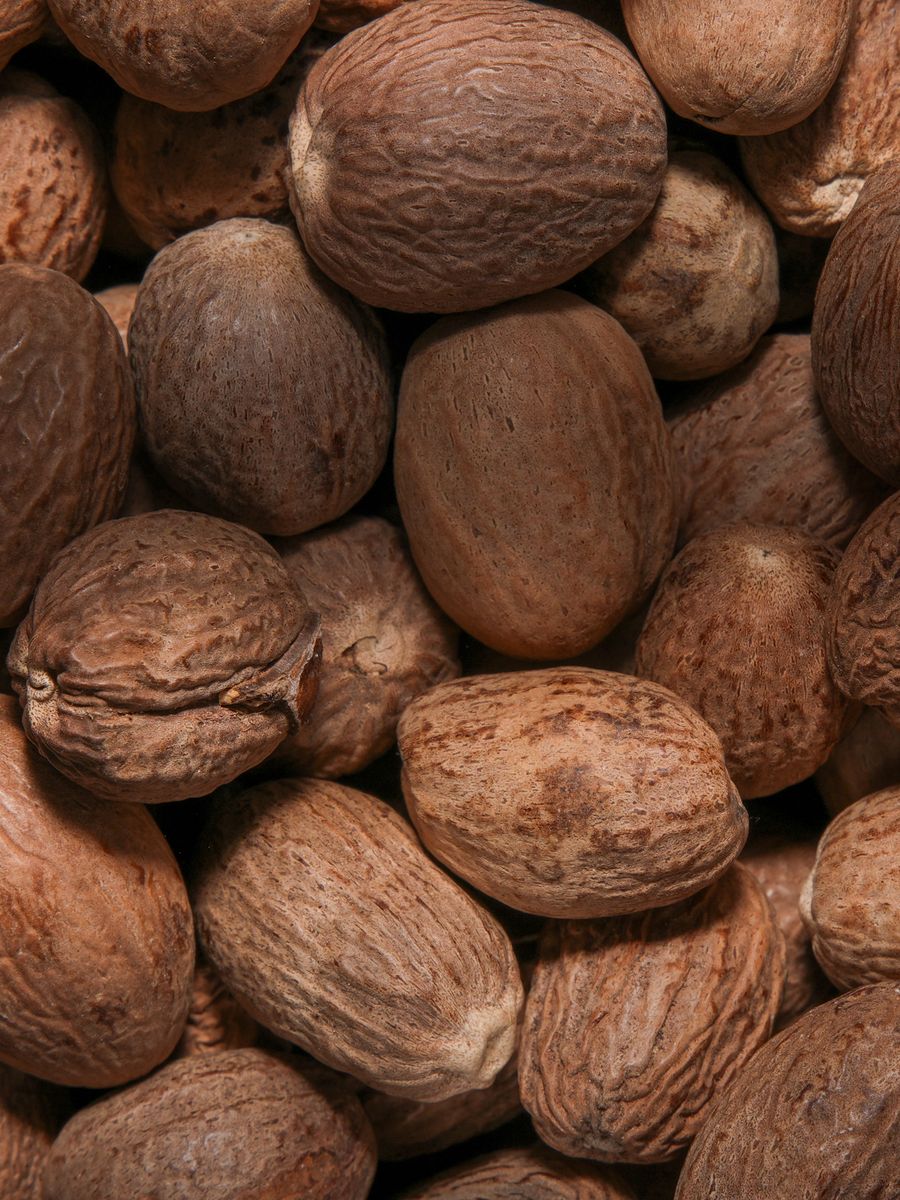
- The dried seed kernel (nutmeg); the dried scarlet aril of the same fruit is the separate spice mace
- Flavour
- Warm, sweet and woody with a nutty, balsamic richness and a faint, slightly bitter heat; mace is brighter and more delicate
- Key aroma
- Sabinene and alpha-pinene (terpenes) for the fresh, piney lift, with myristicin giving the signature warm, narcotic-sweet depth
- Top grades
- Sound, whole seeds graded by size and soundness (export grades such as Sound Shrivelled and ABCD), with broken/wormy/punctured (BWP) as the lowest; standardised under ISO 6577. India's IISR varieties Keralashree and Viswasree are prized for bold nuts and thick mace
01Overview
What is nutmeg?
Nutmeg is one of the very few spices that comes packaged with a second spice. It is the dried seed of Myristica fragrans, a tall evergreen tree of the Myristicaceae — the family named after it. The tree's fruit looks like a small golden apricot; when ripe it splits open to reveal a glossy brown seed wrapped in a vivid scarlet, lace-like net. That net is the aril, and dried on its own it becomes mace. So a single fruit gives two distinct spices: nutmeg from the kernel inside the seed, and mace from the crimson webbing around it. They share a family resemblance on the palate — warm, sweet, woody — but mace is lighter and more floral, nutmeg deeper and rounder.
We want to be straight about provenance, because honesty is the whole point of a reference page. Nutmeg is not native to India or the Western Ghats. Its only original home is the Banda Islands, a speck of volcanic land in eastern Indonesia, where for centuries it grew nowhere else on earth — a monopoly so valuable it shaped European empires and even, by way of a 1667 treaty, the fate of Manhattan. Nutmeg reached South India relatively late, on colonial trade routes, and took happily to the shaded, high-rainfall homestead gardens of Kerala's hills. That is the honest AroWest story: not a native treasure, but a prized Western Ghats homestead tree spice, hand-tended under the canopy.
A last point worth fixing in mind, because it confuses many people: the warm pinch you grate into a sauce is entirely safe and delicious, but nutmeg in large doses is genuinely toxic and psychoactive. The same compound that gives it depth — myristicin — turns dangerous in spoonful quantities. We cover that plainly in the health section. In cooking, nutmeg is used by the rasp, never the spoon, and at those amounts it is one of the kitchen's great background notes.
02History & origin
The spice that empires fought — and traded — a continent for
For most of recorded history, every nutmeg on earth came from one place: the Banda Islands, a tiny volcanic archipelago in the Maluku group of eastern Indonesia. Arab and then Venetian traders carried it west along secretive routes, and by medieval Europe nutmeg was a luxury credited with everything from flavouring to warding off plague — its source a closely guarded mystery. For a time it ranked among the most valuable commodities in the world: in the early 17th century, nutmeg bought for a pittance in Banda could be resold in Europe at an enormous markup, a profit said to run into the tens of thousands of percent.
That value made Banda a battleground. The Dutch East India Company (the VOC), founded in 1602, set out to seize total control of the nutmeg trade. Under Jan Pieterszoon Coen, the Dutch conquest of the islands between 1609 and 1621 was brutal: the Bandanese population was largely killed, deported or starved, and the Dutch enforced their monopoly by confining nutmeg cultivation to islands they controlled and destroying trees elsewhere.
One small Banda island, Run, was held by the English East India Company — and became the prize in one of history's strangest swaps. By the 1667 Treaty of Breda, England relinquished its claim to nutmeg-rich Run, and the Dutch in turn gave up their claim to a far-off trading post called New Amsterdam — today's Manhattan. For decades, a nutmeg island was reckoned the better deal.
The monopoly finally cracked in the late 18th century, when the French administrator Pierre Poivre and others smuggled nutmeg seedlings out of the Moluccas and established them in Mauritius, then Zanzibar, Grenada and beyond. Carried on these same colonial spice networks, nutmeg eventually reached South India and settled into the homestead gardens of the Western Ghats — a latecomer, but one that found a home in the hills.

03Origin & terroir

A Banda native that became a Western Ghats homestead tree
Here is the honest version of the AroWest nutmeg story. There is no ancient Indian nutmeg dynasty and no "Malabar nutmeg" that conquered the world. Nutmeg came to these hills late, on colonial trade routes, long after the Banda Islands had already made and lost their fortune on it. What the Western Ghats gave nutmeg was not origin but a second home — and a particularly good one.
Nutmeg wants exactly what our hills offer: a warm, humid, tropical climate, heavy and well-distributed rainfall, deep well-drained soils and, crucially, shade. It is naturally an understorey tree, and in Kerala it is rarely grown in open monoculture. Instead it is tucked into mixed homestead gardens, sharing the canopy with arecanut, coconut, coffee, pepper and fruit trees — classic Western Ghats agroforestry, where one smallholding grows a dozen crops on a single patch of sloping land.
Today India is one of the world's major nutmeg producers — second only to Guatemala — and almost all of that crop is Kerala's. Thrissur and Ernakulam are the heart of it, with Idukki — our own district — Kottayam and the other high-range districts adding to the total, plus pockets in Tamil Nadu and coastal Karnataka. It is overwhelmingly a smallholder, family-garden crop: trees grafted or seed-raised, grown in the shade, the fruit gathered when it splits and falls, the scarlet mace peeled from the seed by hand and both dried slowly. That is the truthful angle — not a conquest, but a quiet domestic tree spice, plantation-direct from the homesteads of the Ghats.
“Nutmeg was never ours by birth. The Western Ghats simply gave it the shade, the rain and the patient hands it always wanted.”
04Research & trade
Who studies India’s nutmeg
Nutmeg came to these hills late, but India now researches and improves it in the Western Ghats — where most of the country’s crop is grown.
ICAR-Indian Institute of Spices Research (IISR), Kozhikode
India's national institute for spices research, in Kozhikode, Kerala. Nutmeg is one of its mandate tree spices — IISR has released the improved nutmeg varieties Viswasree and Keralashree and works on cultivation, grafting, crop protection and quality.
Spices Board of India
The Ministry of Commerce body, headquartered in Kochi, that regulates, promotes and sets quality and export standards for Indian spices including nutmeg and mace, and supports growers in the Western Ghats.
Kerala Agricultural University (KAU)
Kerala's agricultural university, which researches and extends nutmeg cultivation for the state's smallholders — including farmer-participatory breeding and homestead agroforestry, the systems most Kerala nutmeg is grown under.
ISO 6577 — nutmeg & mace standard
The international specification for nutmeg (whole or broken) and mace (whole or in pieces) from Myristica fragrans, setting limits for moisture, ash, volatile oil and defects — the global benchmark behind nutmeg grading and trade.
Sources: ICAR–IISR (Kozhikode), the Spices Board and Kerala Agricultural University — see references.
05Botany & cultivation
How & where it grows
Myristica fragrans is a tall, slow-growing evergreen tree, typically 5 to 13 metres but occasionally reaching 20, with dark glossy leaves and small, pale-yellow, fragrant flowers. Left to itself it forms a dense, shapely canopy and can keep bearing fruit for decades — productive lives of forty years or more are common.
The tree is usually dioecious: individual trees are male or female, and only the females fruit. Because seedlings reveal their sex only after several years of growth, growers traditionally over-planted and removed surplus males, or — increasingly — propagate proven female (or hermaphrodite) trees by grafting and epicotyl grafting to guarantee fruiting stock and faster, earlier yields.
The fruit is a smooth, golden-yellow, apricot-like drupe. When fully ripe it splits cleanly in two to expose the prize inside: a single shiny brown seed enclosed in a hard shell, and wrapped around that shell a bright crimson, branching aril. The aril is mace; the kernel within the cracked seed is nutmeg. One fruit, two spices — the defining fact of this tree.
After harvest the mace is carefully peeled from the seed and dried separately, fading from scarlet to a warm amber or orange. The seeds in their shells are dried for several weeks until the kernel rattles loose inside, then cracked open and the nutmegs removed. Both spices are then graded, the whole process — picking, peeling, drying, sorting — still largely done by hand.
Nutmeg is a strictly tropical, lowland-to-mid-elevation crop, happiest below about 700 metres with high humidity and 2,000 to 3,500 mm of annual rain. In India, ICAR-IISR has released improved varieties — notably Viswasree (2001) and Keralashree (2013) — selected for bold nuts, thick entire mace, higher yields and tolerance to fruit rot, helping smallholders get more, and more reliable, fruit from each tree.
06Cultivation & agronomy
How it's grown
Nutmeg is a slow, patient, shade-loving tree crop that suits the humid lowlands and mid-elevations of the Western Ghats well. In India it is grown mainly as a homestead garden tree in Kerala (and parts of adjoining Tamil Nadu and Karnataka), tucked under the canopy of coconut, arecanut and fruit trees rather than in large open plantations. It rewards good drainage and steady moisture but suffers from waterlogging and harsh sun, so site selection and shade management matter a great deal.
Climate & soil
A tropical, humid crop happiest in warm lowlands to mid-elevations, generally below about 700-900 m, with well-distributed annual rainfall of roughly 1,500-3,000 mm and no long dry spell. It prefers deep, fertile, well-drained loams or lateritic soils rich in organic matter, ideally slightly acidic to near-neutral; it does not tolerate waterlogging, salinity or strong drying winds, and young plants need partial shade.
Propagation & planting
Best raised by vegetative propagation (epicotyl or approach grafting) using scions from proven high-yielding female or hermaphrodite mother trees, so the plant fruits earlier and its sex is known. Seedlings can be raised from fresh, sound seed sown soon after extraction, but roughly half typically turn out to be non-fruiting males whose sex shows only after several years, so grafted plants are generally preferred. Plant grafts or seedlings in pits filled with topsoil and well-rotted compost, ideally at the onset of the monsoon.
Crop calendar
Nursery (year-round, best pre-monsoon)
Sow fresh seed in shaded beds or raise grafts; harden young plants under roughly 50% shade for several months before field planting.
Planting (May-June, with the monsoon)
Transplant grafts or seedlings into prepared pits at the start of the rains so they establish in moist, cool conditions; stake and shade each plant.
Vegetative growth (years 1-4)
Trees build canopy under maintained shade; irrigate in dry months, weed, mulch and protect from sun scorch and grazing. Grafts may show first flowering from around the 4th-5th year.
Flowering & early bearing (around year 4-6 onward)
Trees begin to flower; non-fruiting males can be identified and removed or top-worked. Economic bearing builds up gradually, often from about the 6th-8th year.
Fruit development (roughly 6-9 months after flowering)
Pollinated female flowers set golden, apricot-like fruit that slowly matures on the tree.
Harvest (often staggered through the year in Kerala)
Pick or collect fruit when it ripens and splits open; trees in Kerala often flower and fruit over a long period, giving a staggered harvest with peaks varying by location.
In the field
- Spacing & layout: Plant roughly 8-9 m apart (very approximately 120-150 trees per hectare in pure stands), or wider when interplanted in coconut/arecanut gardens, to allow each tree a full, airy canopy.
- Shade management: Provide partial shade (roughly 40-50%) for young plants and lighter shade for mature trees; nutmeg is naturally an understorey tree and scorches in full open sun, so it pairs well with taller canopy crops.
- Irrigation & drainage: Irrigate during dry months to keep soil evenly moist, but ensure sharp drainage as roots are prone to rot in standing water; basin or drip irrigation suits homestead conditions.
- Mulching & weeding: Mulch the basin with leaf litter or organic matter to conserve moisture and suppress weeds, and keep the root zone weed-free, especially in the early years.
- Identifying & managing males: Since only female trees fruit, identify sex at flowering; remove or top-work surplus males, commonly retaining about one male per 10 females for pollination.
- Wind protection: Shelter from strong, dry winds with windbreaks or canopy companions, as exposed trees can suffer leaf damage and poor fruit set.
07Variety guide
Every variety, in depth
Nutmeg in India's Western Ghats is no ancient crop—it arrived on colonial spice ships and made its quiet home in Kerala's shaded homesteads over the past three centuries. Today, where farmers once relied on seedlings of mixed sex and uncertain character, ICAR-IISR in Kozhikode has released proven female clones and farmer-tested selections that turn an unpredictable tree into a reliable bearer. Below are India's main nutmeg varieties and types—from the named released cultivars to the landrace seedlings still common in Thrissur and Ernakulam—with what matters most to growers: parentage, yield, mace quality, and the practical difference between a grafted female and a gamble on a seedling.
IISR ViswasreeViswasree Nutmeg
Released varietyICAR-Indian Institute of Spices Research, Kozhikode, Kerala · ICAR-IISR · 2001
Bold, heavy seeds with thick, well-developed whole mace; consistent yields and good oil recovery. Compact canopy, dark red mace, and low fruit rot incidence.
Full detailsIISR KeralashreeKeralashree Nutmeg
Released varietyICAR-Indian Institute of Spices Research, Kozhikode, Kerala · ICAR-IISR; farmer-participatory selection · 2013
First nutmeg variety developed through farmer-participatory breeding; high-yielding clonal selection with bold nuts and thick, entire mace. Rich in sabinene and myrcene with low myristicin and elemicin; early and consistent bearing.
Full detailsPunnathanam JathyPunnathanam nutmeg; Punnathanam selection
Improved landraceIdukki district, Kerala; developed by farmer Varkey Thoman · Varkey Thoman (farmer-breeder) · 1994
Extra-large nutmegs (4.5 cm long × 3 cm wide); high yield with low fruit breakage; pest tolerant. Tested and validated by IISR, KAU, and NIF; recipients of 8th National Innovation Foundation Award (2015).
Full detailsLocal Kerala Homestead SeedlingsNative seedling stock; Thrissur seedlings; Ernakulam types
Traditional cultivarKerala (Thrissur, Ernakulam, Idukki, Kottayam districts) · Farmer-maintained; no formal institution; centuries of homestead selection
Locally adapted to Western Ghats humidity and shade conditions; hardy and long-lived; variable mace thickness and colour; no formal registration
Full detailsGrafted Female SelectionGrafted plants; Epicotyl grafts; Vegetatively propagated nutmeg
Botanical typeKerala and Tamil Nadu nutmeg-growing areas; IISR and KAU nurseries · Commercial and institutional nurseries; propagated from elite female trees
Guaranteed female / hermaphrodite bearing plants; uniform, predictable yields and quality; faster onset of bearing (4–5 years vs 8–10 for seedlings); canopy control through grafting height
Full detailsSeedling (Myristica fragrans)Seed-raised; Unselected seedling; Natural population
Traditional cultivarFrom seed of existing trees throughout Kerala and Western Ghats · Farmer-maintained; traditionally raised in-situ or in nursery beds
Cheapest propagation method; locally hardy; long productive life (40+ years); variable but often adequate nutmeg quality
Full detailsHermaphrodite / Bisexual FormsHermaphroditic trees; Rare fruiting males
Botanical typeSporadic occurrence in Kerala homesteads and commercial plantings · Natural occurrence in Myristica fragrans; selected when identified
Self-fertile trees; eliminates need for separate male pollinators; single tree can set fruit. Approximately 5% of seed-raised populations; valuable in breeding programmes.
Full detailsThrissur Type (Regional Landrace)Thrissur seedling; North Kerala nutmeg; Thrissur homestead type
Regional typeThrissur district, Kerala; traditional homestead adaptation · Farmer-maintained landraces; centuries of homestead selection in Thrissur soil and climate
Suited to Thrissur's climate and lateritic soils; moderate nutmeg size; variable mace quality; adapted to mixed homestead shade systems
Full detailsErnakulam Type (Regional Landrace)Ernakulam seedling; Central Kerala nutmeg; Ernakulam homestead type
Regional typeErnakulam district, Kerala; traditional homestead cultivation · Farmer-maintained; no formal institution; homestead selection over generations
Suited to Ernakulam's climate and coconut-arecanut-nutmeg mixed gardens; variable but often bold nuts in good soils; mace quality inconsistent
Full detailsIdukki High-Range TypeIdukki seedling; High-range nutmeg; Idukki homestead type
Regional typeIdukki district, Kerala; high-range (600–900 m elevation) homestead gardens · Farmer-maintained; traditional high-range selection
Tolerates Idukki's cooler temperatures and high rainfall; often produces good-quality, bold nuts; whole mace development tends to be superior
Full detailsMyristica fragrans (Species)True nutmeg; Muskatnussbaum (German); Noix de muscade (French)
Botanical typeNative to Banda Islands, Maluku, Indonesia; now cultivated throughout tropical regions including Kerala, India · Natural species; no formal breeder; cultivation via selection and grafting within the species
The true nutmeg of commerce; distinguished from false nutmeg (Myristica malabarica, Bombay nutmeg, rampatri) and other substitutes; superior aroma and oil recovery
Full details08Pests, diseases & disorders
What can go wrong
Nutmeg is relatively hardy but faces a handful of recurring problems in the humid Western Ghats, where high rainfall and dense shade favour fungal diseases. Most can be managed with good drainage, sanitation, balanced shade and prompt removal of affected material, keeping any chemical use to recommended, registered products applied as per the local package of practices and only when needed.
Fruit rot / fruit drop (Phytophthora and related fungi)
DiseaseSigns: Water-soaked dark patches on fruits, premature splitting, rotting and heavy fruit fall, worse in the wet season and in dense, poorly drained gardens.
Manage: Improve drainage and air circulation, prune for light, collect and destroy fallen rotten fruit, and avoid waterlogging; choose tolerant varieties (e.g. IISR selections) and apply a recommended/registered protectant fungicide as per the local package of practices only if pressure is high.
Thread blight / leaf and shoot diseases
DiseaseSigns: Fine white-to-brown fungal threads on twigs, blighting of leaves and tender shoots, and dieback in damp, shaded, crowded canopies.
Manage: Open up the canopy and shade, remove and destroy affected twigs, reduce excessive humidity around trees, and use a registered fungicide as advised locally only when the disease is spreading.
Die-back
DiseaseSigns: Progressive drying of shoots and branches from the tips inward, often following fungal infection, wounds or stress.
Manage: Prune well below affected tissue into healthy wood, protect cut ends, correct nutrition and drainage, and maintain tree vigour; apply a recommended protectant on cuts as per local practice.
Shot-hole borer / stem borers
PestSigns: Small boreholes in trunk or branches, frass (sawdust-like waste), and wilting or dieback of affected limbs, often on stressed trees.
Manage: Keep trees vigorous, remove and destroy severely bored branches, and swab or seal active holes; use a registered control product only on confirmed active infestation as per the local package of practices.
Scale insects & mealybugs
PestSigns: Clusters of soft or armoured insects on shoots and leaf undersides, sticky honeydew and sooty mould, and yellowing or weakening of growth.
Manage: Encourage natural enemies (such as ladybird beetles and parasitoids), prune and destroy heavily infested shoots, and spray a horticultural oil or soap solution; reserve any registered insecticide for severe cases as per local advice.
Fruit-splitting / sun-scald (disorder)
DisorderSigns: Uneven or premature cracking of fruit, and scorched, bleached patches on leaves and fruit exposed to direct harsh sun.
Manage: Maintain adequate shade for the canopy, keep soil moisture even (avoid wet-dry swings), and mulch the root zone to buffer moisture stress; this is a cultural, not a chemical, problem.
09Soil & fertiliser
Feeding the plant
Nutmeg responds well to generous organic matter and balanced nutrition spread through the year, but it is a long-lived tree, so feeding should build soil fertility steadily rather than force quick growth. Always confirm rates with a soil test, and split applications to match the rainy and post-rainy seasons in your area.
| Stage | Inputs | Notes |
|---|---|---|
| Planting / establishment (year 0-1) | Well-rotted FYM or compost mixed into the pit, with only a light, balanced fertiliser starter if a soil test indicates need. | Focus on organic matter and good drainage; avoid heavy chemical fertiliser on young, tender roots. |
| Young trees (years 1-5) | Annual FYM/compost increasing with age, plus modest, balanced nutrition split into pre- and post-monsoon doses. | Gradually raise rates each year as the canopy grows; keep fertiliser spread within the root zone, not against the trunk. |
| Bearing trees (year 6+) | A larger annual dose of FYM/compost with a balanced nutrient supply (relatively higher potassium to support fruiting), guided by a soil test. | Apply in 2-3 splits over the year so nutrients are available through flowering and fruit development. |
| Micronutrient correction (as needed) | Magnesium, zinc, boron or other micronutrients applied to soil or as a foliar spray only when a deficiency is confirmed. | Lateritic Western Ghats soils can be low in some micronutrients; correct based on leaf or soil analysis rather than routinely. |
Common deficiencies & issues
- Nitrogen deficiency: General pale-green to yellowing of older leaves, slow growth and a thin canopy; correct with organic matter plus a balanced nitrogen source, avoiding excess that promotes soft, disease-prone growth.
- Potassium / magnesium deficiency: Yellowing or browning along leaf margins and between veins of older leaves, with poorer fruit fill; common on light, leached soils and best corrected per soil test.
- Micronutrient (zinc/boron) issues: Small or distorted new leaves, and poor flowering or fruit set; confirm with analysis before applying targeted micronutrients.
10Grades & quality
The grades, decoded
Nutmeg is not graded by a glamorous port name the way pepper is by "Tellicherry." It is graded on plain, practical things: the size of the seed, how sound and unbroken it is, and how free it is of insect damage and mould. The international benchmark is ISO 6577, which sets limits for moisture, ash, volatile-oil content and defects for both nutmeg and mace. In trade you will mostly meet sound whole grades sorted by count-per-pound, with broken, wormy and punctured nuts at the bottom — and, from India, the named IISR cultivars valued for bold nuts and thick mace.
| Grade | Name | What it means |
|---|---|---|
| Sound / Whole | Sound whole nutmeg | Clean, whole, well-dried seeds free of insect damage and mould, sorted by size (often by count per pound or per 100 g). The premium grade for whole-spice sale and grating; firm, oily and heavy for its size. |
| SS | Sound Shrivelled | Whole and sound but smaller, lighter and more wrinkled seeds — still good, aromatic nutmeg, just lower in bulk density and uniformity than top whole grades. |
| ABCD | Graded by size (A/B/C/D) | A common export sizing system (used in Indonesia and elsewhere) where letters denote seed-size bands; larger, denser nuts command a premium for whole sale, smaller ones go to grinding and oil. |
| BWP | Broken, wormy & punctured | The lowest grade — broken, insect-bored, shrivelled or mouldy nuts. Used mainly for grinding and oil extraction rather than whole sale. |
| Mace | Whole / blade mace | The dried aril of the same fruit, graded separately by colour and wholeness; whole "blades" of bright orange mace are prized over broken or pale pieces. Standardised alongside nutmeg under ISO 6577. |
| IISR | Viswasree / Keralashree (India) | ICAR-IISR-released Indian cultivars valued for bold, heavy nuts and thick, entire mace, with reliable yields — prized for quality and consistency rather than a port name. |
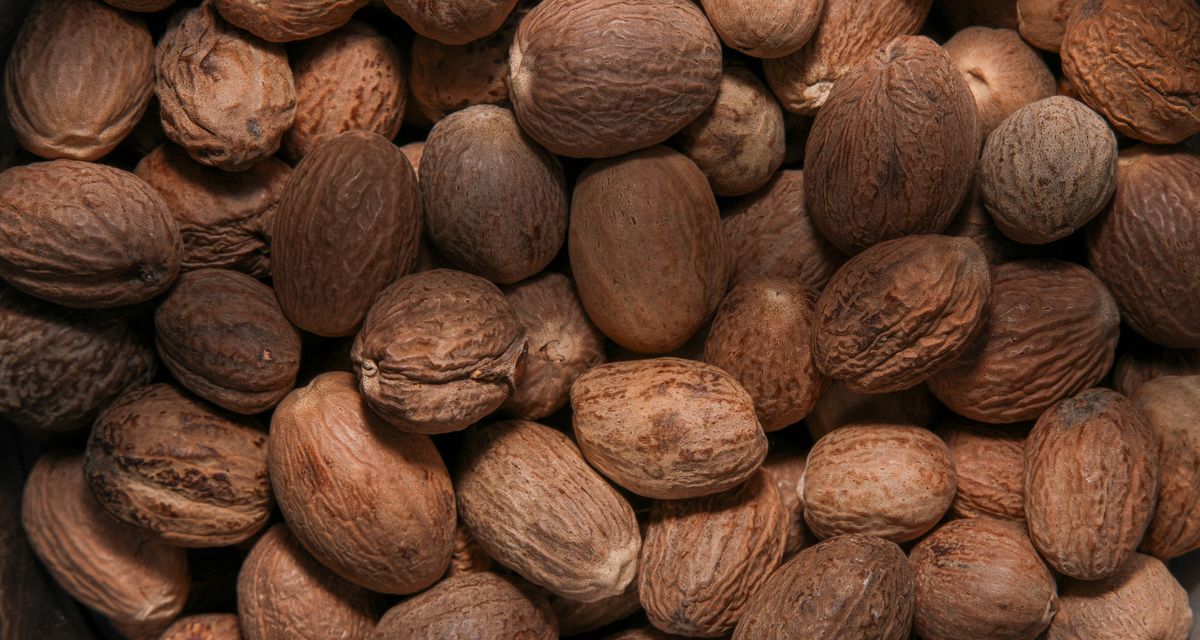
A few faults routinely downgrade a lot. "Wormy" or punctured nuts have been bored by insects and lose oil and weight; shrivelled, light nuts have dried too hard or too long; and mould — the real worry with under-dried nutmeg — can carry food-safety concerns and is a genuine quality red flag. A good nutmeg is whole, heavy for its size, oily when you scratch the surface, and intensely fragrant the moment it is grated. We grade for sound, oil-rich, well-dried seeds and bright, whole mace.
11Flavour & chemistry
What gives it that aroma
Nutmeg's aroma is built from two layers. The fresh, green, slightly piney top note comes mainly from terpenes — above all sabinene, with alpha-pinene, beta-pinene and limonene — the same kind of compounds that give pine and citrus their lift. The warm, sweet depth underneath comes from a group of phenylpropanoids, chiefly myristicin, alongside elemicin and small amounts of safrole.
It is myristicin that gives nutmeg its unmistakable cosy, balsamic character — and, in large doses, its toxicity. The same molecule reads as comforting warmth in a pinch and as a poison in a spoonful, which is why dose matters so much with this particular spice.
Mace, the aril, carries a similar but distinct oil profile — often even richer in sabinene — giving it a brighter, more delicate, slightly more peppery-floral character than the seed. That is why cooks reach for mace when they want nutmeg's warmth in a cleaner, paler form.
Because so much of the flavour lives in volatile oil, freshly grated nutmeg is dramatically more aromatic than pre-ground powder, which loses its top notes within months. The whole seed is essentially a sealed flask of that oil — grate it on demand and you get the full two-layer aroma every time.
12Culinary uses
How to cook with it
Nutmeg is a background spice, not a soloist. Used by the rasp — a few light grates — it rounds and deepens a dish without announcing itself; overdone, it turns soapy and bitter fast. It crosses freely between sweet and savoury, and it is at its best grated fresh, because whole nutmeg keeps its volatile oils far better than the pre-ground powder. Mace, its sibling, gives a similar but brighter, more delicate note and is loved in pale dishes where flecks of nutmeg would show.
- Garam masala & biryani: Nutmeg and mace are classic warm components of garam masala and the aromatic blends behind Mughlai biryani, korma and kheer — used in tiny amounts for rounded, festive warmth.
- Cream sauces & dairy: A few grates of nutmeg is the secret in bechamel, mornay, creamed spinach, mashed potato and cheese sauces — it lifts and balances the richness of milk, cream and butter.
- Custards & puddings: Nutmeg is iconic on egg custard, rice pudding, kheer, eggnog and baked custards, dusted over the top or grated into the mix for its sweet, comforting aroma.
- Baking & spice blends: It is a backbone of pumpkin spice, gingerbread, fruit cakes and spice cookies, working alongside cinnamon, clove and ginger — by the pinch, never the spoon.
- Mulled & warm drinks: Grated nutmeg finishes mulled wine, spiced cider, hot chocolate, masala chai and coffee, adding a warm, aromatic top note.
- Mace for pale dishes: Where you want nutmeg's warmth without dark specks — white sauces, light soups, pound cakes, pickles and ground spice blends — mace gives a cleaner, brighter version of the same flavour.
Nutmeg keeps warm company: cinnamon, clove, cardamom, ginger, allspice and black pepper on the spice side; cream, butter, cheese, eggs and milk among dairy; and spinach, potato, pumpkin, apple, pear and chocolate among ingredients. It is a finishing-and-rounding spice — add it late and lightly, and let it sit under the other flavours rather than over them.
13Consumption & dosage
How much, how often
Nutmeg is a background spice used by the rasp, not the spoon: a few light grates round and warm a dish without dominating it. It crosses freely between sweet and savoury cooking and is at its best grated fresh, since the whole seed holds its aromatic oil far better than pre-ground powder.
- Everyday culinary amount & form: Use a pinch of powder or just a few passes of whole seed on a fine grater per dish; freshly grated nutmeg is noticeably more aromatic than store-bought ground powder.
- Indian festive & spice-blend use: Small amounts of nutmeg (and its sibling mace) feature in garam masala, Mughlai biryani, korma, payasam/kheer and sweets, adding rounded, festive warmth.
- Dairy, sauces & desserts: A light grating lifts bechamel, cheese sauces, creamed spinach, mashed potato, custards, rice pudding and eggnog, balancing the richness of milk and cream.
- Baking & warm drinks: It is a backbone of pumpkin spice, gingerbread and fruit cakes, and finishes mulled wine, spiced cider, hot chocolate, masala chai and coffee.
- Mace for pale dishes: Where dark flecks would show, cooks often use mace, the same fruit's red aril, for a cleaner, brighter version of nutmeg's warmth.
- Who should be cautious: Stick to culinary pinches and avoid large or medicinal quantities; pregnant women in particular are generally advised to avoid medicinal or spoonful amounts, and nobody should eat nutmeg to get an effect.
14Health & wellness
What the evidence says
The strongest themes in the research are below. Many studies use concentrated extracts, and the evidence is still developing.
- Antioxidant-rich essential oil: Nutmeg's volatile oil and phenolic compounds show strong antioxidant activity in laboratory assays. This is well documented in the chemistry literature, but it reflects the concentrated oil and extracts, not the trace amounts in a grated pinch.
- Antimicrobial activity in the lab: Nutmeg oil and its components, including myristicin, show antibacterial and antifungal activity against a range of organisms in vitro. This is laboratory evidence; it does not mean eating nutmeg treats infections in people.
- Anti-inflammatory potential: In experimental and animal models, nutmeg extracts and myristicin show anti-inflammatory effects. Human dietary evidence is limited, so this is best read as promising rather than proven.
- Traditional digestive & calmative use: Nutmeg has a long traditional role in Ayurveda and folk medicine for digestion, sleep and as a calmative. These uses are culturally well attested but not backed by strong modern clinical trials.
- A real, important safety ceiling: This is the one to take seriously: nutmeg is toxic and psychoactive in large doses. Doses from roughly 5 g (about two teaspoons) upward can cause myristicin poisoning — hallucinations, agitation, racing heart, dry mouth, nausea and dizziness, typically starting 3 to 6 hours after ingestion and lasting up to 1 to 3 days. Rare fatalities have been reported, sometimes when nutmeg was combined with other drugs. Culinary pinches are entirely safe; deliberately eating spoonfuls is dangerous and there is no safe recreational dose.
15Nutrition
By the numbers
Per 100 g, ground nutmeg looks remarkably energy-dense and fat-rich — but that frame is misleading, because nobody eats 100 g of nutmeg; a teaspoon is only about 2 g, and a typical grating far less. The numbers reflect a concentrated dried seed rich in aromatic oil and fat. The standout micronutrients are manganese and copper. Values below are from USDA FoodData Central for "Spices, nutmeg, ground" (FDC 171326).
| Nutrient | Per 100 g |
|---|---|
| Energy | 525 kcal |
| Protein | 5.84 g |
| Total fat | 36.3 g |
| Carbohydrate | 49.3 g |
| Dietary fibre | 20.8 g |
| Total sugars | 2.99 g |
| Calcium | 184 mg |
| Iron | 3.04 mg |
| Magnesium | 183 mg |
| Phosphorus | 213 mg |
| Potassium | 350 mg |
| Sodium | 16 mg |
| Zinc | 2.15 mg |
| Manganese | 2.9 mg |
| Copper | 1.03 mg |
| Vitamin C | 3.0 mg |
| Folate | 76 µg |
Values are approximate and vary by sample; source: USDA FoodData Central.
16Myths vs facts
Setting the record straight
Myth: Nutmeg is native to India and a traditional Indian spice.
Fact: Nutmeg's original home is the Banda Islands of Indonesia; it reached South India relatively late through trade, and is grown here mainly as a Western Ghats homestead tree rather than as a native crop.
Myth: Nutmeg and mace come from two different plants.
Fact: They come from one fruit of one tree (Myristica fragrans): nutmeg is the inner seed kernel and mace is the red, lacy aril wrapped around that seed.
Myth: Every nutmeg tree you plant will give fruit.
Fact: Nutmeg trees are usually male or female, and generally only females fruit; seedling stock is typically about half non-fruiting males, which is why grafted plants from proven female trees are preferred.
Myth: Eating lots of nutmeg is a harmless natural high.
Fact: Large doses can cause genuine myristicin poisoning, with reported effects such as hallucinations, racing heart, nausea and dizziness that may last a day or more; there is no safe recreational dose, though culinary pinches are fine.
Myth: Ground nutmeg is just as good as whole.
Fact: Much of nutmeg's flavour is volatile oil that fades fairly quickly once ground, so whole seeds grated fresh are far more aromatic and store much longer.
Myth: All nutmeg in the market is the same true spice.
Fact: Cheaper wild or false nutmegs (such as Myristica malabarica, the Bombay or wild nutmeg) are sometimes passed off as the real thing; genuine nutmeg comes only from Myristica fragrans and is more aromatic and denser.
17In your kitchen
How to choose, use & store
Choose
Buy nutmeg whole whenever you can — the intact seed protects its aromatic oil far better than powder, which fades within months. Look for whole seeds that feel heavy and dense for their size, with no boreholes, cracks or shrivelling; a good nutmeg leaves a faint oily sheen and a strong, sweet smell when you scratch it. For mace, choose whole, bright orange blades over broken, pale or dusty pieces. Avoid any nutmeg with a musty, mouldy smell.
Use
Grate nutmeg fresh, by the rasp, straight into the dish — a few passes on a fine grater or dedicated nutmeg mill is usually plenty, and it is easy to overdo. Add it late to cream sauces, custards and drinks so its aroma stays bright, and treat it as a rounding, background note rather than a lead flavour. Use mace where you want the warmth without dark flecks. And keep the everyday rule in mind: cook with pinches, never spoonfuls.
Store
Store whole nutmeg and whole mace in an airtight container away from heat, light and moisture, and whole seeds will keep their aroma for a year or more — far longer than ground. Grate or grind only what you need, when you need it. Keep the jar sealed and out of the sun; when the warm, sweet smell starts to fade, the oil is going and it is time to refresh.
18FAQ
Frequently asked questions
What part of the plant is nutmeg — and what is mace?
Nutmeg is the dried seed kernel of the tree Myristica fragrans. Mace is the bright red, lacy aril that wraps around that same seed inside the fruit. So one fruit gives two different spices: nutmeg from the seed, mace from the red netting around it. Mace tastes similar but lighter and more delicate.
Is nutmeg native to India?
No. Nutmeg is native only to the Banda Islands of Indonesia — the original Spice Islands — where for centuries it grew nowhere else on earth. It reached South India late, on colonial trade routes. We are upfront about this: our honest story is that nutmeg is a prized Western Ghats homestead tree spice, not an Indian native.
Where is nutmeg grown in India?
Almost entirely in Kerala, as a shaded homestead crop. Thrissur and Ernakulam are the main districts, with Idukki (our own district), Kottayam and other high-range areas, plus pockets in Tamil Nadu and coastal Karnataka. It is grown in mixed homestead gardens alongside arecanut, coconut, pepper and coffee rather than in open plantations.
Is nutmeg dangerous or toxic?
In cooking amounts, no — the pinch you grate into food is completely safe. But in large doses nutmeg is genuinely toxic and psychoactive. Eating roughly 5 grams (about two teaspoons) or more can cause myristicin poisoning: hallucinations, agitation, a racing heart, nausea and dizziness, usually starting 3 to 6 hours later and lasting up to a few days. Never use nutmeg recreationally.
How much nutmeg is safe to eat?
Culinary amounts — a few grates, a pinch, the small quantities in spice blends and recipes — are safe for almost everyone. Problems begin only at deliberate, spoonful-scale doses around 5 grams and up. The simple rule: cook with pinches, never spoonfuls, and never eat nutmeg to get an effect.
What gives nutmeg its flavour?
Two layers of chemistry. Terpenes — mainly sabinene, with alpha-pinene and limonene — give the fresh, piney top note. Phenylpropanoids — chiefly myristicin, with elemicin and a little safrole — give the warm, sweet, balsamic depth. Myristicin is the signature note, and also the compound responsible for nutmeg's toxicity in large doses.
Should I buy whole nutmeg or ground?
Whole, almost always. The intact seed protects its aromatic oil, so whole nutmeg stays fragrant for a year or more, while ground nutmeg fades within months. Grate it fresh as you need it with a fine grater or nutmeg mill. Choose seeds that are heavy and dense for their size, with no boreholes or shrivelling.
Can pregnant women have nutmeg?
The small amounts used in normal cooking are generally considered fine, but large or medicinal doses should be avoided in pregnancy because of nutmeg's myristicin content and psychoactive effects. If you are pregnant or nursing, keep to culinary pinches and check with a healthcare professional before using nutmeg in any larger or therapeutic way.
What are the IISR nutmeg varieties?
ICAR-IISR in Kozhikode has released improved Indian nutmeg cultivars — Viswasree (released in 2001 through clonal selection) and Keralashree (released in 2013, the first developed through farmer-participatory breeding). They are selected for bold, heavy nuts, thick entire mace, higher yields and better tolerance to fruit rot, helping Kerala's smallholders.
Did the Dutch really trade Manhattan for a nutmeg island?
In effect, yes. Under the 1667 Treaty of Breda, England gave up its claim to the tiny nutmeg-rich Banda island of Run, and the Dutch gave up their claim to New Amsterdam — today's Manhattan. At the time, a nutmeg island was widely judged the more valuable prize, which says a lot about how precious nutmeg once was.
How should I store nutmeg?
Keep whole nutmeg and whole mace in an airtight container away from heat, light and moisture. Whole seeds hold their aroma for a year or more; ground nutmeg fades fast, so grate small and fresh. When the warm, sweet smell weakens, the oil is going — that is your cue to replace it.
What is the difference between nutmeg and mace in cooking?
They come from the same fruit and taste similar — warm and sweet — but mace is lighter, brighter and more delicate, while nutmeg is deeper and rounder. Cooks often choose mace for pale dishes (white sauces, light cakes, ground blends) where dark nutmeg flecks would show, and nutmeg where its fuller warmth is wanted.
Is nutmeg the same as mace?
Not quite — they are two spices from one fruit. Nutmeg is the inner seed kernel; mace is the lacy red aril wrapped around the seed. They are harvested together, separated and dried apart. Nutmeg is rounder and sweeter, mace brighter and more delicate, so they are not always interchangeable in a recipe.
How long until a nutmeg tree starts giving fruit, and how long does it keep producing?
Grafted trees may flower from around the 4th-5th year and reach economic bearing from roughly the 6th-8th year, while seedlings usually take longer. The good news is that nutmeg is a long-term asset: a well-managed tree can stay productive for several decades, so it rewards patience and steady care.
Why are half my seedling nutmeg trees not fruiting?
Nutmeg trees are usually separate males and females, and generally only the females bear fruit. Seedling stock comes out roughly half male, and the sex often shows only at flowering after several years. That is why grafted plants raised from proven female (or hermaphrodite) mother trees are preferred, with about one male commonly kept per ten females for pollination.
What should I look for when buying nutmeg, and how do I avoid fakes?
Choose whole seeds that feel heavy and dense for their size, with no boreholes, cracks, shrivelling or musty smell, and that release a strong sweet aroma when scratched. Buy whole rather than ground where you can, and be aware that cheaper wild or false nutmegs (like Myristica malabarica) are sometimes substituted; true nutmeg from Myristica fragrans is rounder, oilier and far more fragrant.
Sources & further reading
- Nutmeg — Wikipedia (botany, Banda Islands origin, seed/aril/mace, dioecious trees, oil composition, 2023 global production) en.wikipedia.org
- Myristicaceae — Wikipedia (the nutmeg family) en.wikipedia.org
- Nutmeg | Description, History, Mace & Uses — Encyclopaedia Britannica britannica.com
- Dutch conquest of the Banda Islands — Wikipedia (VOC monopoly, Coen, 1609–1621) en.wikipedia.org
- Run (island) — Wikipedia (Banda nutmeg island; 1667 Treaty of Breda Run-for-Manhattan swap) en.wikipedia.org
- Keralashree (Nutmeg) — ICAR-Indian Institute of Spices Research (2013 farmer-participatory variety, yield, oil profile) spices.res.in
- Viswasree-Nutmeg — ICAR-Indian Institute of Spices Research (2001 clonal-selection variety) spices.res.in
- Nutmeg cultivation in India: Viswasree and Keralashree varieties — Krishi Jagran (Kerala growing, yields) krishijagran.com
- Nutmeg Intoxication: A Case Report — PMC/Cureus (toxic dose ~5–10 g, symptoms, onset, duration 24–48 h) pmc.ncbi.nlm.nih.gov
- Toxicity of Nutmeg (Myristicin): A Review — IJASEIT 2015 (myristicin/elemicin/safrole, ~5 g toxic dose, 3–6 h onset, up to 72 h) ijaseit.insightsociety.org
- Nutmeg (myristicin) poisoning — fatal case & poison-centre series — Forensic Science International (PubMed) pubmed.ncbi.nlm.nih.gov
- ISO 6577:2002 — Nutmeg, whole or broken, and mace — Specification (grading & quality limits) iso.org
- Spices, nutmeg, ground — USDA FoodData Central (FDC 171326), nutrition per 100 g fdc.nal.usda.gov
- ICAR–Indian Institute of Spices Research, Kozhikode (mandate tree spices incl. nutmeg) spices.res.in
Last reviewed: 23 June 2026 · Written by the AroWest editorial team (Western Crest Ventures LLP). Educational content, not medical advice.