

Quick facts
- Botanical name
- Elettaria cardamomum
- Family
- Zingiberaceae (ginger)
- Also known as
- Green cardamom · Elaichi
- Native to
- Western Ghats, S. India
- Heartland
- Udumbanchola, Cardamom Hills
- Part used
- Dried pods & seeds
- Flavour
- Sweet, floral, citrus-eucalyptus
- Key aroma
- α-terpinyl acetate · 1,8-cineole
- Top grades
- AGEB · AGB · AGS
01Overview
What is cardamom?
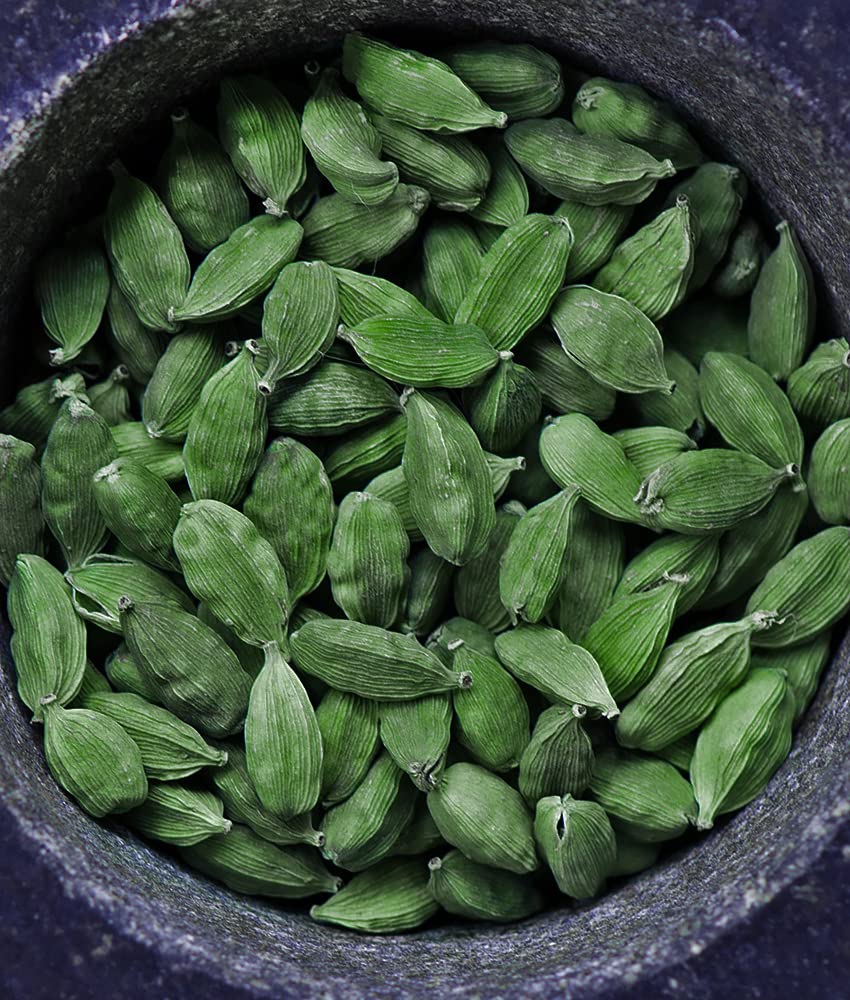
Cardamom is the dried fruit of Elettaria cardamomum, a shade-loving perennial in the ginger family (Zingiberaceae). The pods are small, three-sided and pale green; split one open and you find a little cluster of black seeds that hold nearly all of the aroma. In India it is elaichi; to the spice trade it has been the "Queen of Spices" for centuries — and, by weight, one of the most valuable spices on earth, behind only saffron and vanilla.
What makes it unforgettable is the smell — sweet and floral, with a lift of citrus and a cool, almost minty finish. One ingredient can carry a whole pot of masala chai, a tray of Scandinavian buns, a tiny cup of Gulf coffee or a Kerala biryani. Over the next few sections we follow it from the mountain it comes from to your kitchen — and clear up a couple of things the spice aisle tends to get wrong.
02History & origin
A port's name on a mountain's spice
Long before anyone packed it into jars, cardamom grew wild on the floor of the rainforest in the southern Western Ghats — so abundantly that the range itself took the spice's name: the Cardamom Hills, Yela Mala, from ela, the old word for cardamom. From the Malabar coast it travelled the ancient spice routes to Greece, Rome and the Arab world, prized as medicine, perfume and luxury all at once.
The modern trade took shape under the kingdom of Travancore. The Cardamom Proclamation of 1822 placed the hills under special administration to organise and protect the crop, and as prices climbed through the 1850s the state pushed cultivation hard. Here is the quirk that still shapes the spice's name: Travancore required the harvest to be sold into the royal depot at Alleppey (Alappuzha) — its great port — and shipped to the world from there. Foreign buyers met the spice at the dock, never in the mountains, so they named it for the harbour: "Alleppey Green."
The name stuck so firmly that "Alleppey Green Cardamom" is today a registered Geographical Indication (GI No. 72, granted 2007–08). It is, when you think about it, a port's name worn by a mountain's spice. Cultivation later spread overseas — Guatemala is now the largest grower by volume — but India is still the world's largest consumer, and the heart of the original crop never moved. It stayed in the hills. It stayed in Udumbanchola.

03The Udumbanchola story


Where the spice is actually born
Drive up into Idukki and the air changes: cooler, wetter, green in every direction. This is the high range — roughly 800–1,300 metres up — where the monsoon sits in the trees and cardamom grows the way it always has, in deep shade, slowly, its aroma tightened by cold mountain nights. Near the centre of this country sits Udumbanchola, a taluk of Idukki and, by any honest measure, one of the true homes of cardamom.
You can read it straight off the map. Vandanmedu, in Udumbanchola, runs one of the largest cardamom auctions on earth — the price found on its floor each week moves the market for the entire crop. A few ridges over in Pampadumpara, also in Udumbanchola, the state's Cardamom Research Station has studied the plant since 1956. And the wider Cardamom Hill Reserve these towns sit inside grows close to 70% of all the cardamom in India.
For us, this isn't a marketing flourish — it's our address. AroWest is registered in Udumbanchola taluk, up in the highland villages around Nedumkandam. So when we say our cardamom is plantation-direct, we mean it crosses a few hills, not half a country. We built AroWest to put the name of the place back onto the spice — to let people taste Udumbanchola, instead of the harbour it once happened to ship from.
"Everyone sells 'Alleppey Green.' We're from where it grows."
04Research & trade
A whole country studies cardamom — here
If you want proof that these hills are cardamom's true home, look at where India chose to research and trade the crop. Almost all of it sits in the same Idukki high range, in and around Udumbanchola.
Indian Cardamom Research Institute (ICRI)
India's national cardamom research institute — the research wing of the Spices Board, set up in 1978 at Myladumpara in these hills. It keeps a national germplasm conservatory of about 540 cardamom accessions and has released eight high-yielding varieties.
Cardamom Research Station, Pampadumpara
In Udumbanchola taluk itself, this Kerala Agricultural University station has researched cardamom since 1956, holding a living bank of 77 cultivated and 14 wild cardamom types.
Spices Park, Puttady
The Spices Board's 10-acre cardamom-and-pepper park (opened 2011), where the crop is cleaned, graded, stored and e-auctioned — value addition built right at the source.
Vandanmedu auction
One of the world's largest cardamom auction floors, in Udumbanchola — the price set here each week moves the market for the entire crop.
Sources: Spices Board (ICRI; Spices Park, Puttady), Kerala Agricultural University and Kerala Tourism — see references.
05Botany & cultivation
How & where it grows
The cardamom plant is a herbaceous perennial that grows from a branching underground rhizome, sending up leafy shoots that can reach 2–4 metres. Slender flowering stems (panicles) trail along the ground and bear pale flowers that develop into the green pods we harvest. It thrives in the shade of the rainforest canopy, in rich loamy soil, at roughly 600–1500 m elevation with warm temperatures and high, well-distributed rainfall — exactly the conditions of the Western Ghats.
Because pods on the same plant ripen unevenly, harvesting is painstaking: pickers move through the plantation in multiple rounds, taking only the mature-but-still-green capsules by hand. The pods are then carefully dried (traditionally in curing chambers) at controlled temperatures to lock in the green colour and volatile oils, then cleaned, sorted and graded by size and colour. This hand-intensive process is the main reason cardamom is so costly.
"True" green cardamom (Elettaria cardamomum) should not be confused with large/black cardamom (Amomum subulatum), a related but distinct species grown largely in the eastern Himalaya and dried over fire for a smoky flavour.
06Cultivation & agronomy
How it's grown
Small cardamom (Elettaria cardamomum) is a shade-loving perennial herb of the Western Ghats, where it grows under the natural forest canopy at mid-elevations; the harvested spice is the dried three-sided fruit capsule and its aromatic seeds. It is a major plantation crop of Idukki district in Kerala, and is also grown in the hills of Karnataka (Kodagu/Coorg, Hassan, Chikmagalur) and the Tamil Nadu hills (lower Pulneys, Anamalais).
Climate & soil
Cardamom generally does well at roughly 600-1500 m altitude under regulated filtered shade, with a warm, humid climate, well-distributed rainfall of about 1500-4000 mm and moderate temperatures (it is sensitive to both frost and prolonged high heat, so very hot, dry spells are harmful). It prefers deep, well-drained, humus-rich forest loams that are slightly acidic (commonly around pH 5.0-6.5); waterlogging and harsh open sun are both damaging, so a balanced overhead canopy is important.
Propagation & planting
Cardamom is propagated either vegetatively by suckers (each planting unit typically having one old and one young growing shoot) for true-to-type, early-bearing plants, or by seedlings raised in nurseries from selected high-yielding mother clumps for larger areas. Sucker planting tends to give quicker establishment and uniformity, while seedlings are cheaper and give wider genetic variation; in either case, sourcing material from healthy, disease-free clumps and nurseries helps avoid carrying over systemic problems like katte.
Crop calendar
Nursery (Jan-Mar)
Sow fresh seeds from selected capsules in raised primary beds; prick out into secondary beds or polybags as seedlings grow, keeping them shaded and moist.
Land preparation & pitting (Apr-May)
Open pits along the contour under regulated shade, and fill with topsoil mixed with compost or farmyard manure ahead of the monsoon.
Planting (Jun-Jul)
Transplant well-grown seedlings (commonly around 10-18 months old) or healthy suckers with the onset of the southwest monsoon so roots establish in moist, cool soil; stake and mulch.
Vegetative growth (Aug-Apr)
Plants build up tillers over the first 1-2 years; carry out shade regulation, weeding, trashing and mulching through this phase.
Flowering (Apr-Jul)
Panicles emerge near the base; ensure adequate soil moisture and pollinator (honeybee) activity for good capsule set.
Harvest (Aug-Feb, peak Oct-Nov)
Pick mature, near-ripe capsules in multiple rounds (roughly every 15-25 days), then cure and dry carefully to retain green colour and aroma.
In the field
- Shade regulation: Maintain a balanced, regulated overhead canopy by lopping dense branches before the monsoon and the hot months; too much shade reduces yield, while too little causes sun scorch and tiller drying.
- Irrigation & mulch: Provide protective irrigation (sprinklers where possible) during the dry summer months, roughly January to May, and mulch the base with leaf litter or trashed cardamom material to conserve moisture and feed the soil.
- Trashing: Remove old, dried, drooping and disease-affected leaves and shoots once or twice a year so light and air reach the panicles and pests find fewer hiding spots.
- Weeding & soil cover: Hand-weed or slash a few times a year, taking care of the shallow feeder roots, and keep a live or dead mulch cover on slopes to check erosion.
07Variety guide
Every variety, in depth
In Kerala's rolling spice gardens, cardamom isn't just one plant—it's three distinct botanical types, each with its own character. The Malabar type, with flowers drooping down like a skirt, thrives in the softer elevations of 600–1200 metres. Mysore stands tall and erect, reaching its best between 900–1200 metres on the wind-swept heights. And Vazhukka, a natural hybrid, splits the difference—semi-erect panicles suited to the 900–1200 metre sweet spot where both parents do well. For nearly four decades, farms grew the same local germplasm, grinding out 200–300 kg per hectare. Then came the ICRI and IISR varieties, the PV selections from Pampadumpara, and later the farmer rebels like Rejimon Joseph's Njallani, which turned Idukki inside out. Today, small cardamom's map is written in released varieties and farmer selections—each answering a specific plea: more capsules per panicle, disease tolerance, resilience to drought or virus. What follows are the varieties that matter on the ground in Kerala, Karnataka, and Tamil Nadu's cardamom hills.
A grower's story
Njallani: When a Marginal Farmer's Selection Rewrote Idukki's Cardamom Story
Late Sebastian Joseph owned just 1.5 acres in Kattapana, a fold in Idukki's cardamom-covered hills. He had studied only to fourth standard, yet he saw what most missed: that four clones from his field bore capsules with exceptional size and panicle density. He and his son Rejimon covered those plants with mosquito nets, placed bee hives beside them, and let nature make crosses on their terms. The result was capsules noticeably larger than the common Mysore type, with panicles bearing 120–160 capsules per clump instead of the typical 30–35. They called it Njallani, from their ancestral name. The National Innovation Foundation recognised their work, and farmers—hungry for yields and quality—listened. From one farmer's 1.5 acres, Njallani now covers much of Idukki's cardamom area, making it one of India's most successful farmer-developed agricultural varieties. Yields reported at around 1,000 kg per hectare of dry cardamom: that was the quiet revolution a marginal farmer and his son made possible. Today, every cardamom farmer in Idukki knows the Njallani name, and most have a Njallani clump somewhere on their land.
Malabar TypeProstrate panicle type
Botanical typeKerala, traditional cardamom hills (Western Ghats) · Natural germplasm · Pre-1970s
Panicles hang downward (prostrate), globose to oblong capsules. Adapted to older, lower-elevation plantations with mixed shade.
Full detailsMysore TypeErect panicle type
Botanical typeKarnataka, Kodagu region (Western Ghats) · Natural germplasm · Pre-1970s
Panicles erect, bold dark green ovoid capsules. Robust tall plants (3–4 m); excellent for higher elevations with moderate shade.
Full detailsVazhukka TypeSemi-erect panicle type; Intermediate type
Botanical typeNatural hybrid zone, Western Ghats (Kerala–Karnataka border) · Natural hybrid (Malabar × Mysore) · Pre-1970s
Semi-erect panicles, combining vigour of both parents. Bold, globose to ovoid capsules, intermediate morphology. Excellent flavour and disease profile in field.
Full detailsICRI-1ICRI 1
Released varietyIdukki, Kerala (ICRI Myladumpara) · Indian Cardamom Research Institute (ICRI) · 1980s
Early maturing Malabar type. Medium-sized panicles, globose extra bold dark green capsules. Pioneering ICRI release that significantly improved yields in Kerala.
Full detailsICRI-2ICRI 2
Released varietyIdukki, Kerala (ICRI Myladumpara) · Indian Cardamom Research Institute (ICRI) · 1980s
Mysore type with medium-long panicles and oblong bold parrot green capsules. Performs well in higher altitudes and moderate shade conditions. Tolerant to azhukal (leaf spot) disease.
Full detailsICRI-3ICRI 3
Released varietyIdukki / Appangala, Karnataka (ICRI) · Indian Cardamom Research Institute (ICRI) · 1980s
High-yielding Malabar selection. Recognised across cardamom regions, particularly in Karnataka and Tamil Nadu.
Full detailsICRI-4ICRI 4
Released varietyLower Pulney Hills, Tamil Nadu (ICRI regional station) · Indian Cardamom Research Institute (ICRI) · 1980s
Early maturing Malabar type specifically selected for low-rainfall cardamom tracts. Medium-sized panicles with globose bold parrot green capsules. Critical for drought-prone Lower Pulney hills (<1000 mm annual rainfall).
Full detailsICRI-5ICRI 5
Released varietyIdukki, Kerala (ICRI Myladumpara) · Indian Cardamom Research Institute (ICRI) · 1990s
First Malabar hybrid from ICRI crosses. High-yielding, vigorous plants with bold capsules and excellent recovery. Recommended for all Kerala and Tamil Nadu cardamom zones with 2000+ mm rainfall.
Full detailsICRI-6ICRI 6
Released varietyIdukki, Kerala (ICRI Myladumpara; MCC-73 collection) · Indian Cardamom Research Institute (ICRI) · 1990s
Outstanding for bold capsules and essential oil content. High response to dense planting. Notably higher yields than ICRI-1 and ICRI-2 under good management.
Full detailsICRI-7ICRI 7
Released varietyIdukki, Kerala (ICRI Myladumpara) · Indian Cardamom Research Institute (ICRI) · 1990s
High-yielding hybrid with excellent recovery and oleoresin content. Bold angular capsules and strong response to closer spacing and high plant density.
Full detailsPV-1PV 1
Released varietyPampadumpara, Kerala (Cardamom Research Station, KAU) · Kerala Agricultural University (KAU), CRS Pampadumpara · 1991
Early maturing Malabar type with short panicles and elongated slightly ribbed light green capsules. Well-adapted to Kerala's high-rainfall cardamom tracts with good dry recovery and essential oil content.
Full detailsPV-2PV 2
Released varietyPampadumpara, Kerala (Cardamom Research Station, KAU) · Kerala Agricultural University (KAU), CRS Pampadumpara · 1990s
High-yielding Vazhukka type with deep green long bold capsules. Early maturing with unbranched lengthy panicles, suited to high-altitude intensive cultivation. High dry recovery and essential oil content.
Full detailsPV-3PV 3; KAU-PV3
Released varietyPampadumpara, Kerala (Cardamom Research Station, KAU) · Kerala Agricultural University (KAU), CRS Pampadumpara · 1990s
Selection notable for high α-terpinyl acetate content (61% of essential oil), conferring superior aroma and flavour profile. Important for quality-conscious buyers and specialty markets.
Full detailsMudigere-1Mudigere 1
Released varietyMudigere, Karnataka (ZAHRS, UAHS, Shivamogga) · Zonal Agricultural & Horticultural Research Station (ZAHRS), UAHS, Mudigere · 1990s
Compact Malabar variety with notable pest tolerance. Resistant to hairy caterpillars, white grubs, thrips, and shoot/panicle borers. Short panicles and oval bold pale green capsules with good essential oil content. A practical choice for pest-prone areas.
Full detailsMudigere-2Mudigere 2
Released varietyMudigere, Karnataka (ZAHRS, UAHS, Shivamogga) · Zonal Agricultural & Horticultural Research Station (ZAHRS), UAHS, Mudigere · 1990s
Malabar type suited to valley cultivation in Karnataka's cardamom zone. Good essential oil content.
Full detailsMudigere-3Mudigere 3
Released varietyMudigere, Karnataka (ZAHRS, UAHS, Shivamogga) · Zonal Agricultural & Horticultural Research Station (ZAHRS), UAHS, Mudigere · 1990s
Pest-tolerant Malabar type. Resistant to thrips and borers, making it practical for cardamom tracts where insect pressure is significant.
Full detailsIISR Vijetha-1IISR Vijetha
Released varietyAppangala, Kodagu, Karnataka (Cardamom Research Centre, IISR) · Indian Institute of Spices Research (IISR), Cardamom Research Centre, Appangala · 2001
Malabar type specifically bred for mosaic (Katte)-infected areas. Strong Katte virus resistance with good yield potential. Excellent for marginal and degraded cardamom lands where virus is endemic.
Full detailsIISR AvinashIISR Avinash; RR1
Released varietyAppangala, Kodagu, Karnataka (Cardamom Research Centre, IISR) · Indian Institute of Spices Research (IISR), Cardamom Research Centre, Appangala · 2000s
Developed through clonal selection specifically for rhizome rot (Pythium, Rhizoctonia) resistance. High-yielding with dark green capsules of excellent quality. Critical for rhizome-rot-prone areas.
Full detailsIISR Kodagu SuvasiniCCS-1; Kodagu Cardamom-Suvasini
Released varietyAppangala, Kodagu, Karnataka (Cardamom Research Centre, IISR) · Indian Institute of Spices Research (IISR), Cardamom Research Centre, Appangala · 1997
Malabar type, early maturing, compact plant habit. Suitable for high-density monocropping (intensive cultivation). Multi-pest resistant: rhizome rot (Pythium, Rhizoctonia), thrips, and shoot/panicle/capsule borers. Excellent bold capsule percentage and essential oil content with high dry recovery.
Full detailsAppangala-1Appangala 1
Released varietyAppangala, Kodagu, Karnataka (Cardamom Research Centre) · Cardamom Research Centre, Appangala · 1990s
Rhizome rot-resistant selection with intermediate morphology between Malabar and Vazhukka. Oval to elongated capsules with good essential oil profile.
Full detailsAppangala-2Appangala 2
Released varietyAppangala, Kodagu, Karnataka (Cardamom Research Centre) · Cardamom Research Centre, Appangala · 2014
Hybrid variety recommended for Katte-virus-infected areas. Mosaic-virus-resistant under field conditions. Medium bold green capsules with high-quality aroma compound (α-terpinyl acetate), important for specialty spice markets.
Full detailsNjallaniNjallani Green Gold; Green Gold
Farmer selectionKattapana, Idukki, Kerala · Sebastian Joseph and son Rejimon Joseph (farmer selection; documented and recognised by National Innovation Foundation) · 1990s–2000s (selection and recognition)
Landmark farmer-developed variety. Capsules noticeably larger than standard Mysore variety. 120–160 capsules per panicle (compared to 30–35 in ordinary varieties). Exceptional productivity and market appeal. Documented and recognised by National Innovation Foundation. Now dominates Idukki's cardamom cultivation.
Full detailsElarajanElarajan; Elarajan cardamom
Farmer selectionIdukki district, Kerala · K.J. Benny (farmer selection; evaluated by ICRI) · 2000s
Farmer selection recognised for uniform, extra-bold capsules with high yield potential. Evaluated for essential oil quality and aroma profile by research institutes.
Full detailsCCS-1Kodagu Cardamom-Suvasini; IISR Kodagu Suvasini
Released varietyAppangala, Kodagu, Karnataka (IISR Cardamom Research Centre) · Indian Institute of Spices Research (IISR), Cardamom Research Centre, Appangala · 1997
Malabar type, early maturing, compact plant suitable for intensive high-density cultivation. Multi-pest resistant: rhizome rot, thrips, and shoot/panicle/capsule borers. Excellent bold capsule percentage (89%) and essential oil content with high dry recovery.
Full detailsThiruthaliThirumali (alternative spelling)
Farmer selectionSanthampara, Idukki, Kerala · T.P. Joseph · 2000
Exceptional yield (4-6 kg dry/plant, 2000-3000 kg/ha) with medium-bold parrot green capsules commanding premium prices. High resistance to stem borers, root grubs, and decay. Panicles of 50-60 racemes with 15-20 capsules each make it distinctive among farmer selections.
Full detailsPanikulangara Green Bold No.1Panikulangara Green Bold
Farmer selectionPanikulangara Estate, Idukki, Kerala · Joy Peter · 1993 (selected); 2000 (commercialized); 5th NIF award 2009
Bold capsules (>8mm in 80% of produce) retain bright green color after drying, unlike Njallani. Yields 6-8 kg/plant with 95% berry setting. Superior for rainfed conditions with minimal irrigation and moderate thrips/borer tolerance.
Full detailsPappaluPappalu Cardamom
Farmer selectionIdukki region, Kerala · KV Paulose · 2015 (8th National Grassroots Innovation Award)
Long panicles (130-147 cm) with high capsule density and early flowering relative to parent plants. Tolerance to major cardamom pests (thrips, stem borer, root grub, capsule rot) with strong agronomic performance. 25% dry recovery.
Full detailsArjunArjun Cardamom
Farmer selectionIdukki, Kerala · Menuwin Thomas · 2015 (8th National Grassroots Innovation Award)
High elevation adapted variety (suitable for ~3000 ft elevation) with larger capsules (50% at 10mm x 8mm) commanding market value. Strong recovery (20-25% dry) and specific thrips/stem borer resistance for high-altitude Idukki conditions.
Full detailsWonder CardamomWonder Cardamom variety
Farmer selectionPampadumpara, Idukki, Kerala · Sabu Varghese · 2007 (4th NIF award); 2015 (IPR/PPVFR grant)
Drought-resistant variety enabling cultivation in high-temperature areas and rubber plantation intercropping. Yields ~3 kg/plant with minimal maintenance needs and shade requirement compatibility—valuable for diversified farming systems in Idukki. Recovered from identified superior plant in 1992 through vegetative propagation (1992-1999).
Full detailsPNS VaigaiPNS Vaigai Vazhukka
Elite landraceTheni, Tamil Nadu (Cardamom Hill Reserve region) · P.N. Surulivel · 1991 (isolated/planted); 1996 (first yield)
Larger seed size and bold capsules (60-70% measuring 7mm+) with higher internode count (40-45 avg). Commands 15-20% market premium with thin-rind high recovery. Exceptional drought and waterlogging tolerance. Peak yield 3250 kg dry/ha in 2002-2003.
Full detailsPachaikkaiPachaikkai Improved Cardamom
Elite landraceTamil Nadu (Cardamom Hill Reserve region) · L. Ramaiah & R. Murugan · 1986 (initial observation); 2013 (7th NIF Award)
Exceptionally bright green bold capsules with more seeds than competitors. Green color does not fade even after one year—a major quality distinction from Njallani and Malabar. Drought-tolerant with premium market value (Rs 100-150/kg above standard).
Full detailsPalakudiPallakudi, Palakuzhi
Elite landraceCardamom Hill Reserve, Kerala · Traditional farmer selection
Indigenous variety with finer aroma and flavors than hybrid varieties. Distinct circular shape and smaller pods compared to high-yielding hybrids, making it rare and sought after. Creamy, sweet, and nutty taste profile suitable for desserts.
Full detailsKaniparambanKaniparamban landrace
Elite landraceIdukki, Kerala (traditional landrace) · Traditional farmer selection
Historic indigenous landrace of Idukki that largely disappeared after the 1990s with Njallani's dominance. Represented important genetic diversity in the region; pushed out despite agronomic merits due to Njallani's superior year-round yield.
Full detailsPanikulangara Green Bold 2Panikulangara Green Bold No.2
Farmer selectionIdukki, Kerala · Joy Peter (registered via ICAR-IISR, PPV&FRA REG/2014/4)
The second registered selection in the Panikulangara Green Bold series, grown alongside Green Bold 1 for its bold capsules that hold their green colour after drying.
Full detailsWhite-flower CardamomEla (white flower cardamom)
Farmer selectionIdukki, Kerala · Registered farmer variety via ICAR-IISR (PPV&FRA REG/2013/1011)
A registered Idukki farmer selection distinguished by white flowers — most cardamom blooms carry pale-violet veining — maintained as a distinct local clone.
Full details08Pests, diseases & disorders
What can go wrong
Cardamom faces a few key insect pests and several damaging diseases, with the katte (mosaic) virus historically among the most feared because it has no cure once a plant is infected. Effective protection relies on integrated pest management (IPM): clean planting material, sanitation, shade and moisture balance, biological controls, and only a recommended or registered product applied as per the local package of practices when monitoring shows it is needed.
Cardamom thrips
Insect pestSigns: Tiny rasping insects scar leaves, panicles and developing capsules, causing corky, malformed, dull capsules that lose market value; damage is often worst in dry weather.
Manage: Trash and remove old shoots to reduce hiding sites, conserve natural enemies, maintain humidity through mulch and irrigation, and use a recommended or registered product as per the local package of practices only when monitoring thresholds are crossed.
Shoot, capsule & panicle borer
Insect pestSigns: Caterpillars bore into pseudostems (causing dead heart and drying central shoots), into panicles, and into capsules, leaving holes and hollow, damaged seeds.
Manage: Cut and destroy bored shoots and affected panicles, encourage parasitoids, and time any registered insecticide application as per local recommendations to the egg-laying or early larval window.
Root grubs
Insect pest (soil)Signs: White grubs feed on roots, leading to yellowing, wilting and poor anchorage of clumps, with plants pulling out easily.
Manage: Expose grubs through soil working, encourage beneficial soil organisms, and apply a registered soil treatment as per the local package of practices where infestation is confirmed.
Katte (cardamom mosaic virus)
Viral diseaseSigns: Pale green to yellow stripes or mosaic running parallel to the veins on young leaves, stunting, reduced tillering and progressive yield loss; spread by aphids and through infected suckers.
Manage: There is no cure: use virus-free seedlings or suckers, rogue out and destroy infected clumps promptly, control aphid vectors, and avoid taking suckers from affected gardens.
Rhizome rot / clump rot
Fungal/bacterial diseaseSigns: Rotting and softening at the collar and rhizome with yellowing, drooping and collapse of tillers, often in waterlogged or poorly drained patches.
Manage: Improve drainage, avoid water stagnation, remove and destroy affected clumps, and apply a recommended biocontrol or a registered fungicidal drench as per the local package of practices.
Azhukal (capsule rot)
Fungal diseaseSigns: During heavy monsoon, leaves, panicles and capsules rot and shed, capsules turn dull and decayed, and affected tillers may die back; favoured by continuous wet, shady conditions.
Manage: Regulate shade and improve air movement, ensure drainage, remove fallen infected material, and use a recommended or registered protective spray ahead of the wet season as per the local package of practices.
09Soil & fertiliser
Feeding the plant
Cardamom feeds heavily on organic matter and responds well to a balanced supply of nitrogen, phosphorus and potassium plus micronutrients, ideally applied in split doses timed to growth and flowering. The notes below are general guidance only; always confirm rates and ratios with a soil test and the local package of practices for your zone.
| Stage | Inputs | Notes |
|---|---|---|
| Planting / basal | Well-rotted farmyard manure or compost in the pit, plus a basal portion of phosphorus and potassium as advised | Mix generous organic manure with topsoil at planting to build humus, hold moisture and supply slow-release nutrients to young roots. |
| Establishment (year 1-2) | Light split doses of N, P and K with continued organic mulch | Apply small balanced doses after the early monsoon and again later in the rains to encourage tiller production without scorching shallow roots. |
| Pre-flowering (Apr-May) | Nitrogen and potassium split, with micronutrients only if a soil test indicates | Feed ahead of panicle emergence to support flowering and capsule set, ideally when soil is moist or irrigated. |
| Post-monsoon / capsule fill (Sep-Oct) | Potassium-leaning split with organic top-dressing | Support capsule development and plant vigour going into harvest, applying around the clump and lightly incorporating. |
Common deficiencies & issues
- Nitrogen: General pale-green to yellow older leaves, weak tillering and reduced vigour; correct with split organic and N sources rather than a single heavy dose, and confirm with a soil test.
- Potassium: Scorching or browning along leaf margins and poor capsule filling; address with split potassium applications confirmed by a soil test.
- Magnesium & micronutrients: Interveinal yellowing (often Mg) or other micronutrient symptoms; treat only the deficiencies your soil test reveals, since Western Ghats soils are often acidic.
10Grades & quality
The grades, decoded
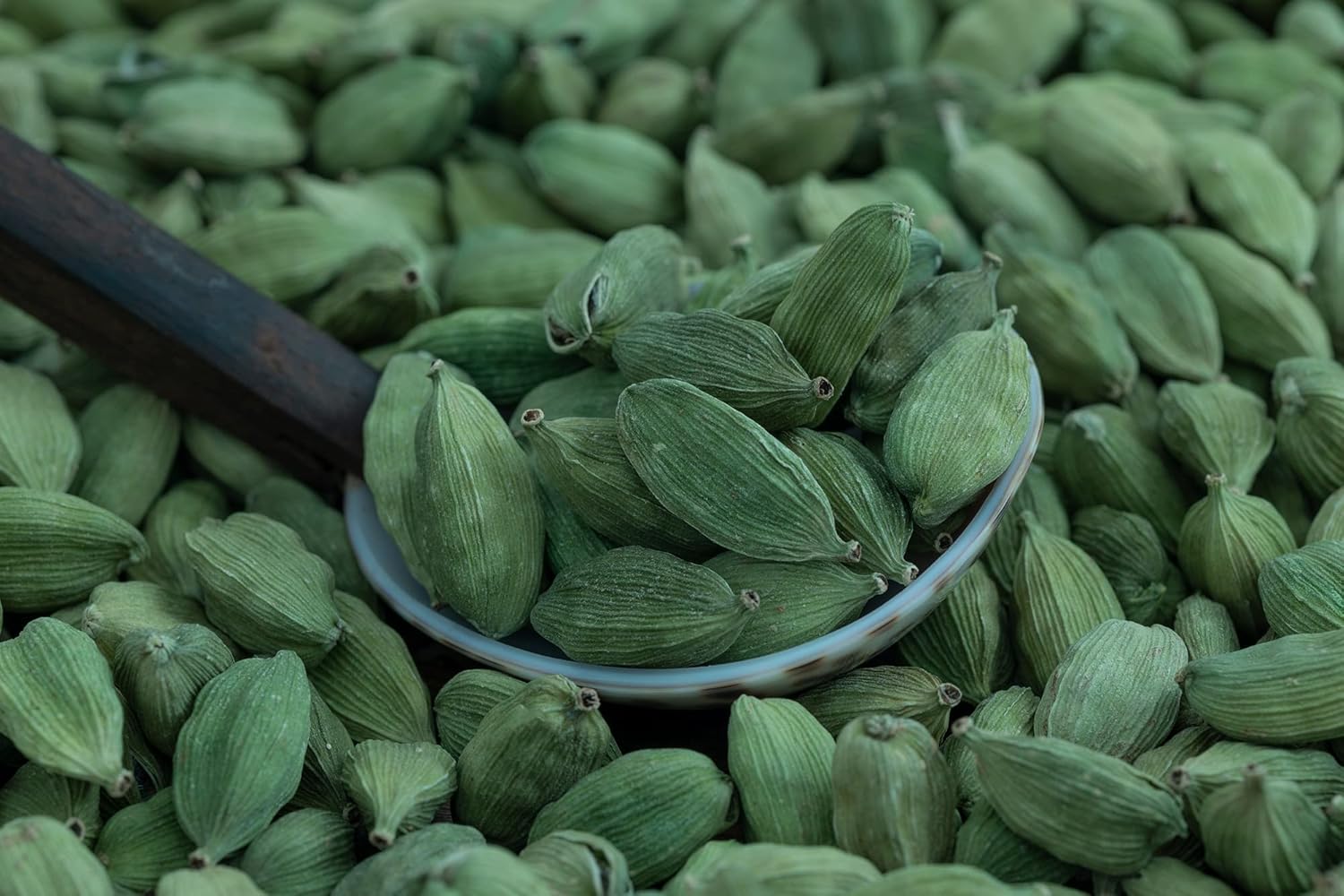
Quality in green cardamom is judged mainly by pod size, colour, and aroma — bigger, greener, oil-rich pods command the highest prices. Indian export grades defined around the Spices Board system include:
| Grade | Name | Typical pod size |
|---|---|---|
| Super Bold | Alleppey Green Super Bold (9 mm) | ~9 mm+ (the largest, most oil-rich pods — top market grade) |
| AGEB | Alleppey Green Extra Bold | ~8 mm+ (premium, very bold & green) |
| AGB | Alleppey Green Bold | ~7 mm+ |
| AGS | Alleppey Green Superior | ~6.5 mm+ |
In everyday trade you'll also see cardamom sold simply by millimetre size — 6 mm, 7 mm, 8 mm, and the premium 8 mm+ "bold" and 9 mm "super bold" pods — and by colour intensity. The bigger the pod the more seed and oil it carries, so 9 mm super-bold fetches the top price. Whatever the label, the markers of good cardamom are the same: plump, unsplit, deep-green pods with a strong, fresh aroma.
11Flavour & chemistry
What gives it that aroma
Cardamom's signature comes from its essential oil (roughly 2–10% of the seed), a complex blend of volatile terpenes. The two dominant compounds are α-terpinyl acetate (sweet, floral, herbaceous — usually the largest fraction) and 1,8-cineole / eucalyptol (the fresh, cooling, camphoraceous note). Supporting players include limonene, sabinene, linalool, myrcene and pinene.
Green cardamom tends to carry more 1,8-cineole than black cardamom, which is part of why it reads as bright and fresh rather than smoky. Because these aromatics are volatile, flavour is at its peak when the seeds are freshly ground from whole pods — pre-ground cardamom loses its character quickly.
12Culinary uses
How to cook with it
Few spices cross as many cuisines. Cardamom is used both whole (pods bruised and simmered, then removed) and ground (seeds milled fresh):
- Indian cooking: masala chai, biryani and pulao, garam masala, kheer and many sweets.
- Middle East: Arabic "gahwa" coffee, spice blends, rice and desserts.
- Nordic baking: cardamom buns (kardemummabullar), breads and pastries.
- Sweet & drinks: custards, ice cream, chocolate, mulled drinks and cocktails.
It pairs naturally with cinnamon, clove, ginger, saffron, vanilla, coffee, citrus and rose. A little goes a long way — start small and build.
13Consumption & dosage
How much, how often
Green cardamom is used in tiny amounts for its intense, sweet-floral aroma; the spice is the dried capsule, which can be used whole, lightly bruised, or with just the inner seeds ground fresh. A little goes a long way, and grinding seeds just before use preserves the most flavour.
- Everyday culinary amounts: Typically 2-4 whole pods (or a pinch of freshly ground seeds) flavour a pot of chai, a rice or biryani dish, or a dessert for several people; whole bruised pods are added to simmering dishes and the seeds are ground for sweets and spice blends.
- Traditional and household use: Cardamom is traditionally added to tea and coffee, milk-based sweets, garam masala and festive dishes, and pods are sometimes chewed as a natural mouth freshener after meals.
- Forms: Available as whole green pods (best aroma and shelf life), loose seeds, and ground powder; whole pods stored airtight away from heat and light keep their flavour far longer than pre-ground powder.
14Health & wellness
What the evidence says
Cardamom has a long history in Ayurvedic and folk medicine, and modern research is beginning to examine those uses. The strongest themes in the literature are below — note that many studies use concentrated doses, and evidence is still developing.
- Digestive support: a classic carminative, traditionally used to ease bloating, gas and indigestion; its volatile oils are thought to relax gut smooth muscle.
- Antioxidant activity: rich in antioxidant plant compounds that help counter oxidative stress.
- Blood-pressure & metabolic markers: some randomised trials and meta-analyses report modest reductions in blood pressure and inflammatory markers, though results are mixed and more research is needed.
- Oral & breath freshening: chewed traditionally to freshen breath; lab studies note antibacterial activity against some oral bacteria.
- Anti-inflammatory potential: compounds such as 1,8-cineole show anti-inflammatory effects in laboratory and animal studies.
15Nutrition
By the numbers
Per 100 g of ground cardamom (USDA FoodData Central). A typical culinary serving is far smaller — around 1 teaspoon (~2 g) — so per-serving amounts are modest:
| Nutrient | Per 100 g |
|---|---|
| Energy | ~311 kcal |
| Carbohydrate | ~68 g |
| — of which dietary fibre | ~28 g |
| Protein | ~11 g |
| Fat | ~6.7 g |
| Notable minerals | Manganese (very high), iron, magnesium, potassium, calcium, zinc |
Values are approximate and vary by sample; source: USDA FoodData Central.
16Myths vs facts
Setting the record straight
Myth: Bigger, brightly green pods are always the best quality.
Fact: Size and a good green colour do indicate grade, but aroma comes from plump, mature seeds inside; very bright uniform green can also reflect curing or handling, so judge by fragrance and seed fill, not colour alone.
Myth: Cardamom needs deep shade like a forest understorey to crop well.
Fact: It needs balanced, regulated shade; too dense a canopy actually lowers flowering and yield, while sensible shade lopping before the hot and wet seasons improves both yield and capsule health.
Myth: More fertiliser means more capsules.
Fact: Cardamom has shallow roots and over-feeding can scorch them and waste inputs without raising yield; balanced split doses guided by a soil test give far better results than heavy applications.
Myth: Katte (mosaic) disease can be cured if you spray in time.
Fact: Katte is a virus with no cure once a plant is infected; management is preventive only, through virus-free planting material, removing infected clumps and controlling the aphids that spread it.
Myth: Cardamom melts fat or guarantees weight loss.
Fact: Cardamom is a flavour-rich spice used in tiny amounts; some studies explore possible metabolic effects, but it is not a weight-loss treatment and is best enjoyed as part of a balanced diet.
Myth: Saved seed from any garden gives the same good crop.
Fact: Seedling progeny vary genetically and may carry disease, so yield and quality differ; using selected mother clumps or vetted improved selections from a reliable nursery gives far more dependable results.
17In your kitchen
How to choose, use & store
Choose
Plump, unsplit, deep-green pods with a strong fresh aroma. Avoid pale, shrivelled or musty pods.
Use
Bruise whole pods for slow dishes (remove before serving), or grind the seeds fresh for desserts and chai.
Store
Whole pods in an airtight jar, away from heat and light, keep ~1 year+. Grind only what you need.
18FAQ
Frequently asked questions
What is the difference between green and black cardamom?
Green cardamom (Elettaria cardamomum) is the "true" cardamom — small green pods with a sweet, floral, citrusy aroma for sweet and savoury dishes. Black (large) cardamom is a different species, Amomum subulatum, with bigger brown pods and a smoky flavour from fire-drying, used mainly in savoury cooking. They are not interchangeable.
Where does the best cardamom come from?
Green cardamom is native to the Western Ghats of South India, and Indian cardamom from the high estates of Idukki, Kerala — including Udumbanchola — is prized for its aroma and deep green colour. Guatemala is today the largest producer by volume; India remains a major producer and the largest consumer.
Why is it called "Alleppey Green" if it isn't grown in Alleppey?
Because Alleppey (Alappuzha) was the port, not the farm. Under the kingdom of Travancore, cardamom from the high ranges had to be sold into the royal depot at Alleppey and exported from there, so foreign buyers named it after the harbour they received it from. The plant itself grows up in the Cardamom Hills of the Western Ghats — districts like Idukki, including Udumbanchola — never on the coast. "Alleppey Green" is today a registered Geographical Indication (GI No. 72).
Is Udumbanchola cardamom the same as "Alleppey Green"?
It is the same lineage at its source. Udumbanchola, in Idukki, sits in the heart of the Cardamom Hills that the "Alleppey Green" grade comes from — so high-grown Udumbanchola cardamom is exactly the mountain origin the famous name points back to. AroWest simply names the place where it grows instead of the port it was once shipped from.
Is cardamom good for digestion?
Cardamom is traditionally used to ease indigestion, bloating and gas, and its volatile oils are thought to relax gastrointestinal smooth muscle. It is a classic carminative in Ayurvedic and folk practice; clinical evidence is still developing.
Why is cardamom so expensive?
Cardamom is among the world's most expensive spices — usually after saffron and vanilla — because pods ripen unevenly and must be hand-picked over several rounds, then carefully dried and graded to keep their colour and oil. That labour, plus weather-sensitive yields, keeps prices high.
How much cardamom is safe to eat?
Cardamom used as a culinary spice is generally recognised as safe for most people. Concentrated supplements or large medicinal doses are different — if you are pregnant, take medication (for example for blood pressure or gallstones) or have a medical condition, consult a qualified healthcare professional first.
Sources & further reading
- Spices Board of India — Cardamom (small) catalogue & grades. indianspices.com
- USDA FoodData Central — Spices, cardamom (nutrient profile). fdc.nal.usda.gov
- Heydarian A. et al. (2024). Effect of cardamom consumption on inflammation and blood pressure: systematic review & meta-analysis of RCTs. Food Science & Nutrition. Wiley Online Library
- Cardamom and the metabolic syndrome: a narrative review. PMC. ncbi.nlm.nih.gov
- Cardamom (Elettaria cardamomum) monograph — Herbal Reality. herbalreality.com
- Alleppey Green Cardamom — name origin (Alleppey port) & GI status (No. 72). Wikipedia. en.wikipedia.org
- Cardamom Hills (Yela Mala) — geography & the 1822 Cardamom Proclamation. Wikipedia. en.wikipedia.org
- Idukki District — official history (Cardamom Hill Reserve). Government of Kerala. idukki.nic.in
- Vandanmedu cardamom auction centre (Udumbanchola). Kerala Tourism. keralatourism.org
- Cardamom Research Station, Pampadumpara (Udumbanchola), est. 1956. Kerala Agricultural University. kau.in
- Indian Cardamom Research Institute (ICRI) — Spices Board's cardamom research wing, est. 1978 at Myladumpara. Spices Board of India. indianspices.com
- Spices Park, Puttady — cardamom & pepper processing park (Spices Board). Spices Board of India. indianspices.com
Last reviewed: 21 June 2026 · Written by the AroWest editorial team (Western Crest Ventures LLP). Educational content, not medical advice.