

Quick facts
- Botanical name
- Myristica fragrans Houtt.
- Family
- Myristicaceae (the nutmeg family)
- Also known as
- Javitri / jaipatri (Hindi), jathipathri / jaadipatri (Malayalam & Telugu), jaadhipathiri (Tamil); "mace blades" or "mace flowers" in the trade
- Native to
- The Banda Islands of the Maluku archipelago (the Moluccas / "Spice Islands") of eastern Indonesia — for most of history the only place nutmeg and mace grew
- Heartland
- World production today centres on Indonesia and Grenada, with India, Sri Lanka and others following; in India, more than 90% of the nutmeg-and-mace crop grows in the homesteads of Kerala — Thrissur, Ernakulam, Kottayam, Idukki and the surrounding Western Ghats districts
- Part used
- The fleshy aril (the lacy net) that surrounds the nutmeg seed — dried whole as "blades" or ground
- Flavour
- Warm, sweet and aromatic like nutmeg but lighter, brighter and more delicate, with a faintly bitter, woody-floral edge and a warm orange-amber colour
- Key aroma
- Sabinene leads (often around a quarter of the oil), supported by α-pinene, β-myrcene, myristicin, elemicin and safrole — mace is rich in essential oil
- Top grades
- Graded by origin, colour and wholeness rather than a single ISO letter scale: Banda mace (flaky, pale-orange, the benchmark), Penang and Siau mace, Indian/javitri whole blades, and broken/ground lots; the brightest, most intact orange blades command the highest value
01Overview
What is mace?
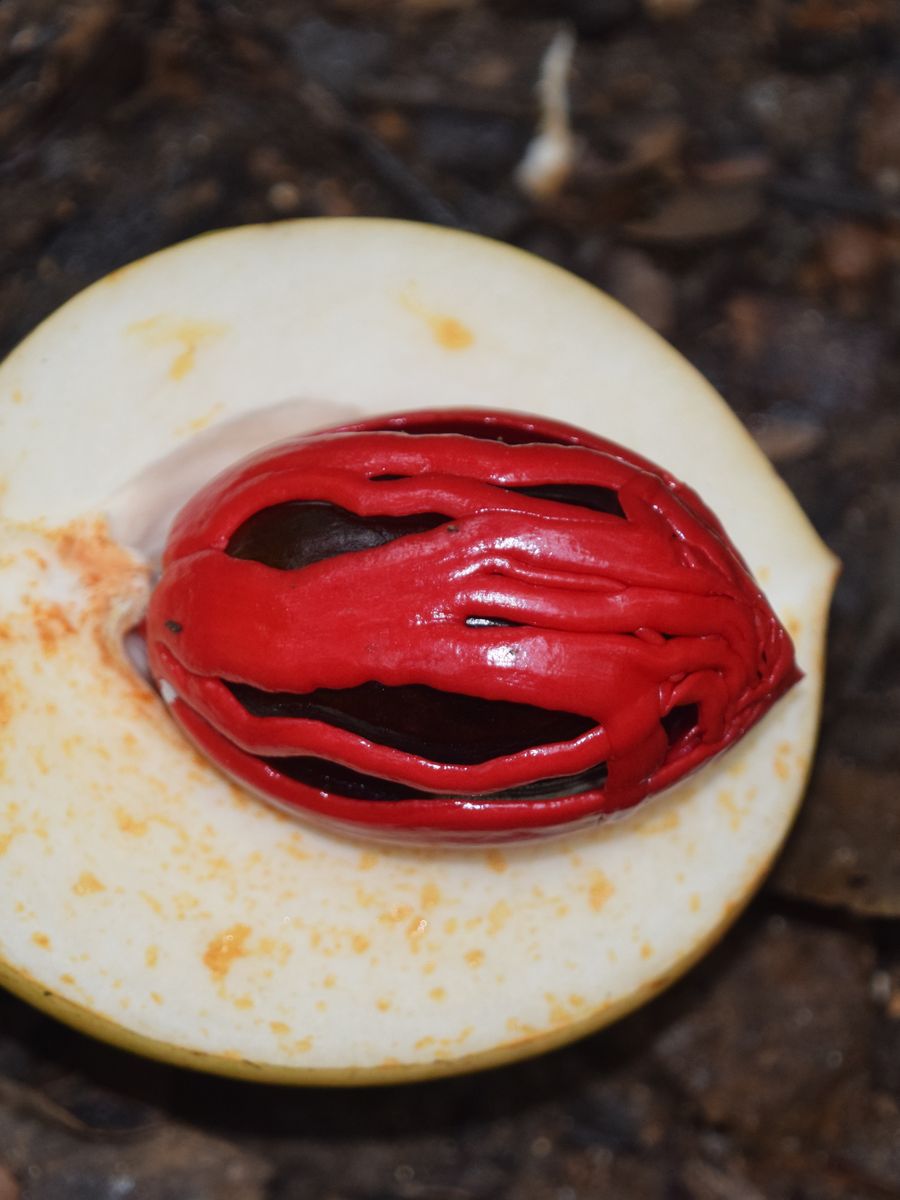
Mace is one of the few spices that is, quite literally, half of another. It is the aril — a brilliant scarlet, lacy membrane — that grows tightly over the seed of the nutmeg tree, Myristica fragrans. When the tree's apricot-like fruit splits open at ripeness, you can see all of it at once: the glossy brown seed in the middle, the crimson net wrapped around it, and the fleshy fruit wall holding both. That seed, dried, is nutmeg. That crimson net, peeled off and dried flat, is mace. Two of the world's classic spices from a single fruit — and mace is the rarer, more delicate of the two.
In Indian kitchens mace is javitri, and it is prized as much for its colour and finesse as its flavour. It carries the same warm, sweet, woody character as nutmeg, but lighter and brighter — more perfume, less punch — which is why cooks reach for it in pale, refined dishes where nutmeg's deeper brown notes (and colour) would be too heavy. We want to be straight about provenance, because honesty matters more than marketing: the nutmeg tree is not native to India or the Western Ghats. Its only original home was a cluster of tiny volcanic islands in Indonesia. But it settled beautifully into the shaded homestead gardens of Kerala, and today more than nine-tenths of India's nutmeg and mace is grown in those Western Ghats hills — the same forest country we farm.
02History & origin
One fruit the world went to war over
For most of recorded history, nutmeg and mace came from exactly one place on earth: the Banda Islands, a speck of volcanic land in the Maluku archipelago of eastern Indonesia. Nowhere else did the tree grow, and that scarcity made the twin spices astonishingly valuable. They travelled west for centuries — through Arab, Indian and Venetian hands — while their source stayed a guarded secret and their price multiplied many times over along the way.
When Europeans finally traced the trade to Banda, the islands became one of the most fought-over places on the planet. The Portuguese arrived in the early 16th century; then the Dutch East India Company (VOC) moved to seize total control. Under Jan Pieterszoon Coen, the Dutch conquest of the Banda Islands in 1621 was catastrophic for the Bandanese: historians put the pre-conquest population at around 15,000, of whom only about 1,000 survived — the rest killed, enslaved, deported or starved — with survivors and imported labourers forced to work the nutmeg groves. To protect their monopoly, the VOC restricted cultivation to a few controlled islands and even limed exported nutmegs to stop anyone planting them.
The monopoly held for the better part of two centuries before it finally broke. The French smuggled seedlings out in the late 18th century, and around the turn of the 19th century the British spread nutmeg cultivation to new ground — most famously to Grenada in the Caribbean, which still carries a split-open nutmeg on its national flag. Mace, all the while, travelled as nutmeg's quieter twin: the same trade, the same ships, the same fortunes — but always the rarer, smaller harvest, because each fruit yields only a thin wrapping of aril against a whole seed.

03Origin & terroir

Not native — but India grows nearly all of it in Kerala
Here is the honest version of the AroWest story for mace. There is no ancient Indian mace dynasty, no "Malabar mace" that conquered the world. The nutmeg tree is an Indonesian native, carried to South India on colonial spice routes. What India does have is a quietly remarkable fact: more than 90% of the Indian nutmeg-and-mace crop is grown in Kerala — in the warm, wet, shaded homesteads of the Western Ghats, the same kind of forest country we farm.
Indian nutmeg grows across Thrissur, Ernakulam, Kottayam, Idukki and neighbouring Kerala districts — on the order of twenty thousand hectares in Kerala alone, with the national area around twenty-three thousand hectares — with smaller plantings in Karnataka, Tamil Nadu, Goa and Maharashtra. It is rarely a monoculture. Here the nutmeg tree is a homestead and agroforestry crop, grown under the same mixed canopy as arecanut, coconut, pepper, clove and fruit trees, sharing shade and soil with its neighbours. That mixed-garden system is the truthful AroWest angle: not conquest, but a tree that found a second home in our hills and now feeds Indian kitchens with javitri grown a few valleys from where we work.
It helps to be clear-eyed about scale, too. Mace is genuinely rare — far scarcer than nutmeg — because every fruit yields a whole seed but only a thin lace of aril, so for each unit of mace there are several units of nutmeg. India consumes most of its own nutmeg and mace domestically. So when you cook with javitri, you are using the scarcer half of a fruit that grows, in this country, almost entirely in Kerala's Western Ghats homesteads.
“One fruit, two spices — and mace is the rarer one. In India, almost all of it grows in Kerala's Western Ghats homesteads.”
04Research & trade
Who studies India’s mace
Mace and nutmeg come from one tree, so the same Western Ghats institutes that research nutmeg also shape India’s mace.
ICAR–Indian Institute of Spices Research (IISR), Kozhikode
India's national institute for spices research, in Kozhikode, Kerala. Its mandate covers the tree spices — nutmeg (and therefore mace), clove and cinnamon — and it has released improved high-yielding nutmeg varieties such as IISR Viswasree and IISR Keralashree, selected for both nutmeg and mace yield and quality (around 480 kg dry mace per hectare).
Spices Board of India
The Ministry of Commerce body, headquartered in Kochi, that regulates, promotes and sets quality standards for Indian spices — including nutmeg and mace — and maintains India's official spice trade records.
ICAR–AICRP on Spices
The All India Coordinated Research Project on Spices, coordinated from IISR Kozhikode — the country's largest spices research network, linking ICAR with state agricultural universities to improve crops including nutmeg and mace across agro-climatic regions.
Kerala Agricultural University (KAU)
Kerala's state agricultural university, whose research stations and package-of-practices guidance underpin nutmeg-and-mace cultivation in the homestead gardens of the Western Ghats, where almost all of India's crop is grown.
Sources: ICAR–IISR (Kozhikode), the Spices Board and Kerala Agricultural University — see references.
05Botany & cultivation
How & where it grows
Mace and nutmeg both come from Myristica fragrans, an evergreen tropical tree of the family Myristicaceae. Left to grow it usually reaches about 5–15 metres, occasionally to 20 metres or more, with dark glossy leaves and small, pale, fragrant flowers. The tree is dioecious — individual trees are male or female — so only the female trees, once pollinated, set the fruit that carries the spices.
The fruit is a fleshy, apricot- or peach-like drupe. When it ripens — typically six to eight months after flowering — it splits open along a seam and reveals the prize: a single glossy, dark-brown seed wrapped in a vivid crimson, net-like aril. The seed is nutmeg; the aril is mace. No other common spice pairing is born this intimately, one inside the other, from the same fruit.
The tree is slow to reward its grower. Seedlings raised from fresh seed take several years to begin bearing — often around the seventh or eighth year — and a tree may not reveal its sex until it flowers. Once established, though, a healthy nutmeg tree bears for decades, reaching its prime in its twenties and fruiting productively for many years.
At harvest the ripe fruits are gathered (often as they fall or with a long hooked pole), then split open by hand. The crimson aril is carefully peeled away from the seed in one piece where possible — this is the mace. The seeds are set aside to become nutmeg.
The peeled aril is then flattened and dried — traditionally in the sun for one to two weeks — during which its brilliant crimson fades to the familiar pale orange, amber or tan of dried mace "blades." Good drying preserves the oil and the colour; rushed or careless drying dulls both. Mace is rich in volatile oil, which is exactly why careful handling matters so much.
06Cultivation & agronomy
How it's grown
Mace and nutmeg come from the same tree, Myristica fragrans, so you do not grow a "mace plant" — you grow the nutmeg tree and harvest the crimson aril (mace) along with the seed. In India this is overwhelmingly a Kerala homestead crop, tucked under the canopy in mixed gardens alongside arecanut, coconut, pepper and coffee. It is a patient, long-lived tree spice that rewards shade, steady moisture and good drainage.
Climate & soil
A strictly tropical, humid, warm crop happiest at lower-to-mid elevations (commonly up to about 900 m), with roughly 1,500-3,000 mm of well-distributed rainfall and warm temperatures around 25-35 C; it cannot take frost or prolonged dry heat. It prefers deep, well-drained loamy or lateritic soils rich in organic matter, slightly acidic to near-neutral (about pH 5.5-7.0), and being naturally an understorey tree it needs filtered shade, especially when young. Waterlogging and strong, dry winds are its main enemies.
Propagation & planting
Traditionally raised from fresh seed sown soon after extraction, but seedlings reveal their sex only after years and roughly half tend to turn out to be unproductive males. The more reliable modern route is vegetative propagation — typically epicotyl or approach grafting onto seedling rootstock using scions from proven high-yielding female (or hermaphrodite) mother trees — which gives fruiting trees, keeps height manageable and tends to bring earlier, more uniform bearing. Grafted plants are usually hardened in a shaded nursery for around 12-18 months before field planting.
Crop calendar
Nursery & grafting
Sow fresh seed in shaded beds/polybags or graft proven scions; raise plants under heavy shade (roughly 50-60%) for about 12-18 months until sturdy and well-rooted.
Planting (onset of monsoon)
Transplant grafts into generous pits (around 60-90 cm) enriched with FYM/compost at the start of the rains (roughly June in Kerala) so roots establish in moist soil; provide temporary shade and stakes.
Establishment (years 1-4)
Young trees grow under shade with regular watering in dry spells, weeding, mulching and gap-filling; little to no fruit yet, so the focus is on a healthy framework.
Flowering & fruit set
Mature trees flower and set fruit; ensure enough female/bearing trees and, in grafted orchards, a few pollinators (male or hermaphrodite trees) nearby for good set.
Fruit maturation
The golden, apricot-like fruit develops over several months; it is ready when the husk yellows and begins to split, exposing the scarlet mace over the seed.
Harvest & separation
Gather split/fallen fruit, peel the crimson mace from the seed by hand (ideally the same day), then dry mace and seeds separately and grade; harvest commonly peaks over a few months, often around mid-year and again later, varying by location and season.
In the field
- Spacing & shade: Plant roughly 8-10 m apart (commonly around 40-60 grafted trees per acre, depending on spacing) under filtered shade; in homestead gardens it shares the canopy with arecanut, coconut and fruit trees rather than growing in open sun.
- Irrigation & drainage: Keep soil evenly moist in dry months — young trees especially suffer from drought — but ensure free drainage, as the roots will not tolerate waterlogging.
- Mulching & organic matter: Mulch the basin with leaf litter or husk and add compost/FYM each year to conserve moisture, feed soil life and protect surface roots.
- Weeding & basin care: Keep basins weed-free, especially in the early years, with shallow weeding or a smother cover so young grafts are not out-competed.
- Wind & canopy protection: Shelter trees from hot, dry winds with the surrounding canopy or windbreaks, and remove dead or crossing wood to keep the canopy open and healthy.
07Variety guide
Every variety, in depth
Mace—the lacy, crimson-to-gold aril wrapped around the nutmeg seed—comes from the same tree as nutmeg and matures in India where Kerala's humid coastal belt has cultivated it for centuries. Below are the principal Indian varieties and botanical types: released cultivars from ICAR institutes, farmer-bred selections gaining official recognition, and regional landraces prized for size, yield, or aroma. Curing practices and clone genetics jointly determine mace quality; the tree itself is dioecious, though rare hermaphrodite varieties have emerged.
IISR ViswashreeVishwashree, A 9/4
Released varietyICAR-Indian Institute of Spices Research (IISR), Kozhikode, Kerala · ICAR-IISR · 2001
High myristicin and elemicin content in both nut and mace oils; low fruit rot incidence from Diplodia species. Significantly outperforms earlier varieties in aromatic chemical composition with stronger spicy profile.
Full detailsIISR KeralashreeKeralasree, IC-537218 elite
Released varietyICAR-Indian Institute of Spices Research (IISR), Kozhikode, Kerala; selected from Burliar, Nilgiris, Tamil Nadu germplasm · ICAR-IISR (farmer participatory breeding) · 2013
First nutmeg variety developed through farmers' participatory breeding. Mace and nut oils rich in sabinene and myrcene (for delicate aroma) with intentionally low myristicin and elemicin. Bold nut, thick and entire mace that fully covers seed.
Full detailsKonkan SugandhaKonkan Sugandh
Released varietyDr. Balasaheb Sawant Konkan Krishi Vidya Peet (DBSKKV), Fruit Research Station, Vengurla, Maharashtra · Dr. Balasaheb Sawant Konkan Krishi Vidya Peet (SAU) · 1998
Only hermaphrodite nutmeg variety released in India. Both male and female flowers on same tree, eliminating the major plantation problem of 50% unproductive male trees; each tree can produce fruit. Suited to Konkan's humid, warm coastal climate.
Full detailsKonkan ShrimantiKonkan Shrimanthi
Released varietyDr. Balasaheb Sawant Konkan Krishi Vidya Peet (DBSKKV), Dapoli, Maharashtra · Dr. Balasaheb Sawant Konkan Krishi Vidya Peet (SAU) · 2005
High-yielding variety with bold nuts and notably thick mace. Major contribution to Konkan's spice economy.
Full detailsPunnathanam JathyPunnathanam, Punnathanam variety
Traditional cultivarIdukki district, Kerala (developed in wild forests from original seed from Kottayam) · Varkey Thomman (farmer-developer, 1994); continued and recognized by Shajan Varghese (son) · 1994 (formal development); 2015 recognition by National Innovation Foundation; 2024 Best Spice Farmer (Innovation) Award from IISR
Extra-large nut variety—4.5 cm long × 3 cm wide, far exceeding standard sizes. High annual productivity (3000 fruits per mature tree). Organically cultivated, low-maintenance, pest-tolerant. Farmer-led improvement model widely recognized nationally.
Full detailsKAU PutharaPuthara, KAU Poothara
Farmer-bred selectionVaikaprayar near Vakim, Kottayam district, Kerala · Joseph (farmer from FACT background); recognized and registered by Kerala Agricultural University (KAU) · 2018 (official KAU recognition and registration); Plant Genome Saviour Award (year not specified in available literature)
Produces unusually large, consistent nutmegs in huge bunches from single trees. Dried nutmeg weighs minimum 10g, selected specimens 16g. KAU recognition indicates official merit. Recipient of multiple awards including Sugandhsree Innovative Farmer Award (2019) and Best Spice Farmer (Innovation) Award from IISR (2024).
Full detailsMalabar Type (Traditional East Indian)Kerala type, East Indian nutmeg
Botanical typeNative to Kerala and south-western India (Malabar region historically); also wild/semi-cultivated in Nilgiris, Kottayam, Idukki · Farmer selection over centuries; not formally bred · Pre-colonial (17th century trade history); modern cultivations trace to 1800s–present
Darker, more flavorful nutmeg than West Indian types; higher myristicin concentration (5-13%). Premium in global spice markets. Multiple local landraces within Malabar type distinguished by size and aromatic profile.
Full detailsKeralashree Elite Seedling LandracesKAU-farmer varieties (multiple), superior mother trees, PVS-selected clones
Regional typeAcross Kerala nutmeg-growing regions (Thrissur, Ernakulam, Kottayam); identified via Participatory Varietal Selection (PVS) surveys · Farmer-maintained landraces; identified and characterized by Kerala Agricultural University (KAU) · Surveyed 2010–2014; five varieties released as KAU-farmer varieties (exact years not specified in available literature)
PVS approach identified five superior clones from 29 mother trees based on economic yield traits (nut size, mace thickness, fruit number). Diversity reflects century-long farmer selection across Kerala's varied microclimates.
Full detailsBombay Nutmeg Type (Myristica malabarica)Wild nutmeg, M. malabarica reference population
Botanical typeSouth-western India (native range); Konkan coast and Western Ghats · Not formally bred; wild and semi-cultivated populations · Ancient/pre-colonial; not formally released
Alternative nutmeg species producing lower-grade, milder spice with minimal aroma. Lacks fragrance characteristic of true nutmeg. Historically used as adulterant in true nutmeg trade. Not commercially significant for spice production in India.
Full detailsHermaphrodite/Monoecious Type (rare)Monoecious, bisexual flowering
Botanical typeOccurs sporadically (estimated 5% frequency) in mixed seedling populations; Konkan Sugandha is the only formally released hermaphrodite variety · Natural occurrence; selected and released via DBSKKV (Konkan Sugandha) · Konkan Sugandha formally released 1998
Bears both male and female flowers on same tree, solving the 50% male tree problem of dioecious breeding. Reduces plantation inefficiency. Konkan Sugandha is the sole released example.
Full details08Pests, diseases & disorders
What can go wrong
The nutmeg tree is relatively hardy in well-managed shade gardens, and most losses come from fruit and seed rots in wet weather plus a few borers and sucking pests. Because mace is peeled and dried by hand, post-harvest mould is as much a quality threat as any field pest, so good drying and storage matter as much as anything done in the field. Favour clean cultural practice and integrated pest management (IPM); reach for chemicals only as a last, registered resort.
Fruit rot / fruit drop (die-back)
DiseaseSigns: Water-soaked, dark rotting patches on developing fruit, premature fruit splitting and drop, and sometimes tip die-back of shoots — typically worst in the heavy monsoon.
Manage: Improve canopy aeration and drainage, collect and destroy fallen rotten fruit, avoid waterlogging, and apply a recommended/registered protectant as per the local package of practices only when disease pressure is high; planting healthy, well-spaced grafts also helps.
Thread blight / leaf and twig blight
DiseaseSigns: Fine whitish-to-brown fungal threads webbing over leaves and twigs in humid shade, with leaf browning, defoliation and dieback of small branches.
Manage: Prune affected twigs and improve light and air movement by thinning the canopy; remove debris and, if needed, use a recommended registered fungicide per local recommendations rather than blanket spraying.
Shot-hole borer / bark and shoot borers
PestSigns: Small boreholes in stem, bark or shoots with fine frass, wilting of affected shoots and, in seeds, insect-bored "wormy" kernels that lower grade.
Manage: Keep trees vigorous (stressed trees are attacked more), prune and destroy infested wood, and treat severe infestations with a registered product as advised locally; harvest and dry promptly to limit seed boring.
Scale insects & mealybugs
PestSigns: Clusters of soft scales or white mealybugs on leaves, shoots and fruit stalks, with sticky honeydew and sooty black mould on leaves below; can weaken young trees.
Manage: Encourage natural enemies (ladybird beetles, parasitoids), prune and destroy heavily infested shoots, control the ants that farm them, and spot-treat with horticultural oil or a recommended registered insecticide only where infestations are heavy.
Storage mould / aflatoxin risk on dried mace
DisorderSigns: Musty smell, dull or blackened patches and loss of bright orange colour on dried mace stored damp; a genuine food-safety and quality concern.
Manage: Dry mace thoroughly to a safe moisture level, cool fully before packing, and store airtight away from heat and humidity; reject and discard any mouldy or musty lots rather than blending them in.
Sun-scald / drought stress
DisorderSigns: Scorched, yellowing or browning leaves and poor fruit set on trees in too much direct sun or under prolonged dry spells, especially when young.
Manage: Maintain adequate shade, mulch basins and irrigate during dry months; establish young grafts under temporary shade until the canopy develops.
09Soil & fertiliser
Feeding the plant
You feed the whole tree, not the mace specifically — but a well-nourished tree carrying plenty of healthy fruit gives more and better mace. The backbone in Kerala homesteads is generous organic matter (FYM/compost), topped up with balanced NPK split across the rainy season, and micronutrients only where a soil or leaf test shows a need. Always confirm rates with a soil test rather than feeding blind.
| Stage | Inputs | Notes |
|---|---|---|
| Planting (year 0) | Well-rotted FYM/compost worked into each pit, plus a phosphorus source guided by a soil test | Build organic matter and drainage at planting so young roots establish; avoid strong fresh manure or heavy chemical fertiliser right against the roots. |
| Young trees (years 1-4) | Annual FYM/compost plus small, gradually increasing split doses of N, P and K scaled to tree age | Apply in two or more splits with the monsoon; start low and raise the dose each year as the canopy grows, keeping nitrogen modest to avoid soft, disease-prone growth. |
| Bearing trees (year 5+) | A generous annual dose of FYM/compost per tree plus a balanced NPK dose, split pre- and post-monsoon | Match the full adult NPK rate to local package-of-practices guidance and your soil test; place fertiliser in a shallow basin around the drip line and cover with mulch. |
| Micronutrient correction (as needed) | Magnesium, zinc, boron or others only if a soil/leaf test shows a deficiency | Lateritic Kerala soils can run short of some micronutrients; correct specifically rather than adding a blanket mix. |
Common deficiencies & issues
- Nitrogen shortage: Overall pale, yellow-green older leaves and weak, slow growth with poor canopy — common where organic matter is low; correct with compost and a modest split N dose.
- Potassium shortage: Yellowing and scorching along older-leaf margins and poorer fruit filling; address with a K source guided by a soil test, as good potassium supports fruiting.
- Magnesium shortage: Yellowing between the veins of older leaves while the veins stay green, often on acidic lateritic soils; correct with a magnesium source after testing.
- Micronutrient (zinc/boron) issues: Small or distorted new leaves and poor flowering or fruit set can signal zinc or boron shortage; confirm by test before any corrective application.
10Grades & quality
The grades, decoded
Mace isn't graded by a single port name the way pepper is by "Tellicherry" or cardamom by "Alleppey Green." It's graded mostly by origin and by the colour, size and wholeness of the dried blades — bright, intact, orange blades being the most prized. The names you'll meet in the trade are island and regional labels rather than formal letter grades.
| Grade | Name | What it means |
|---|---|---|
| Premium | Banda mace (Indonesia) | From the Banda Islands, the spice's original home — flaky, pale-yellow to orange, intact blades with a delicate aroma. Widely regarded as the benchmark for fine mace. |
| Premium | Penang / Siau mace | Penang (Malaysia) and Siau Island (Indonesia) mace are sun-dried, reddish-to-orange grades prized for bright colour and clean, whole blades; sold as top island grades. |
| Standard | Whole blades (Indian / javitri) | Kerala-grown mace, dried as whole or near-whole blades. Graded by colour and intactness; the brighter and more unbroken the blade, the higher the value. |
| Commercial | Broken mace / bits | Fragmented blades from sorting and handling. Perfectly good in flavour and ideal for grinding or extraction, but less valued than whole blades because appearance matters in the spice. |
| Processed | Ground mace | Milled to a fine powder. Convenient and even-blending, but loses its volatile oil far faster than whole blades — best bought little and often, or ground fresh at home. |
Two things separate a fine mace lot from an ordinary one: colour and wholeness. The best blades are bright orange-amber, supple rather than crumbling, and whole — a tangle of broken bits and dull, brownish pieces signals age, poor drying or weak oil. Because mace is so much rarer than nutmeg — each fruit gives a whole seed but only a thin lace of aril — quality blades carry a real premium. We grade for colour, intact blades and aroma, not bulk.

11Flavour & chemistry
What gives it that aroma
Mace tastes like nutmeg with the volume turned down and the colour turned up: warm, sweet and aromatic, but lighter, brighter and more delicate, with a faint, pleasant bitterness and a woody-floral lift. Because it doesn't carry nutmeg's deeper brown, slightly resinous bass note, cooks reach for mace when they want that warm-spice character without the weight — and without staining a pale sauce.
Chemically, mace and nutmeg are close relatives, since they come from the same fruit. Both are rich in essential oil — published figures put mace's volatile-oil content broadly in the same high range as the nutmeg kernel (on the order of several percent up to the mid-teens, varying with origin) — which is part of why a little goes a long way.
The aroma is led by sabinene — a fresh, woody-terpene note that is the single largest component of mace oil (often around a quarter of it) — together with myristicin, the aromatic ether that gives the nutmeg–mace pair its signature warm, slightly narcotic-sweet character. Around these sit α-pinene and β-myrcene (piney, balsamic terpenes, each often well over a tenth of the oil) and the related ethers elemicin and safrole. Compared with the nutmeg seed, mace oil leans even more heavily toward these terpenes.
That myristicin is also the reason for a genuine word of caution. In ordinary culinary pinches mace is a delight, but the same family of compounds that defines its aroma is mildly psychoactive and toxic in large doses — so mace, like nutmeg, is a spice to use by the blade and the pinch, never the spoonful (more on that in the health section).
12Culinary uses
How to cook with it
Mace is the colour-safe, refined member of the warm-spice family. Cooks use it whenever they want nutmeg's warmth but a cleaner, lighter result — in pale sauces, light meats, sweet bakes and aromatic rice. Whole blades are bloomed in hot fat or simmered to infuse, then often lifted out; ground mace is stirred in late so its delicate oil isn't cooked away.
- Garam masala & whole-spice blends: A blade or two of mace is a classic part of garam masala and many North Indian spice mixes, lending warmth and a floral lift; it's bloomed in hot ghee or ground into the blend.
- Biryani, pulao & korma: Javitri is treasured in Mughlai cooking — biryani, pulao and rich, pale kormas — precisely because it perfumes the dish without darkening a delicate white or cream gravy the way nutmeg would.
- Pale & creamy sauces: A pinch of ground mace is the traditional warm note in béchamel, white sauces, soups and potato dishes, where it adds depth without colour or heaviness.
- Baking & desserts: Mace shines in cakes, doughnuts, custards, fruit cakes and spice cookies, often alongside cinnamon and nutmeg — brighter and more delicate than nutmeg on its own.
- Charcuterie, sausages & terrines: Mace is a quiet workhorse in processed and preserved meats — sausages, pâtés, terrines and potted dishes — where it rounds out richer, fattier flavours.
- Pickles, drinks & infusions: Whole blades go into pickling spice, mulled drinks, spiced syrups and aromatic stocks, steeping slowly and then being removed before serving.
Mace keeps the same warm company as nutmeg but flatters lighter dishes: cinnamon, cardamom, clove, black pepper and bay on the savoury side; cream, milk, potato, chicken, white fish, eggs and pale rice in the pot; and butter, sugar, vanilla, citrus and stone fruit in baking. Reach for mace instead of nutmeg whenever the colour of the dish matters, or when you want the perfume to stay light and floral rather than deep and brown.
13Consumption & dosage
How much, how often
Mace (javitri) is used in tiny amounts as a warm, aromatic background spice — nutmeg's lighter, brighter cousin, prized in pale dishes where dark nutmeg flecks would show. A blade or two, or a small pinch of powder, flavours a whole pot.
- Garam masala & Mughlai dishes: A blade or two of mace goes into garam masala, biryani, korma, pulao and rich gravies for delicate warmth; it is added whole in the tempering or ground fine into the blend, used by the pinch.
- Pale & milk-based dishes: Cooks often favour mace over nutmeg in white sauces, light soups, kheer, payasam, pound cakes and milk sweets, where it gives nutmeg's warmth without muddying the colour.
- Pickles, sausages & preserves: Ground mace is a classic in pickling spice, processed and cured meats and some baked goods for its clean, warm-aromatic note.
- Festive & winter cooking: Like other warming spices, mace features more in festive sweets and richer winter cooking; a little also finishes spiced drinks and desserts.
- Who should go easy: Mace shares nutmeg's myristicin, so pregnant or nursing women are generally advised to keep to small culinary amounts and avoid large or "medicinal" doses; the same caution applies to anyone tempted to use it heavily as a self-remedy.
14Health & wellness
What the evidence says
The strongest themes in the research are below. Many studies use concentrated extracts, and the evidence is still developing.
- A genuinely oil-rich, antioxidant spice: Mace is rich in volatile oil and in antioxidant compounds; laboratory studies of mace extracts report antioxidant and anti-inflammatory activity. This is promising in-vitro and animal evidence, not proof that culinary amounts treat disease in people.
- Antimicrobial activity in the lab: Extracts of Myristica fragrans (mace and seed) show antibacterial and antifungal activity in laboratory tests, including against Helicobacter pylori and some oral bacteria — robust in-vitro findings that do not translate to eating mace as a treatment.
- Mineral density: By weight, mace is a notable source of minerals — particularly copper, iron and manganese, plus some vitamin A and vitamin C. The catch is dose: a culinary pinch weighs almost nothing, so these per-100 g figures are a nutritional curiosity rather than a meaningful dietary contribution.
- Traditional digestive & carminative use: Mace has a long traditional role across Indian and Chinese systems of medicine for digestion, appetite and nervous complaints. These uses are culturally well attested but not backed by strong modern clinical trials.
- A real toxicity ceiling (this is the important one): Mace shares nutmeg's active compounds, including myristicin, which is mildly psychoactive and toxic in larger amounts. Doses well above culinary use (on the order of a teaspoon or more of nutmeg, roughly 5 g, supplying about 1–2 mg/kg myristicin) can cause nausea, dizziness, dry mouth, racing heart, agitation and hallucinations, with documented poisonings — including a reported case of accidental mace ingestion causing reversible coma in a child. This is the single most important health fact about mace.
15Nutrition
By the numbers
Per 100 g, ground mace looks strikingly nutrient-dense — but that framing is misleading, because nobody eats 100 g of mace; a blade or a pinch weighs a fraction of a gram. The standout minerals are copper, iron and manganese, with modest vitamin A and C. Values below are from USDA FoodData Central for "Spices, mace, ground" (FDC 170927).
| Nutrient | Per 100 g |
|---|---|
| Energy | 475 kcal |
| Protein | 6.71 g |
| Total fat | 32.38 g |
| Carbohydrate | 50.50 g |
| Dietary fibre | 20.2 g |
| Calcium | 252 mg |
| Iron | 13.9 mg |
| Magnesium | 163 mg |
| Phosphorus | 110 mg |
| Potassium | 463 mg |
| Sodium | 80 mg |
| Zinc | 2.30 mg |
| Copper | 2.47 mg |
| Manganese | 1.50 mg |
| Vitamin C | 21 mg |
| Vitamin A | 40 µg RAE (800 IU) |
Values are approximate and vary by sample; source: USDA FoodData Central.
16Myths vs facts
Setting the record straight
Myth: Mace and nutmeg come from different plants.
Fact: They come from one fruit of a single tree, Myristica fragrans. Nutmeg is the inner seed; mace is the lacy red aril wrapped around that seed. They are separated and dried apart, which is why they look and taste a little different.
Myth: Mace is just dyed or coloured nutmeg.
Fact: Mace is a naturally crimson-to-orange aril; its colour is real, not added. It dries from scarlet to a warm amber-orange on its own. Bright, intact "blades" are simply well-dried natural mace, not artificially coloured nutmeg.
Myth: You can plant a mace seed and grow a mace tree.
Fact: There is no mace seed. You grow the nutmeg tree, and mace is the aril it produces. Trees are often best raised by grafting from proven female mother trees, because seedlings are slow and roughly half tend to turn out to be unproductive males.
Myth: Darker, redder mace is always the best quality.
Fact: The best mace is whole, intact, well-dried blades with a clean bright orange-amber colour and strong aroma. Unusually deep-red or uneven colour can signal added colour or poor drying; aroma, wholeness and a clean smell matter more than redness.
Myth: Mace is a powerful medicine you can dose freely for sleep or digestion.
Fact: Mace is traditionally used and studies suggest some interesting properties, but it shares nutmeg's myristicin and can be unsafe in large amounts. It is a flavouring spice, not a self-dosed remedy; any therapeutic use is best discussed with a qualified professional.
Myth: Ground mace keeps just as well as whole blades.
Fact: Most of mace's flavour is volatile oil, so ground mace tends to fade within months while whole blades hold their aroma far longer. Buy whole blades when you can and grind small, fresh amounts as needed.
17In your kitchen
How to choose, use & store
Choose
Buy mace as whole blades whenever you can — the intact aril protects its oil far better than powder. Look for bright orange-amber blades that are supple and whole, not dull brown, brittle or crumbled to bits; colour and intactness are the truest signs of quality and freshness. A good blade smells immediately warm and sweet when you crush a corner. Because mace is genuinely rare — far less of it exists than nutmeg — expect it to cost more, and treat a tangle of dull broken pieces as a sign of an old or poorly dried lot.
Use
Use mace lightly — it's potent and refined, not a bulk spice. Bloom whole blades in hot ghee or oil at the start of a biryani or korma, or simmer them into milk, stock or a syrup and lift them out before serving. Grind blades fresh for spice blends and bakes, and add ground mace late so its delicate oil isn't driven off. Reach for mace instead of nutmeg whenever you want the warmth but not the colour. And keep to culinary amounts — a blade or a pinch — never a spoonful.
Store
Store whole mace blades in an airtight container away from heat, light and moisture, and they'll hold their aroma and colour for a year or more. Ground mace fades much faster — buy it in small amounts or grind your own as needed. Keep the jar sealed and out of the sun; when the bright warm smell weakens or the colour goes dull, the oil is going and it's time to refresh.
18FAQ
Frequently asked questions
What exactly is mace?
Mace is the aril — a lacy, scarlet membrane — that grows over the seed of the nutmeg tree, Myristica fragrans. Inside a single apricot-like fruit, the brown seed becomes nutmeg and the crimson net around it, peeled off and dried, becomes mace. One fruit yields both spices, which is why they're so closely related.
Are mace and nutmeg the same thing?
They come from the same fruit but they're two different spices. Nutmeg is the hard inner seed; mace is the lacy aril that wraps it. They taste similar — warm and sweet — but mace is lighter, brighter and more delicate, with a warm orange tone, while nutmeg is deeper and more resinous. Mace is also the rarer of the two. (See our companion nutmeg guide for the seed.)
What is javitri?
Javitri is simply the Indian name for mace — jaipatri in Hindi, jathipathri in Malayalam and Telugu. It's the dried aril of nutmeg, prized in Mughlai and North Indian cooking for adding warmth and aroma to biryani, korma and garam masala without darkening a pale dish.
Is mace native to India?
No. The nutmeg tree is native to the Banda Islands of Indonesia — the original Spice Islands — and was carried to South India on colonial trade routes. We're upfront about this. The honest Indian story is that more than 90% of the national nutmeg-and-mace crop is grown in Kerala's Western Ghats homesteads, the same forest country we farm — not native origin, but a tree that found a second home in our hills.
Why is mace more expensive than nutmeg?
Because there's far less of it. Every fruit holds a whole seed but only a thin lace of aril, so for every unit of mace there are several units of nutmeg produced. Bright, whole, well-dried blades are scarcer still — which is why quality mace carries a real premium over the seed.
What gives mace its flavour?
Mace is rich in essential oil. Its aroma is led by sabinene — a fresh, woody terpene that's often the single largest component, around a quarter of the oil — together with myristicin, the warm, sweet aromatic ether that defines the nutmeg–mace character, plus α-pinene, β-myrcene, elemicin and safrole. The result is nutmeg's warmth, but lighter and more floral.
When should I use mace instead of nutmeg?
Reach for mace whenever the colour of the dish matters or you want a lighter, more delicate warmth — pale kormas and biryani, white sauces, custards, light meats and bakes. Nutmeg's deeper brown can muddy a cream or white gravy; mace adds the same family of flavour while keeping the dish bright.
Should I buy mace whole or ground?
Whole blades, when you can. The intact aril protects its volatile oil, so blades keep their aroma and colour for a year or more, while ground mace fades within months. Look for bright orange-amber, supple, whole blades — dull, brittle, broken pieces signal age or poor drying. Grind small amounts fresh as you need them.
Is mace safe to eat?
In culinary amounts — a blade or a pinch — mace is safe for most people. The caution is about dose: mace contains myristicin, a mildly psychoactive compound, and larger "medicinal" or recreational amounts can cause nausea, dizziness, palpitations, agitation and hallucinations, with documented poisonings — including a reported reversible coma after accidental ingestion in a child. Use it as a spice, never by the spoonful. This isn't medical advice.
Can I use mace during pregnancy?
Small amounts used to flavour food are generally considered fine, but mace and nutmeg in larger, more-than-food quantities are regarded as possibly unsafe in pregnancy, with traditional reports of abortifacient effects. If you're pregnant or nursing, keep mace to ordinary culinary amounts and check with a qualified healthcare professional before using it in any therapeutic way.
Does mace have real health benefits?
Mace is rich in volatile oil and antioxidant compounds, and laboratory studies report antioxidant, anti-inflammatory and antimicrobial activity for mace extracts. But that work uses concentrated extracts, not the pinch you cook with, so treat culinary mace as a flavourful, nutrient-dense spice rather than a medicine — and remember the genuine toxicity ceiling at high doses. None of this is medical advice.
How is mace processed and dried?
After the ripe fruit splits open, the crimson aril is peeled from the seed by hand, ideally in one piece. It's then flattened and dried — traditionally in the sun for one to two weeks — during which the brilliant crimson fades to the pale orange, amber or tan of dried mace blades. Careful drying locks in both the oil and the colour.
How should I store mace?
In an airtight container, away from heat, light and moisture. Whole blades keep their aroma and colour for a year or more; ground mace fades fast, so buy it small or grind your own. When the bright, warm smell weakens or the colour dulls, the oil is going — that's your cue to replace it.
How long before a nutmeg tree starts giving mace, and how much can I expect?
Grafted trees usually begin bearing in about 5-7 years and reach full bearing around 15-20 years, often staying productive for several decades. A mature tree can carry several thousand fruits a year, but mace is only a thin aril on each, so dried mace per tree is modest — typically well under a kilogram. That low recovery, plus hand peeling, is a key reason mace usually costs more than nutmeg. Actual figures vary with variety, age and care.
Can I grow mace separately from nutmeg?
No. Mace and nutmeg are two spices from the same fruit of one tree, so you grow the nutmeg tree and harvest both. When the ripe fruit splits, you peel the crimson mace off the seed by hand and dry the mace and the seed separately. There is no standalone mace plant or mace seed to sow.
How do I judge good-quality dried mace when buying?
Look for whole, intact "blades" with a clean, bright orange-amber colour and a strong, sweet-warm aroma, and avoid pieces that are dull, musty, broken to dust or unevenly deep red. A musty smell points to damp storage and possible mould, while broken, pale, scentless lots have lost their oil — wholeness, aroma and a clean smell matter more than how red it looks.
Sources & further reading
- Mace | Nutmeg, Spice, Flavoring, Aroma & Uses — Encyclopaedia Britannica (aril, processing, Banda mace, drying, colour) britannica.com
- Myristica fragrans — Wikipedia (botany, authority Houtt., aril vs seed, native Maluku/Banda origin, dioecious, fruit anatomy) en.wikipedia.org
- Nutmeg — Wikipedia (history, Banda Islands, Dutch monopoly, Grenada flag, mace as the aril, world production, myristicin) en.wikipedia.org
- Dutch conquest of the Banda Islands — Wikipedia (VOC monopoly, 1621 conquest under Coen, ~15,000 to ~1,000 population figures) en.wikipedia.org
- Myristicin — Wikipedia (psychoactive constituent, metabolism, toxicity) en.wikipedia.org
- Nutmeg & Mace (Myristica fragrans) — Gernot Katzer's Spice Pages (mace chemistry, sabinene, myristicin, flavour, oil content) gernot-katzers-spice-pages.com
- FAO — Production, handling and processing of nutmeg and mace; composition and constituents (essential-oil percentages of mace vs seed) fao.org
- Comparison of chemical compositions of seed and mace essential oils of Myristica fragrans — NVEO (sabinene ~24–26%, myristicin, α-pinene, β-myrcene, safrole percentages in mace oil) nveo.org
- Spices, mace, ground — USDA FoodData Central (FDC 170927), nutrition per 100 g fdc.nal.usda.gov
- Mace spice (Myristica fragrans): nutrition facts and health benefits — Nutrition-and-You (USDA-based minerals, vitamins, compounds, mace vs nutmeg) nutrition-and-you.com
- Anti-Helicobacter pylori, Anti-Inflammatory, Cytotoxic, and Antioxidant Activities of Mace Extracts from Myristica fragrans — PMC (PMC7146089) pmc.ncbi.nlm.nih.gov
- Antibacterial Activity of Myristica fragrans against Oral Pathogens — PMC (PMC3434417) pmc.ncbi.nlm.nih.gov
- Toxicity of Nutmeg (Myristicin): A Review — IJASEIT (toxic dose ~5 g nutmeg, 1–2 mg/kg myristicin, CNS effects) ijaseit.insightsociety.org
- Mace Poisoning: Accidental Toxic Ingestion in a Child Leading to a Reversible Coma — PMC (PMC11754422) pmc.ncbi.nlm.nih.gov
- Nutmeg — Health Benefits, Side Effects, Uses, Dose & Precautions — RxList (myristicin, pregnancy caution, large-dose effects) rxlist.com
- IISR Keralashree — a high yielding and high quality nutmeg (Myristica fragrans Houtt.) — Journal of Spices and Aromatic Crops (Indian cultivation, mace yield, IISR varieties) updatepublishing.com
- Viswasree (Nutmeg) variety — ICAR–Indian Institute of Spices Research (dry nut and dry mace yield per hectare) spices.res.in
- ICAR–Indian Institute of Spices Research, Kozhikode — mandate crops including nutmeg & mace spices.res.in
Last reviewed: 23 June 2026 · Written by the AroWest editorial team (Western Crest Ventures LLP). Educational content, not medical advice.