
Quick facts
- Botanical name
- Zingiber officinale Roscoe
- Family
- Zingiberaceae (the ginger family — also turmeric, cardamom and galangal)
- Also known as
- Dry ginger: sonth / saunth / sukha adrak (Hindi), chukku / sukku (Malayalam & Tamil), shunthi / nagara / vishwabheshaja (Sanskrit); fresh ginger is adrak (Hindi), inji (Malayalam/Tamil)
- Native to
- None in the strict sense — ginger is a true cultigen that does not exist in the wild; it was first domesticated in Maritime/monsoon Asia and carried west into India in deep antiquity
- Heartland
- India is the world's largest producer (~45% of global output); other major growers are Nigeria and China. In India, Kerala (notably Idukki and Wayanad), Karnataka and the North-East lead; Kerala's Cochin and Calicut ginger built the export trade
- Part used
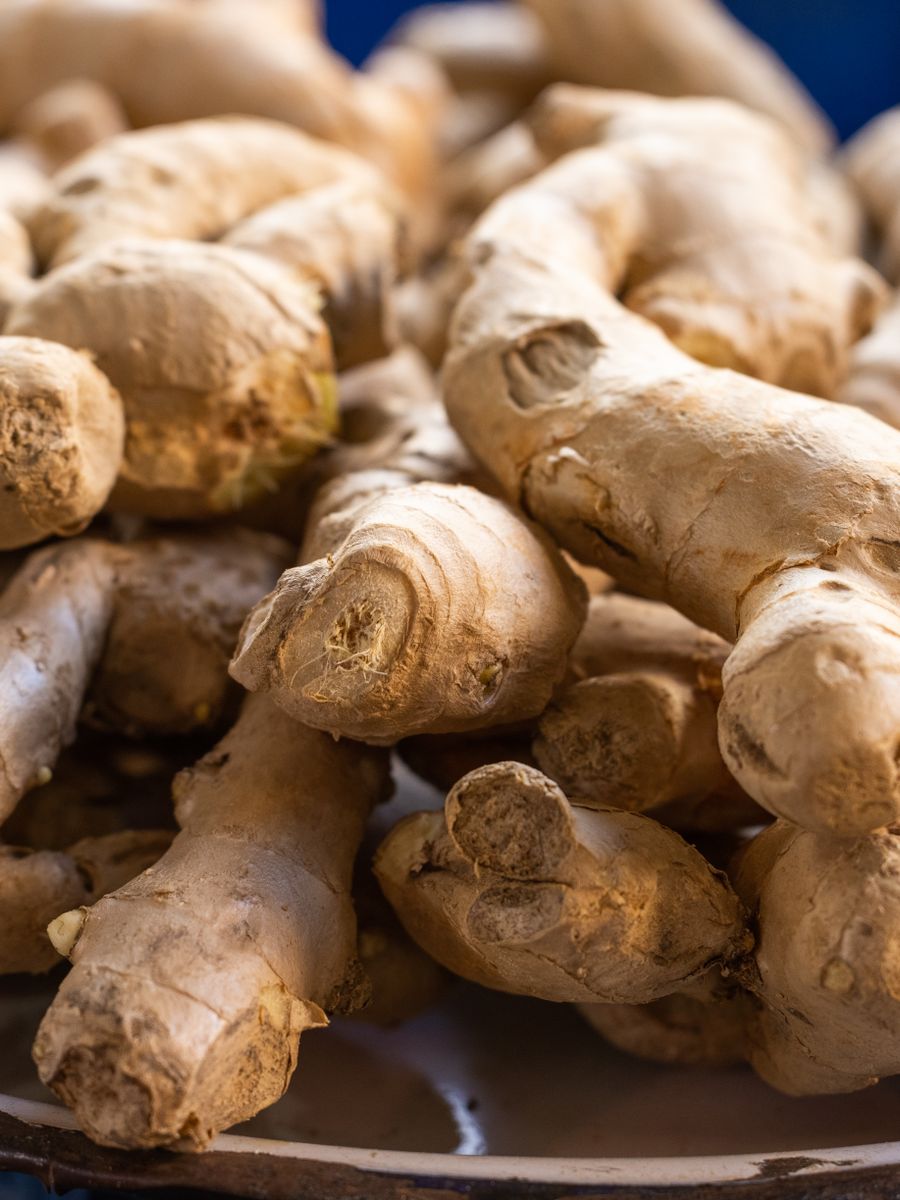
- The dried, mature underground rhizome (whole "hands" / fingers, split, or ground to powder)
- Flavour
- Warm, sharply pungent and woody with citrus-pine top notes; hotter and more penetrating than fresh ginger, with a drier, more concentrated heat
- Key aroma
- Aroma from zingiberene and other sesquiterpenes in the volatile oil; pungency from shogaols (chiefly 6-shogaol), formed when fresh-ginger gingerols dehydrate during drying
- Top grades
- Cochin ginger (light, lemony — the export benchmark) and Calicut ginger (reddish-brown); each traded garbled/ungarbled and bleached(limed)/non-bleached. Assam's "Karbi Anglong Ginger" holds a Geographical Indication
01Overview
What is dry ginger?
Dry ginger is exactly what it sounds like — fresh ginger root, dried. But the drying isn't a passive loss of water; it's a transformation. Fresh ginger is washed, the cork-like skin scraped off, and the rhizome dried in the sun (or in driers) until its moisture falls low enough to store. What remains is a hard, pale, fibrous "hand" of ginger that in Hindi is sonth (or saunth) and in Malayalam and Tamil is chukku (sukku) — the spice at the heart of Ayurvedic kitchens and the South Indian dry-ginger remedies.
The reason dry ginger tastes hotter than fresh isn't your imagination. Fresh ginger's signature pungency comes from a family of compounds called gingerols. As the rhizome dries, gingerols lose water and rearrange into shogaols, which are markedly more pungent — by Scoville-style measures roughly twice as hot — and carry a deeper, more warming character. So drying doesn't just preserve ginger; it concentrates and changes its heat.
We want to be straight about where ginger belongs, because honesty is the whole point of this library. Ginger is not native to the Western Ghats, or to India, or anywhere in the simple sense — it is a cultigen, a plant so long domesticated that it no longer exists in the wild. Its deep roots are in monsoon Asia. What India can claim, truthfully and proudly, is scale and skill: India is the single largest producer of ginger on earth, and Kerala's high ranges — Idukki and Wayanad, the forest country we farm — grow some of the most prized highland chukku in the world.
02History & origin
A spice with no wild home, traded for three thousand years
Ginger's history is a story of cultivation rather than discovery, because there is no wild ginger to discover. It is a true cultigen — a plant known only in domestication — most likely first brought into cultivation by Austronesian peoples of Maritime Southeast Asia and the broader monsoon-Asian world, alongside its relatives turmeric and galangal, and then carried by sea and land across the Indo-Pacific in deep antiquity.
India absorbed ginger early and made it its own. The very name carries that history: English "ginger" descends, through Old English gingifer, Old French gingibre, Latin gingiber and Greek zingiberis, from Sanskrit śṛṅgavera (shringavera) — itself thought to trace to an old Dravidian root behind the Tamil/Malayalam inji-ver ("ginger root"). The word travelled the same routes the spice did.
Ginger was one of the first Asian spices to reach the Mediterranean world. Confucius is recorded eating ginger with his meals in Warring States-era China; by about 150 CE the geographer Ptolemy noted ginger being produced in Ceylon (Sri Lanka), and the Romans imported it heavily. In medieval Europe it became one of the most prized and expensive spices — by one well-known account, in 14th-century England a pound of ginger cost about as much as a whole sheep. Crucially, ginger travelled as the dried rhizome, because dry ginger keeps and ships in a way fresh ginger never could; the dry spice, not the fresh root, built the global ginger trade.
Spanish-era traders carried ginger to the Caribbean and tropical America in the 16th century, where it naturalised into a major export crop — making ginger one of the first Asian spices to be successfully grown in the New World.

03Origin & terroir

India grows the most — and Kerala's high ranges grow the best
Here is the honest AroWest version of the ginger story. We don't claim ginger as a Western Ghats native; nobody truthfully can, because ginger has no wild native range anywhere. What we can claim is the part that actually matters in the cup and the kitchen: India is the world's largest producer of ginger, and the most sought-after highland ginger grows in our hills.
Kerala is the historic home of India's ginger export trade, and the two famous trade types are named for its ports — Cochin ginger and Calicut ginger. Cochin ginger, light-skinned with a clean, lemony note, became the international quality benchmark; Calicut ginger is more reddish-brown. In the high ranges of Idukki and the plateaus of Wayanad, ginger is grown in cool, high-rainfall, well-drained forest soils, often interplanted in the same agroforestry gardens as pepper, cardamom and turmeric — the layered Western Ghats spice garden we work within.
Highland ginger from these tracts is prized for aroma and oil rather than sheer size, and much of Kerala's crop goes to dry ginger (chukku), oil and oleoresin rather than to the fresh-vegetable market. Elsewhere in India the picture is just as place-specific: Assam's "Karbi Anglong Ginger," grown on the Singhason hills by traditional methods, earned a Geographical Indication in 2015 for its low fibre and heady pungency. That is the truthful frame — not a nativity myth, but real terroir: cultivars, altitude, soil and forest climate that make one hill's ginger different from another's.
“Ginger has no wild home anywhere — but the world's biggest crop is Indian, and the prized highland chukku grows in our Western Ghats ranges.”
04Research & trade
Where India researches its ginger
India is the world’s largest ginger producer, and its spice institutes — several in the Western Ghats — breed, grade and protect the crop.
ICAR–Indian Institute of Spices Research (IISR), Kozhikode
India's national institute for spices research, in Kozhikode, Kerala. Ginger is one of its core mandate crops, covering cultivation, improved varieties, crop protection, drying and quality of the dried rhizome.
Spices Board of India
The Ministry of Commerce body (headquartered in Kochi) that regulates, promotes and sets quality standards for Indian spices including ginger, and maintains the official catalogue and GI listings for Indian spices.
Karbi Anglong Ginger — Geographical Indication
India's GI-tagged ginger, registered in 2015 for ginger grown on the Singhason hills of Karbi Anglong, Assam, recognised for its low fibre, strong aroma and pungency.
Kerala Agricultural University (KAU) & AICRP on Spices
KAU and the ICAR All India Coordinated Research Project on Spices develop and evaluate ginger cultivars (including Kerala types like Maran) and best practice for the high-rainfall Western Ghats growing tracts.
Sources: ICAR–IISR (Kozhikode), the Spices Board and Kerala Agricultural University — see references.
05Botany & cultivation
How & where it grows
Zingiber officinale is a herbaceous perennial of the ginger family (Zingiberaceae), the same family as turmeric, cardamom and galangal. It throws up reed-like leafy shoots, often around a metre tall, from a branching underground stem — the rhizome — which is the part we eat and dry.
The rhizome is, botanically, an underground stem rather than a true root: it grows in flattened, knobbly "hands" with finger-like lobes. For dry ginger the rhizome is left to mature fully in the ground (mature ginger is more fibrous and pungent and dries better) before harvest, unlike the young "stem ginger" lifted early for tender fresh use.
Ginger is a wet-tropics crop: it wants warm temperatures, high and well-distributed rainfall, partial shade and rich, friable, free-draining soil. Waterlogging invites rot, which is one reason the sloping, well-drained soils of the Western Ghats highlands suit it so well. It is grown as an annual, planted with the monsoon and lifted roughly eight to ten months later.
Because ginger is a sterile cultigen that rarely sets viable seed, it is propagated vegetatively: small pieces of rhizome, each with a healthy bud ("seed rhizomes" or setts), are planted to raise the next crop. Every ginger plant is, in effect, a clone — which is part of why distinct local cultivars persist so strongly.
For dry ginger, mature rhizomes are harvested, washed and the outer skin scraped off (hand-peeling, not deep cutting, to protect the oil-rich layer just under the skin). The peeled rhizomes are then sun-dried — or dried in mechanical driers — over several days until moisture falls to a safe storage level, shrinking the fresh root to a fraction of its weight as gingerols convert to the more pungent shogaols.
06Cultivation & agronomy
How it's grown
Ginger (Zingiber officinale) for dry ginger is grown as an annual rhizome crop, planted with the monsoon and lifted fully mature 8-10 months later. India is among the world's largest producers, with Kerala (Idukki, Wayanad), Karnataka, Meghalaya, Assam and the wider North-East as leading tracts. Dry ginger needs fully mature, fibre-rich rhizomes, so it is harvested later than ginger grown for the fresh-vegetable market.
Climate & soil
A warm, humid wet-tropics crop, grown from the plains up to about 1,500 m. It prefers roughly 1,500-3,000 mm of well-distributed rainfall (with rain-free spells at planting and again before harvest), partial shade, and temperatures around 25-30 C. It does best in deep, friable, well-drained sandy or red loams rich in organic matter, generally around pH 5.5-6.5; sloping, free-draining land is favoured because waterlogging quickly causes rhizome rot.
Propagation & planting
Ginger rarely sets viable seed, so it is propagated vegetatively from disease-free 'seed rhizomes' (setts) of roughly 20-25 g each, with at least one healthy plump bud. Seed is selected from a known healthy crop, treated as per the local package of practices, and often sprouted in shade before planting; seed rate is commonly on the order of 1,500-1,800 kg/ha depending on spacing and sett size.
Crop calendar
Land prep & planting (Apr-May, pre-monsoon)
Soil is ploughed to a fine tilth and raised beds or ridges-and-furrows are formed for drainage. Setts are planted with the first pre-monsoon showers, about 4-5 cm deep, and covered with a thick mulch of green leaves or straw.
Sprouting & establishment (1-2 months)
Sprouts typically emerge within a few weeks of adequate moisture. Early shade and a second mulching protect the young crop; gap-filling and first weeding/earthing-up are done in this phase.
Active tillering & rhizome bulking (3-6 months)
Leafy shoots multiply and the rhizome begins branching underground through the main monsoon. This is the peak demand period for nutrients, moisture and weed-free, well-drained beds.
Rhizome maturation (6-8 months)
Rhizome growth completes and fibre and pungency build. Irrigation is gradually withdrawn so the crop can mature and dry down; for dry ginger this full maturity is essential.
Harvest (8-10 months, Dec-Feb)
Lifted when leaves turn yellow and dry. Clumps are dug carefully, rhizomes cleaned, and for dry ginger the skin is hand-scraped before soaking and sun- or drier-drying to a hard, storable spice.
In the field
- Spacing & beds: Plant on raised beds (about 1 m wide) or ridges with roughly 20-25 cm between plants and 20-30 cm between rows; good drainage on beds or slopes is the single most important defence against rhizome rot.
- Mulching: Mulch heavily with green leaves or straw at planting and again at 6-8 weeks (commonly applied in splits). Mulch conserves moisture, smothers weeds, moderates soil temperature and adds organic matter as it decomposes.
- Shade & intercropping: Ginger tolerates partial shade and is often grown as an intercrop in coconut, areca or young plantation gardens, or with a light shade cover such as pigeonpea/maize, which suits Western Ghats agroforestry.
- Weeding & earthing-up: Keep beds weed-free with 2-3 hand weedings; earth up around the clumps at weeding to cover exposed rhizomes, improve drainage and encourage rhizome development.
- Irrigation & drainage: In rainfed tracts the crop runs on the monsoon; where irrigated, keep soil moist but never waterlogged and provide channels to drain excess rain. Withhold water before harvest to aid maturity and drying.
- Crop rotation & clean seed: Rotate ginger (avoid back-to-back ginger or repeating after other rot-prone crops) and always plant healthy, well-selected seed setts to help break the soft-rot and bacterial-wilt cycle.
07Variety guide
Every variety, in depth
India grows dry ginger across regions from Kerala's monsoon tropics to Meghalaya's cloud forests, with varieties ranging from released ICAR cultivars bred for yield and oil content to landrace types named after their localities—each with distinct flavor, fiber, and disease profiles that shape both farmer returns and global export quality. The varieties below span botanical classifications (Zingiber officinale and the rare Zingiber rubens), formal releases from IISR and state universities, and traditional cultivars that growers and traders still prize for their regional character.
IISR MahimaAccession 117
Released varietyIndian Institute of Spices Research, Calicut · ICAR-IISR · 2001
Bold rhizomes, moderate essential oil (1.72%), oleoresin (4.48%), low fiber (3.26%). Mature in 200 days. Resistant to root-knot nematode.
Full detailsIISR RejathaAccession 35
Released varietyIndian Institute of Spices Research, Calicut · ICAR-IISR · 2001
Medium-duration, bold cultivar rich in essential oil (2.36%) and oleoresin (6.34%); low fiber (4.0%). Superior flavor and pungency for value-added products.
Full detailsIISR VaradaIISR-Varada
Released varietyIndian Institute of Spices Research, Calicut · ICAR-IISR · 1996
Good quality, high-yielding with plumpy rhizomes, flattened fingers, medium reddish-brown scales. Low fiber content (3.29–4.5%), tolerant to diseases. Less prone to storage insect damage.
Full detailsIISR VajraIISR Vajra ginger
Released varietyIndian Institute of Spices Research, Calicut · ICAR-IISR
Bold and plumpy rhizomes, medium fiber (5.67%), highest yield potential among commercial varieties. Essential oil 2.15%, oleoresin 7.26%. Yellow core, high zingiberene content (29.83%) for desired flavor. Ideal for vegetable use and value-added products.
Full detailsIISR SurasaIISR Surasa non-pungent ginger
Released varietyIndian Institute of Spices Research, Calicut · ICAR-IISR (selection from farmer John Joseph, Kodancherry, Kozhikode) · 2024
India's first non-pungent ginger cultivar for vegetable market. Creamy golden center, plump robust rhizomes, low fiber (21% dry recovery). Suitable for fresh sliced ginger, candy, jams, desserts, and dry ginger when needed.
Full detailsMaranMaran cultivar, Moran Ada (Assam variant)
Traditional cultivarIndigenous to Kerala; documented also as local variant in Assam (Moran Ada, particularly Golaghat district) · Farmer selection/local landrace
High dry ginger suitability, pungent with high flavor, less fibrous. Ideal for oil and oleoresin extraction. Assam's Moran Ada notable for exceptionally high gingerol (27% in oleoresin), high oil content (≥2.80%), and oleoresin (≥10%). Zingiberene content ≥33.4%.
Full detailsWayanad (Wynad Local)Wayanad cultivar, Wynad Local
Traditional cultivarWayanad district, Kerala · Farmer selection/local landrace
Suited for green/fresh ginger market. Excellent culinary value. Associated with quality Kerala export ginger.
Full detailsKuruppampadiKuruppampadi, Kurumpampadi
Traditional cultivarIndigenous to Kerala, likely Kuruppampadi locality · Farmer selection/local landrace
Preferred for dry ginger production. Local Kerala cultivar with recognized quality characteristics.
Full detailsNadiaNadia cultivar, Nadia ginger
Regional typeNadia district, West Bengal · Farmer selection/local cultivar; widely adopted across Northeast India
High-yielding variety widely grown in northeastern India. Smooth light brownish skin, pale-yellow flesh. Moderately pungent with 8-10% gingerol content. Can be used fresh or dry. Resistance to leaf spot noted.
Full detailsHimgiriHimgiri cultivar, HP 05/15 (improved variant)
CultivarHimachal Pradesh / Himalayan region · ICAR / Himachal Pradesh agricultural program
Best for green ginger. Less susceptible to rhizome rot disease. Suitable for rain-fed conditions in Himalayan zones. HP 05/15 variant shows low bacterial wilt incidence (18.10%) and is top performer in organic farming systems.
Full detailsSuprabhaSuprabha cultivar, Suprabha ginger
Traditional cultivarOdisha (developed and tested across 9 agro-climatic zones) · Farmer selection / Odisha research
Superior performance across North Eastern Coastal Plain, East and South Eastern Coastal Plain, Western Central Table Land, and Mid Central Table Land regions of Odisha. High rhizome yield with good essential oil and low fiber. Excellent benefit-cost ratio (6.51).
Full detailsIng MakhirSying Makhir, Sying Traw, Ing Traw, Zingiber rubens (botanical), Meghalaya ginger
Botanical typeMeghalaya (Khasi and Garo Hills); particularly Jaintia Hills district and Assam-Meghalaya border (Sahsniang, Khatkasla villages) · Indigenous tribal communities (farmer-maintained landrace for centuries)
Rare heirloom of distinct species (Zingiber rubens, not Z. officinale) with exceptionally high gingerol content (roughly 2-3× standard varieties) and zingiberene (aromatic compound, ≥33.4%). Organically cultivated at 600-1,500 m elevation under forest canopy. GI-tagged variety. Superior pungency, robust aromatic profile. Hand-harvested, sun-dried, stone-ground traditional processing. High phenolic, flavonoid, tannin, and alkaloid content with strong antioxidant properties.
Full detailsRio-de-JaneiroRio, RdJ ginger
Botanical typeIntroduced from Brazil; now cultivated in multiple Indian states · Non-Indian origin; adopted by Indian farmers
Exotic high-yielding variety with bold rhizome, buff-colored skin, pungent with high flavor, less fibrous. Shoot borer tolerance. Dry recovery 16-18%, fiber 5.19%. Essential oil 2.31%, oleoresin 9.06% (among highest recorded). Very popular with Indian growers for yield superiority.
Full detailsCochin Ginger / Calicut GingerCochin trade type, Calicut trade type, Kerala dry ginger
Trade classificationKerala (Cochin and Calicut regions); historical spice-trade designations · Traditional cultivation and selection across Kerala
Cochin: light yellow color, delicate odor, lemon-like aroma, low fiber, best-known in international market. Calicut: reddish-brown, also delicate, lemon-like flavor, geographically variant. Both washed and dried for export. Traditional processing. Premium quality ginger with extensive global demand.
Full details08Pests, diseases & disorders
What can go wrong
Ginger's biggest threats live in the soil and ride in on infected seed: soft rot and bacterial wilt can wipe out beds in waterlogged conditions. An IPM approach built on clean seed, drainage, rotation and biocontrol prevents far more loss than spraying ever will.
Soft rot (rhizome rot / Pythium)
DiseaseSigns: Lower leaves yellow and droop, shoots collapse, and the rhizome turns soft, watery and foul-smelling; worst in waterlogged, poorly drained beds during heavy monsoon.
Manage: Plant healthy seed on well-drained raised beds, avoid waterlogging, rotate crops, and treat seed and soil with bio-agents such as Trichoderma; rogue out and destroy affected clumps and apply a recommended/registered product as per the local package of practices only where needed.
Bacterial wilt
DiseaseSigns: Sudden wilting of green leaves (often curling and bronzing first), water-soaked stem base, and a milky bacterial ooze when a cut stem is held in water; spreads fast in warm, wet soil.
Manage: Use disease-free seed from a clean source, keep strict field sanitation and drainage, rotate away from ginger and other host crops, remove and destroy infected plants with surrounding soil, and avoid moving soil or water from infected patches; manage as per the local package of practices.
Shoot borer
PestSigns: Caterpillar bores into pseudostems; the central shoot dries to a 'dead heart' with bore holes and frass, and tillers are lost during the active growing months.
Manage: Cut and destroy bored shoots, conserve natural parasitoids, and use light/pheromone monitoring; spray a recommended/registered product as per the local package of practices only at threshold during peak borer activity.
Root-knot & burrowing nematodes
PestSigns: Stunted, yellowing patches, galls or lesions on roots and rhizomes, and poor bulking; often a hidden cause of declining yields on repeatedly cropped land.
Manage: Plant nematode-free seed and tolerant varieties (e.g. IISR Mahima), rotate crops, add organic matter and apply bio-agents such as Pochonia/Trichoderma and neem cake; solarise nursery soil where feasible and follow the local package of practices.
Leaf spot (Phyllosticta)
DiseaseSigns: Small water-soaked spots on leaves that enlarge to oval lesions with pale centres and dark margins, reducing photosynthesis in humid, shaded, crowded stands.
Manage: Improve air movement and avoid excess shade and overcrowding, remove affected leaves, balance nutrition, and use a recommended/registered fungicide as per the local package of practices only if it spreads.
Storage rhizome rot & shrivelling
DisorderSigns: Harvested or seed rhizomes rot, mould or shrivel in storage due to wounds, high moisture or poor curing before storage.
Manage: Harvest mature rhizomes carefully to avoid bruising, cure and dry properly, store clean, well-dried rhizomes in cool, dry, ventilated conditions, and treat seed rhizome as per the local package of practices before storing for the next season.
09Soil & fertiliser
Feeding the plant
Ginger is a heavy feeder grown on a big base of organic matter, with nutrients best given in splits across the long growing season. Use the ranges below as a guide and confirm rates with a soil test, since requirements vary with soil type, organic inputs and yield target.
| Stage | Inputs | Notes |
|---|---|---|
| Basal (at planting) | Well-rotted FYM or compost (commonly in the range of about 25-30 t/ha) worked into beds, plus a basal dose of phosphorus and part of the potassium; neem cake is often added. | Organic matter is the foundation of a ginger crop: it feeds the rhizome, improves drainage and aeration, and supports soil biology against rot. |
| First top-dress (~40-60 days, early growth) | A portion of nitrogen with some potassium, applied at first weeding and combined with earthing-up. | Drives early tillering and leaf growth; place fertiliser near plants and cover with soil/mulch when earthing up. |
| Second top-dress (~90-120 days, active bulking) | The remaining nitrogen and potassium during peak rhizome bulking, again with earthing-up. | Potassium is important for rhizome filling and quality, so do not neglect K in the later split. |
| Late season (maturation) | Generally no further nitrogen; allow the crop to mature and dry down. | Late nitrogen delays maturity and can soften rhizomes, so taper feeding as the crop heads toward harvest. |
Common deficiencies & issues
- Nitrogen deficiency: Older leaves pale and yellow uniformly, with thin, weak tillering and stunted growth; correct with split N and adequate organic matter.
- Potassium deficiency: Leaf margins scorch and brown (especially on older leaves) and rhizome filling is poor; ensure K in the later top-dressings.
- Low organic matter / poor drainage: Crusted, compact soil leads to weak bulking and higher rot risk; build organic matter with FYM, compost and mulch and improve bed drainage.
- Micronutrient issues (e.g. zinc): Interveinal yellowing or stunted new growth can appear on deficient soils; address only on the basis of a soil/leaf test rather than blanket application.
10Grades & quality
The grades, decoded
Dry ginger isn't graded by a single international point system the way clove is. In the Indian trade it's classified by trade type (Cochin vs Calicut, the two Malabar types that built the export market), by whether it's been "garbled" (cleaned and sorted) or ungarbled, and by whether it's "bleached" (limed/whitened) or left natural. Quality within a lot is judged by appearance, volatile-oil content, fibre, pungency and aroma.
| Grade | Name | What it means |
|---|---|---|
| Cochin | Cochin ginger (NGC / NUGC) | The export benchmark: light brown to yellowish-grey skin, delicate lemon-like aroma and clean pungency. Traded garbled (NGC) or ungarbled (NUGC). Generally rated the finer of the two Malabar types. |
| Calicut | Calicut ginger (NGK / NUGK) | Orange to reddish-brown rhizomes with a strong aroma; traded garbled (NGK) or ungarbled (NUGK). Generally considered slightly inferior to Cochin, and limed/bleached Calicut is a major Middle East export. |
| Bleached | Bleached / limed ginger (BGC, BGK…) | Rhizomes coated or dipped in lime (calcium) to give a pale, uniform white finish for markets that prefer it. Cosmetic, not a quality upgrade — non-bleached ginger keeps more of its natural character. |
| Garbled | Garbled vs ungarbled | "Garbled" ginger has been cleaned, scraped and sorted to remove dirt, fibre and undersized pieces; "ungarbled" is the rougher, unsorted lot. Garbling raises grade and price. |
| GI | Karbi Anglong Ginger (Assam) | A Geographical Indication ginger (registered 2015) from the Singhason hills of Assam, prized for low fibre and intense aroma and pungency — a place-specific premium ginger rather than a Malabar trade type. |
For dry ginger, the things that actually separate a good lot from a poor one are oil and fibre, not whiteness. Look for hard, heavy, oil-rich rhizomes with strong aroma when snapped, and be wary of bleached (limed) ginger that has been whitened cosmetically — the lime is for looks, not for the kitchen. We value Cochin-type, non-bleached, well-dried ginger with full aroma over a pale, pretty, lower-oil lot.

11Flavour & chemistry
What gives it that aroma
Dry ginger tastes the way fresh ginger does, but turned up and warmed through: sharply pungent and woody, with citrus-pine top notes and a dry, penetrating heat that builds rather than flashes. It's hotter and deeper than fresh ginger, with less of fresh ginger's bright juiciness and more of a roasted warmth.
The aroma and the pungency come from two different chemistries. The smell is the volatile (essential) oil — rich in sesquiterpenes, especially zingiberene, with notes from compounds like β-sesquiphellandrene and citral-type aldehydes giving the lemony lift. The heat is non-volatile: the gingerols and, in dried ginger, the shogaols.
The headline change in drying is gingerol → shogaol. Fresh ginger's pungency is dominated by 6-gingerol; when the rhizome is dried (and especially heated), gingerols lose a water molecule and rearrange into shogaols, chiefly 6-shogaol. Shogaols are substantially more pungent than gingerols — by Scoville-style measures roughly twice as hot — and have a sharper, more warming bite. This is the real reason dry ginger packs a hotter, more concentrated punch than the same weight of fresh.
Because the heat is concentrated and the aroma oil is volatile, dry ginger powder is potent but fades: the pungency keeps far longer than the fresh aroma, so old ginger powder can still taste hot while smelling flat. A little goes a long way, and the freshest powder is the most fragrant.
12Culinary uses
How to cook with it
Dry ginger and fresh ginger are not interchangeable spoon-for-spoon — dry is more pungent and concentrated, with a different, warmer profile, so you use far less. It shines where you want ginger's warmth baked or simmered in rather than its fresh, raw zing: spice blends, baking, slow drinks and South Indian remedies.
- Masala & spice blends: Ground dry ginger (sonth) is a building block of garam masala, chai masala, curry powders and pickling spice, where its dry, warm heat carries through long cooking better than fresh ginger would.
- Chukku kappi & spiced coffee: In Kerala, chukku kappi — dry-ginger coffee, often with pepper, coriander, cumin, tulsi and jaggery — is the classic comforting drink for a cold or a rainy day. Dry ginger is the backbone of it.
- Kashayam & warming tonics: Dry ginger is central to South Indian kashayams (herbal decoctions) like chukku-malli (dry ginger and coriander) — simmered with jaggery and spices as a traditional cold-and-digestion brew.
- Baking & desserts: Ground ginger is the defining spice of gingerbread, ginger biscuits, parkin and spice cakes, pairing with cinnamon, clove and molasses; its dry heat is exactly what those bakes want.
- Drinks & infusions: Dry ginger flavours ginger tea, masala chai, mulled drinks, ginger wine and traditional ginger ale and beer, where it steeps cleanly without the pulp of fresh root.
- Dals, soups & marinades: A pinch of sonth lifts dals, lentil soups, rasam and marinades with warm pungency — used sparingly, since it's hotter than fresh ginger.
Dry ginger loves warm, sweet company: cinnamon, clove, cardamom, nutmeg, black pepper and coriander on the spice side; jaggery, molasses, honey, lemon, orange and apple on the sweet side. In savoury cooking it sits naturally with cumin, fenugreek, turmeric, garlic and onion. Treat it as a concentrated warming note you build around — start with less than you'd use of fresh ginger.
13Consumption & dosage
How much, how often
Dry ginger (sonth/chukku) is more pungent and concentrated than fresh, so a little goes a long way. It shines where you want ginger's warmth baked or simmered in rather than fresh raw zing.
- Everyday culinary amount: A pinch to about a quarter-teaspoon of ground dry ginger seasons a dish; as a rough swap, use roughly a quarter-teaspoon of dry in place of a tablespoon of grated fresh ginger.
- Spice blends & masalas: Ground sonth is a building block of garam masala, chai masala, curry and pickling blends, where its dry warm heat carries through long cooking.
- Warming drinks & kashayams: Crushed whole chukku is simmered into chukku kappi (dry-ginger coffee) and South Indian kashayams like chukku-malli with jaggery and spices, classic rainy-season comfort brews.
- Baking & desserts: Ground ginger is a defining spice of gingerbread, ginger biscuits and spice cakes, pairing with cinnamon, clove and molasses.
- Who should go easy: Those prone to heartburn or acidity, people on blood-thinning or diabetes medication, and anyone before surgery should keep to modest culinary amounts and check with a clinician before using ginger in larger therapeutic doses.
14Health & wellness
What the evidence says
The strongest themes in the research are below. Many studies use concentrated extracts, and the evidence is still developing.
- Nausea & vomiting — its best-supported use: Ginger is one of the better-evidenced food remedies for nausea. Systematic reviews and meta-analyses report that ginger significantly reduces pregnancy-related nausea versus placebo, and an overview of systematic reviews supports a benefit for several types of nausea and vomiting. For chemotherapy-induced nausea, evidence is more mixed but several trials suggest benefit, generally at doses up to about 1 g/day.
- Motion sickness & post-operative nausea: Ginger has been studied for motion sickness, sea-sickness and post-operative nausea, with a number of trials reporting benefit. The proposed mechanism is local action in the gut — ginger increases gastric emptying and gastro-duodenal motility — rather than acting on the brain like conventional anti-emetics.
- Digestive support (deepana–pachana): Ayurveda calls dry ginger vishwabheshaja, the "universal medicine," and classes it as deepana–pachana (kindling appetite and aiding digestion). Modern data on improved gastric motility give this traditional digestive role a plausible basis, though robust clinical trials for everyday indigestion are limited.
- Anti-inflammatory & antioxidant activity: Gingerols and shogaols are antioxidant and anti-inflammatory in laboratory and animal studies, and some trials suggest ginger may modestly ease menstrual pain and osteoarthritis discomfort. The human evidence is promising but not yet definitive, and effects are generally modest.
- A concentrated dietary source of ginger compounds: Because drying converts gingerols into more potent shogaols, dry ginger is a concentrated source of these bioactive compounds. That said, most clinical studies use standardised ginger extracts or measured grams, not the pinch you cook with — so treat culinary dry ginger as a flavourful, warming spice rather than a medicine.
15Nutrition
By the numbers
Per 100 g, ground dry ginger looks strikingly nutrient-dense — but that frame is a little misleading, because nobody eats 100 g of it; a teaspoon of ground ginger is only about 2 g. The standout is manganese, with meaningful iron, magnesium, potassium and copper, plus good fibre. Values below are from USDA FoodData Central for "Spices, ginger, ground" (FDC 170926), per 100 g.
| Nutrient | Per 100 g |
|---|---|
| Energy | 335 kcal |
| Protein | 8.98 g |
| Total fat | 4.24 g |
| Carbohydrate | 71.6 g |
| Dietary fibre | 14.1 g |
| Total sugars | 3.39 g |
| Calcium | 114 mg |
| Iron | 19.8 mg |
| Magnesium | 214 mg |
| Phosphorus | 168 mg |
| Potassium | 1320 mg |
| Sodium | 27 mg |
| Zinc | 3.64 mg |
| Copper | 0.48 mg |
| Manganese | 33.3 mg |
| Vitamin C | 0.7 mg |
| Vitamin B6 | 0.626 mg |
Values are approximate and vary by sample; source: USDA FoodData Central.
16Myths vs facts
Setting the record straight
Myth: Bleached (white-limed) dry ginger is higher quality.
Fact: Bleaching is just a lime (calcium) coating that whitens ginger for markets that like a pale look; it is cosmetic, not a quality upgrade. Non-bleached ginger keeps more of its natural character, so judge dry ginger by aroma, oil and hardness, not whiteness.
Myth: Dry ginger and fresh ginger can be swapped spoon-for-spoon.
Fact: They are not interchangeable. Drying shifts ginger's pungent compounds (gingerols towards shogaols), giving dry ginger a deeper, warmer, more concentrated heat, so you use far less of it (about a quarter-teaspoon dry for a tablespoon of fresh).
Myth: More nitrogen fertiliser always means a bigger ginger crop.
Fact: Overdoing nitrogen, especially late in the season, tends to produce lush leaf but soft, late-maturing rhizomes and poorer dry-ginger quality. Ginger responds far more to organic matter, balanced potassium and good drainage than to extra N.
Myth: Ginger can be grown back-to-back on the same plot every year.
Fact: Continuous ginger tends to build up soft rot, bacterial wilt and nematodes in the soil. Rotation, clean seed and good drainage are key to breaking the disease cycle; replanting ginger on infected ground invites collapse.
Myth: Ginger is native to India.
Fact: Ginger is an ancient cultigen not known in the truly wild state; it is generally thought to have been domesticated in monsoon/Maritime Asia and carried into India in antiquity. What India can honestly claim is being among the world's largest producers, with prized highland chukku from Kerala's hills.
Myth: Dry ginger cures colds and flu.
Fact: Dry ginger (chukku) is traditionally used as a warming, supportive home remedy, and some studies suggest its compounds may have anti-inflammatory activity, but it is not a proven cure. Studies suggest ginger may help with nausea; treat it as a comforting spice rather than a medicine, and seek medical advice for illness.
17In your kitchen
How to choose, use & store
Choose
Choose dry ginger by oil and aroma, not by how white it is. Good whole dry ginger feels hard, heavy and dense, snaps rather than bends, and releases a strong, warm, lemony-pungent smell when broken. Non-bleached, Cochin-type ginger keeps more of its natural character than cosmetically limed (bleached) ginger, where the pale colour comes from a lime coating rather than quality. If buying powder, buy from a fast-moving source in small amounts and trust your nose — fragrant powder is fresh powder.
Use
Remember dry ginger is hotter and more concentrated than fresh, so use less — a rough rule is about a quarter-teaspoon of ground dry ginger for a tablespoon of grated fresh. Add ground ginger early enough to bloom in fat or liquid in curries, bakes and blends, where its warm heat infuses through cooking. For chukku kappi, kashayams and ginger teas, simmer crushed whole dry ginger (and other spices) gently to draw out both oil and pungency. Toast lightly only if a recipe asks — over-toasting turns it bitter.
Store
Store whole dry ginger in an airtight container away from heat, light and moisture, and it will hold for a year or more — whole keeps far better than powder. Grind small amounts as you need them, because ground ginger loses its fragrant volatile oil within months even while it stays hot. When the warm, lemony smell fades to flat, the aroma oil is gone and it's time to refresh, even if the heat lingers.
18FAQ
Frequently asked questions
What is dry ginger?
Dry ginger is the mature rhizome of Zingiber officinale that has been washed, scraped and dried until hard and storable. In India it's called sonth or saunth (Hindi) and chukku or sukku (Malayalam/Tamil). It's more pungent and concentrated than fresh ginger and is the form used for ginger powder, spice blends and traditional remedies.
Why is dry ginger hotter than fresh ginger?
Because of a chemical change during drying. Fresh ginger's pungency comes from gingerols; as the rhizome dries (and especially when heated), gingerols lose water and rearrange into shogaols, chiefly 6-shogaol. Shogaols are roughly twice as pungent as gingerols, so dry ginger delivers a hotter, deeper, more warming heat than the same weight of fresh.
Is ginger native to India or the Western Ghats?
Not in the literal sense. Ginger is a true cultigen — a plant so long domesticated that it no longer exists in the wild — first cultivated in monsoon/Maritime Asia and carried into India in deep antiquity. We're upfront about that. What India can honestly claim is being the world's largest producer, with prized highland ginger grown in Kerala's Idukki and Wayanad — the Western Ghats country we farm.
What does India contribute to ginger if it isn't native?
Scale and quality. India is the largest ginger producer in the world, around 45% of global output. Kerala's ports gave their names to the two famous trade types, Cochin and Calicut ginger, and Assam's Karbi Anglong Ginger holds a Geographical Indication. The story is real terroir — cultivars, altitude and climate — not a nativity myth.
What are sonth and chukku?
They're regional names for dry ginger. Sonth (or saunth) is Hindi; chukku (sukku) is Malayalam and Tamil. In Sanskrit and Ayurveda it's shunthi or nagara, and it's honoured as vishwabheshaja, the "universal medicine." Chukku is the dry ginger at the heart of Kerala's chukku kappi (dry-ginger coffee) and kashayams (herbal decoctions).
What's the difference between Cochin and Calicut ginger?
They're the two classic Malabar trade types. Cochin ginger is lighter-skinned with a clean, lemony aroma and is generally rated the finer, the export benchmark. Calicut ginger is more reddish-brown and a touch coarser. Both are traded garbled (cleaned/sorted) or ungarbled, and bleached (limed white) or non-bleached.
Should I buy bleached or non-bleached dry ginger?
Non-bleached, generally. "Bleaching" is a lime (calcium) coating that whitens ginger for markets that prefer a pale, uniform look — it's cosmetic, not a quality upgrade. Non-bleached ginger keeps more of its natural character. Judge dry ginger by aroma and oil, not by whiteness: it should be hard, heavy and strongly fragrant when snapped.
Does ginger really help with nausea?
This is ginger's best-supported health use. Systematic reviews and meta-analyses find ginger significantly reduces pregnancy-related nausea versus placebo, and it's been studied with benefit for motion sickness and post-operative nausea; chemotherapy evidence is more mixed. The likely mechanism is in the gut — ginger speeds gastric emptying and motility. This is general information, not medical advice — confirm dose with a clinician, especially in pregnancy.
How much dry ginger should I use instead of fresh?
Far less — dry ginger is more pungent and concentrated. A rough rule is about a quarter-teaspoon of ground dry ginger in place of a tablespoon of grated fresh. They aren't truly interchangeable, though: dry ginger gives a warmer, baked-in heat, while fresh gives a brighter, juicier zing, so use each where it suits.
Is dry ginger good for a cold?
In South Indian and Ayurvedic tradition, dry ginger (chukku) is the classic cold-and-digestion remedy — simmered into chukku kappi or chukku-malli kashayam with pepper, coriander and jaggery. Ginger's warming, anti-inflammatory compounds give this a plausible basis, but it's traditional supportive use, not a proven cure. None of this is medical advice.
What nutrients are in dry ginger?
Per 100 g, USDA data show ground ginger is rich in manganese (about 33 mg), with meaningful iron, magnesium, potassium and copper plus good fibre. But a teaspoon is only about 2 g, so in practice you get flavour and warmth, not large nutrient amounts. Treat it as a beneficial seasoning rather than a supplement.
How should I store dry ginger?
Keep whole dry ginger in an airtight container away from heat, light and moisture, and it holds for a year or more. Grind only what you'll use soon — ground ginger loses its fragrant volatile oil within months even though its heat lingers. When the warm, lemony smell goes flat, it's time to replace it.
Is dry ginger the same plant as turmeric and cardamom?
They're close relatives. Ginger, turmeric, cardamom and galangal all belong to the ginger family, Zingiberaceae. Ginger and turmeric are both prized for their rhizomes, while cardamom is grown for its seed pods. In a Western Ghats spice garden you'll often find ginger, turmeric, cardamom and pepper grown together.
How long does ginger take to mature for dry ginger, and what yield can I expect?
Ginger for dry ginger is lifted fully mature, about 8-10 months after planting, when the leaves yellow and dry down. Fresh yields commonly run around 15-25 t/ha with good management; because dry ginger is only about 16-25% of fresh weight, expect roughly 3-5 t/ha of dry ginger. There is one harvest per year and no ratoon, so a fresh crop is planted each season.
What is the best way to prevent soft rot and rhizome rot in my ginger crop?
Prevention beats cure. Plant healthy, well-selected seed rhizomes on well-drained raised beds or slopes, never let the crop waterlog, rotate so ginger does not follow ginger, and treat seed and soil with bio-agents like Trichoderma. Rogue out and destroy any rotting clumps early, and use a recommended/registered product only as per your local package of practices.
Which ginger variety should I plant if I want to sell dry ginger?
Choose types with high dry-recovery and good aroma/oleoresin rather than maximum fresh tonnage. Landraces like Maran (Moran) are classic dry-ginger types, while ICAR-IISR improved selections (such as Varada, Rejatha for high oil, or Mahima for nematode tolerance) suit different conditions. Whatever you pick, start with clean, true-to-type, disease-free seed rhizome.
Sources & further reading
- Ginger — Wikipedia (cultigen status, Austronesian domestication, etymology, history, production rankings, botany) en.wikipedia.org
- Zingiber officinale Roscoe — Plants of the World Online, Kew Science (taxonomy, distribution, cultivated not wild) powo.science.kew.org
- Ginger | Spices Board of India — spice catalogue (ginger as an Indian export spice; fresh, dry, oil and oleoresin forms) indianspices.com
- Ginger — ICAR–Indian Institute of Spices Research, Kozhikode (ginger as a mandate crop: varieties, cultivation, quality) spices.res.in
- Heat-induced conversion of gingerols to shogaols (drying chemistry; 6-gingerol dehydrates to more pungent 6-shogaol) foodengprog.org
- Quality of dry ginger (Zingiber officinale) by different drying methods — PMC4571220 pmc.ncbi.nlm.nih.gov
- A systematic review and meta-analysis of the effect and safety of ginger in pregnancy-associated nausea and vomiting — PMC3995184 pmc.ncbi.nlm.nih.gov
- Ginger for treating nausea and vomiting: an overview of systematic reviews and meta-analyses — PubMed 38072785 pubmed.ncbi.nlm.nih.gov
- Does the oral administration of ginger reduce chemotherapy-induced nausea and vomiting? Meta-analysis of 10 RCTs — PubMed 30299420 pubmed.ncbi.nlm.nih.gov
- Spices, ginger, ground — USDA FoodData Central (FDC 170926), nutrition per 100 g fdc.nal.usda.gov
- Assam Karbi Anglong Ginger — Vikaspedia (GI registration 2015, Singhason hills, low fibre, pungency) en.vikaspedia.in
- Ginger (Zingiber officinale): Aromatic Spice and Medicinal Herb — University of Reading, Tropical Biodiversity blog blogs.reading.ac.uk
Last reviewed: 23 June 2026 · Written by the AroWest editorial team (Western Crest Ventures LLP). Educational content, not medical advice.