
Quick facts
- Botanical name
- Curcuma longa L.
- Family
- Zingiberaceae (the ginger family)
- Also known as
- Haldi (Hindi), Manjal (Malayalam & Tamil), Haridra (Sanskrit), Indian saffron, the golden spice; food colour E100
- Native to
- A sterile ancient cultigen with no wild population — a human-bred cultivar, most likely derived from wild Curcuma species of South/Southeast Asia; India is its centre of diversity and cultivation
- Heartland
- India grows ~75–80% of the world crop; key centres are Erode (Tamil Nadu), Nizamabad (Telangana), Sangli (Maharashtra) and Lakadong (Meghalaya)
- Part used
- The underground rhizome — boiled (cured), dried and ground to the golden powder
- Flavour
- Warm, earthy and faintly bitter with a peppery, musky-woody edge and a mild ginger kinship
- Key aroma
- Curcuminoids give the colour; turmerones and ar-turmerone, plus zingiberene and germacrone in the essential oil, give the aroma
- Top grades
- Lakadong (very high curcumin) and Erode 'finger' turmeric lead India's named grades; sold as fingers vs bulbs and by curcumin content
01Overview
What is turmeric?
Turmeric is the dried, ground rhizome of Curcuma longa, a perennial herb in the ginger family, Zingiberaceae. It is one of the most-used spices on earth and, for India, something closer to a cultural constant — the pigment in our food, the paste on a bride's skin, the antiseptic our grandmothers reached for first. The English word likely comes through Middle English forms, possibly from the Latin terra merita ('deserved earth'); to us it has always simply been manjal or haldi.
What makes turmeric genuinely remarkable is that it is a plant that cannot exist without people. Curcuma longa is sterile: it produces no viable seed, and is thought to have arisen long ago as a cultivated selection of a hybrid between wild turmeric (Curcuma aromatica) and related species, propagated ever since by replanting pieces of the rhizome. That makes it an ancient cultigen — a living artefact of thousands of years of human agriculture, with India as its centre of diversity. The whole golden colour of the spice comes from a family of compounds called curcuminoids, of which curcumin is the star, and that single molecule is now the subject of a vast wave of modern research.
02History & origin
Manjal across millennia: from Ayurveda to the world's kitchens
Turmeric has been used in India for at least 2,500 years, and the archaeological trail runs even deeper: residues identified as turmeric have been recovered at Farmana in the Indus region, dated to roughly 2600–2200 BCE. It is woven through the classical Indian medical traditions — a major drug in Ayurveda and Siddha, known in Sanskrit as Haridra — and through ritual life, where its auspicious yellow marks weddings, temples and festivals across the subcontinent.
From India the rhizome spread along ancient trade routes into China, Southeast Asia, the Middle East and East Africa, and turmeric residues have been reported from a merchant's tomb at Megiddo in the Levant dated to the second millennium BCE. Because the plant is sterile and can only be moved as a living rhizome, every one of those journeys was carried out deliberately by human hands — turmeric travelled the world the way people did, by being packed and replanted.
For most of that long history turmeric was prized as a dye, a medicine and a food colour as much as a flavour — 'Indian saffron' to traders who wanted its gold without saffron's price. Its modern second life began when chemists isolated curcumin and, in recent decades, turned a thousand laboratory lights on it. Today turmeric is both the oldest of Indian household remedies and one of the most-studied natural compounds in the world.

03Origin & terroir

Truly from here — a plant grown into being
We are usually careful, on these pages, to separate where a spice is grown from where it was born. Turmeric makes this honest in an unusual way: it has no birthplace to point to, because it has no wild form at all. Botanists describe Curcuma longa as a cultigen — a cultivated plant never found growing wild — most likely arisen by selection and vegetative propagation of a hybrid between wild turmeric (Curcuma aromatica) and close relatives. Kew's botanists place its probable origin somewhere across South or Southeast Asia (Vietnam, China or western India have all been suggested), so we won't claim a single Indian birthplace it can't be given. What is beyond doubt is that India is the global centre of Curcuma diversity, home to dozens of species of the genus, and the place where turmeric became the cultural and agricultural force it is.
And whatever its murky beginnings, India dominates turmeric today. India grows on the order of 75–80% of the world's turmeric and consumes the large majority of what it grows — in recent years the country has produced roughly a million tonnes or more across around 3 lakh hectares. The great centres each have their own character: Erode in Tamil Nadu is called the 'Turmeric City' for its vast trade and fertile river lands; Sangli in Maharashtra and Nizamabad in Telangana are huge market hubs; and Lakadong, high in Meghalaya's Jaintia Hills, grows what many consider the finest, highest-curcumin turmeric on earth.
Our own turmeric grows in Udumbanchola, in the Idukki high ranges of the Western Ghats — warm, humid, monsoon-fed hill country that suits the rhizome perfectly. We plant pieces of mother rhizome at the start of the rains, let the leafy clumps build through the wet months, then lift, boil, sun-dry and grind. It is the same unbroken method Indian farmers have used for millennia, in the country that turned this golden root into a way of life.
“Turmeric has no wild home to claim — it is a plant grown into being by human hands, and India is the country that made it indispensable.”
04Research & trade
Where India grows & studies its turmeric
Turmeric originated in India and India still grows most of the world’s crop — researched and GI-protected across several regions.
Spices Board of India
The Ministry of Commerce body that regulates, certifies and promotes Indian spice exports. It sets quality standards for turmeric and supports the development of turmeric clusters at Erode, Nizamabad and Sangli, and India's newly created National Turmeric Board reflects the crop's economic weight.
ICAR–Indian Institute of Spices Research (IISR), Kozhikode
India's national spices research institute, which has bred and released improved turmeric varieties such as IISR Prabha, IISR Pratibha, Suguna, Suvarna and Sudarsana, and leads research on turmeric agronomy, curing and quality.
Geographical Indications for turmeric
India holds six GI tags protecting distinctive regional turmerics — Waigaon and Sangli (Maharashtra), Erode (Tamil Nadu), Kandhamal (Odisha), Lakadong (Meghalaya) and Vasmat (Maharashtra) — each tied to its place, method and reputation.
ETMA Turmeric Market, Erode
The Erode Turmeric Merchants Association complex in Tamil Nadu is one of India's major dedicated turmeric marketplaces, anchoring Erode's status as the 'Turmeric City' and a price-setting hub for the South Indian trade.
Sources: ICAR–IISR (Kozhikode), the Spices Board and the Geographical Indications Registry — see references.
05Botany & cultivation
How & where it grows
Curcuma longa is a perennial, rhizomatous herb that grows to about one metre tall, with long, broad, lily-like leaves rising from the base. The part we eat is underground: a highly branched, deep yellow-to-orange, aromatic rhizome — a central 'bulb' with finger-like offshoots that give us the trade terms 'bulbs' and 'fingers'.
The plant is sterile. It sets no viable seed, so it is propagated entirely by planting sections of rhizome, each with a bud or two — meaning every turmeric plant is effectively a clone of its parent. This is why turmeric depends utterly on cultivation and why its spread across the world was always human-driven.
Where it does flower, in the warm months, it throws up a striking spike of pale, hooded bracts with small flowers tucked inside — beautiful, but botanically a dead end, since the seed is not viable. Growers judge the crop by the rhizome below, not the bloom above.
After lifting, the fresh rhizomes are cured — boiled or steamed in water — then dried in the sun until hard and brittle, often polished to remove the rough skin, and finally ground into the familiar deep orange-yellow powder. The boiling step gelatinises the starch and helps fix and spread the colour evenly through the rhizome, which is why traditional turmeric is cooked before it is dried.
06Cultivation & agronomy
How it's grown
Turmeric (Curcuma longa) is a tropical, rhizomatous perennial grown as an annual field crop in India, the world's largest producer. The underground rhizome is harvested, boiled (cured), dried, polished and ground into the familiar yellow powder. It is a long-duration, fairly hardy crop that suits both irrigated and assured-rainfall areas.
Climate & soil
Warm, humid tropics from sea level up to about 1,200 m, ideally around 20-35 degrees C with roughly 1,500 mm or more of well-distributed rainfall (or assured irrigation). Prefers rich, friable, well-drained loamy or alluvial soils high in organic matter, with a pH of roughly 5.0-7.5; it cannot tolerate waterlogging or heavy, sticky clay.
Propagation & planting
Propagated vegetatively from healthy seed rhizomes - either whole 'mother' rhizomes or well-developed 'finger' bits, each carrying one or two sound buds and typically weighing around 25-35 g. Treat seed material with a recommended fungicide or biocontrol dip as per the local package of practices before planting to reduce rot and scale carry-over.
Crop calendar
Land prep & planting (Apr-Jun, with pre-monsoon showers)
Plough to a fine tilth, form raised beds or ridges-and-furrows, and plant seed bits about 4-5 cm deep; cover and mulch immediately. In irrigated tracts planting can start a little earlier.
Germination & establishment (within roughly 3-4 weeks)
Sprouts emerge with the monsoon; keep soil moist, weed-free and lightly mulched. Gap-fill any blanks with sprouted bits early.
Active vegetative growth & tillering (about 2-4 months)
Leafy canopy and side tillers develop. This is a main demand period for water and nutrients; earth up around clumps to support rhizome bulking.
Rhizome bulking (about 4-7 months)
Underground fingers swell and accumulate curcumin and starch. Maintain even moisture; avoid both drought stress and waterlogging.
Maturity & harvest (about 7-9 months, Jan-Mar)
Leaves yellow and dry down. Withhold irrigation, then dig clumps carefully, separate mother and finger rhizomes, and proceed to curing (boiling), drying and polishing.
In the field
- Spacing & beds: On raised beds or ridges, plant roughly 20-25 cm between plants and 30-45 cm between rows; good drainage on beds is the single biggest safeguard against rhizome rot.
- Mulching: Mulch with green leaves or crop residue at planting and again after about 45-60 days; this conserves moisture, suppresses weeds, moderates soil temperature and adds organic matter.
- Irrigation: Rainfed in high-rainfall belts; elsewhere irrigate at roughly 7-10 day intervals (drip is efficient), keeping soil evenly moist during tillering and bulking and stopping well before harvest.
- Weeding & earthing-up: Two to three weedings in the first few months, combined with earthing-up around the clumps, keep the crop clean and encourage rhizome development.
- Shade / intercropping: Tolerates light shade, so it is commonly intercropped under coconut, arecanut and young orchards or grown with pulses and castor, improving land-use efficiency.
07Variety guide
Every variety, in depth
India grows more turmeric than any country on earth—over 30 varieties with distinct flavours, curcumin profiles, and growing regions. From the cool heights of Meghalaya's Jaintia Hills to Tamil Nadu's red soil and Maharashtra's famous Sangli market, each region gives its turmeric a signature identity. Whether you're a farmer choosing planting material, a trader sourcing for export, or simply curious about where your spice comes from, these are the varieties that matter: released by ICAR institutes like IISR Calicut (Kozhikode), shaped by centuries of farmer selection, and now legally protected in some cases by geographical indication. Here are the most important ones, verified from institute records and market reality.
A grower's story
Lakadong: The Golden Spice of Meghalaya's Jaintia Hills
High in the Jaintia Hills of Meghalaya, where mist clings to the ridges and rain falls most days of the year, lives a turmeric unlike any other. Lakadong takes its name from a tiny village in West Jaintia district, where tribal farmers have cultivated it for centuries—first as a medicine, then as a prized crop. The cool altitude (900–1,800 meters), rich loamy soil, and organic methods have given Lakadong something other turmeric barely reaches: a curcumin content of 7% to 12%, compared to just 2–5% in common varieties. On March 30, 2024, the Geographical Indications Registry granted Lakadong its GI tag, valid until February 14, 2031, recognizing that only turmeric grown in the East and West Jaintia Hills can legally carry the name. Today, women farmers in villages like Shangpung and Mulieh remain the backbone of Lakadong's supply, stewarding both the land and the knowledge passed down through generations—and the world has taken notice of this potent, finely balanced spice.
IISR PrabhaAcc. 360
Released varietyICAR-Indian Institute of Spices Research, Kozhikode (IISR Calicut), Kerala · Indian Institute of Spices Research (IISR), ICAR · 1996
First turmeric variety in the world developed through true seedling selection, alongside IISR Prathibha. Superior curcumin (6.52%) and oleoresin (15.0%) content, surpassing Alleppey. Excellent dry recovery at 19.5%.
Full detailsIISR PrathibhaAcc. 361
Released varietyICAR-Indian Institute of Spices Research, Kozhikode (IISR Calicut), Kerala · Indian Institute of Spices Research (IISR), ICAR · 1996
High curcumin content and oleoresin. Resistance to root-knot nematodes. Versatile cultivation across India. One of only two seedling-selected varieties in the world (alongside IISR Prabha).
Full detailsIISR Kedaram
Released varietyICAR-Indian Institute of Spices Research, Kozhikode, Kerala · Indian Institute of Spices Research (IISR), ICAR · 2004
High-yielding variety with strong curcumin (5.70%) and oleoresin content. Shows consistency and stability across multiple environments. Named after Kedaram district where selection work was conducted. Resistant to leaf blotch disease.
Full detailsSugunaPCT-13
Released varietyICAR-Indian Institute of Spices Research, Kozhikode, Kerala; germplasm from Andhra Pradesh · Indian Institute of Spices Research (IISR), ICAR · 1991
Short-duration variety (190 days). Moderate tolerance to pests and diseases. High yield with good quality rhizomes. Widely adopted in Kerala and Andhra Pradesh.
Full detailsSudarsanaPCT-14; also spelled Sudarshana
Released varietyICAR-Indian Institute of Spices Research, Kozhikode, Kerala; germplasm from Singhat, Manipur · Indian Institute of Spices Research (IISR), ICAR · 1991
Short-duration, disease-resistant variety. Thick, plump rhizomes. Resilience to major pests and diseases makes it preferred by farmers. Northeast-adapted germplasm with strong field performance.
Full detailsLakadongLakadong local, West Jaintia turmeric, Lakshadong
Traditional cultivarLakadong village, West Jaintia Hills, Meghalaya, India (900-1,800 m altitude) · Farmer-stewarded, tribal communities of Jaintia Hills (women-led traditional cultivation) · Traditional variety; GI tag awarded March 30, 2024
Exceptionally high curcumin content (7-12%, with certified samples reaching 12%). Cool altitude, organic cultivation, and rich loamy soil create a signature chemical profile. Geographic Indication protected by Government of India, valid until February 14, 2031. Global demand for premium applications. Women farmers maintain cultivation knowledge.
Full detailsAlleppey FingerAFT (Alleppey Finger Turmeric), Alleppey local, Kerala turmeric
Regional typeCentral districts of Kerala (Alleppey region, Kottayam, Idukki), India · Farmer-selected local cultivar, Kerala · Traditional variety; documented for export since mid-20th century
Premium export variety prized in North America and Europe for high curcumin (5-6.5%), natural orange-yellow colour, and fresh turmeric-like flavour. Finger refers to whole dried rhizomes resembling fingers. Oily texture due to high curcumin.
Full detailsRajapuriRaja Puri, Sangli turmeric cultivar
Regional typeSangli district, western Maharashtra, India · Farmer-selected cultivar, Sangli region · Traditional variety; longstanding cultivation in Sangli
Premier cultivar of Sangli region, prized for large, well-formed fingers, deep golden colour, balanced curcumin content (2.8-4.4%), and consistent quality. Warm, earthy flavour with strong presence. Sangli black soil imparts consistent deep colour.
Full detailsErode localChinnanadan, Erode Manjal
Regional typeErode district, Tamil Nadu; also Coimbatore, Tiruppur, Krishnagiri districts · Farmer-selected local cultivar, Erode region · Traditional variety; GI tag awarded March 6, 2019
Golden-yellow turmeric with pest resistance post-boiling. Curcumin content 2.5-4.5%. Geographic Indication protected. Strong local and export demand. Second-largest turmeric producer state.
Full detailsSangli turmericSangli Manjal, Sangli variety
Regional typeSangli district, Maharashtra, India · Farmer-selected cultivar, Sangli region · Traditional variety; GI tag awarded November 7, 2018
Thick, fleshy rhizomes with minimal wrinkles and thin skin. Consistent deep saffron colour throughout (soil-linked quality). Rich earthy, slightly bitter, peppery flavour with mustardy aroma. Sangli is Asia's premier turmeric trading hub and globally significant market. Fertile black soil and dry climate contribute to quality.
Full detailsMegha Turmeric-1Megha-1, Meghalaya turmeric
Released varietyMeghalaya (Ri-Bhoi district); developed from Lakadong germplasm via tissue culture · Meghalaya State Agricultural Department and ICAR institutes (tissue culture cloning) · Introduced 2013-2014; field tested and adopted
Tissue-cultured clone of superior Lakadong genotype, ensuring genetic purity and disease-free stock. High curcumin (6.8-8%). Pathogen-free certified planting material. Maintains Lakadong potency while providing certified stock. High market demand in India.
Full detailsArmoorErra Guntur (Nizamabad context), Armoor turmeric
Regional typeArmoor village, Nizamabad district, Telangana, India · Farmer-selected cultivar, Nizamabad region · Traditional variety; GI application approved by Registry with technical clearance 2024-2025
First turmeric variety from Telangana to reach GI approval stage (seventh variety nationally). Vibrant colour, high quality, excellent dry recovery. Over 80% of Nizamabad turmeric is Erra Guntur/Armoor type. Strong global demand. GI protection expected to boost exports and farmer premiums.
Full detailsIISR PragatiAcc. 48
Released varietyICAR-Indian Institute of Spices Research, Kozhikode, Kerala · Indian Institute of Spices Research (IISR), ICAR · 2016
High-yielding short-duration variety (180 days). Solves irrigation-shortage problems for water-scarce regions. 30% yield increase over national average, 34% over local varieties. Stable, high curcumin (5.02%) across locations. Moderate root-knot nematode resistance.
Full detailsIISR SuvarnaSuvarna (PCT-8)
Released varietyICAR-IISR, Kozhikode (germplasm from Assam) · ICAR-IISR · 1987
ICAR-IISR’s very first turmeric release — a short-duration type with deep-orange rhizomes and field tolerance to rhizome rot, leaf blotch and leaf spot.
Full detailsIISR Alleppey Supreme
Released varietyICAR-IISR, Kozhikode · ICAR-IISR · 2004
A high-oleoresin Alleppey type (oleoresin ~16%) with reddish-orange rhizomes and consistent curcumin; tolerant to leaf blotch. Suited to rainfed Kerala and irrigated Maharashtra, Karnataka and North Bengal.
Full details08Pests, diseases & disorders
What can go wrong
Turmeric is relatively hardy, but a few rhizome and foliar problems can sharply cut yield and seed quality. Most are best handled by clean seed, good drainage and crop rotation, with biological inputs and only judicious, registered chemical use where needed.
Rhizome rot (soft rot)
DiseaseSigns: Yellowing and collapse of lower leaves and pseudostems; rhizomes turn soft, water-soaked and foul-smelling, often in waterlogged patches.
Manage: Use healthy seed and well-drained raised beds; rotate crops, treat seed rhizomes before planting, apply biocontrol agents such as Trichoderma in the soil, and drench with a registered product as per the local package of practices only where needed.
Leaf spot
DiseaseSigns: Small brown to dirty-yellow spots that enlarge and merge on the leaf, reducing green area and rhizome bulking in severe cases.
Manage: Maintain spacing and field sanitation, remove infected debris, avoid excess nitrogen, and apply a recommended fungicide as per local advice if spread is rapid.
Leaf blotch
DiseaseSigns: Small dirty-yellow blotches on both leaf surfaces that turn reddish-brown; heavy infection gives leaves a reddish, scorched look.
Manage: Use tolerant types where available, ensure good drainage and airflow, destroy crop residue, and use registered fungicides judiciously during prolonged wet spells as per the local package of practices.
Shoot borer
PestSigns: Larvae bore into pseudostems, causing a central dead heart and bore-holes with frass; one of the most damaging pests in many tracts.
Manage: Scout regularly, cut and destroy bored shoots, conserve natural enemies, and apply a recommended insecticide as per the local package of practices when borer activity peaks during the growing season.
Rhizome scale
PestSigns: Tiny encrusting scales on mother and finger rhizomes, mainly at maturity in the field and in storage; shrivels and weakens seed material.
Manage: Select scale-free seed, dip seed rhizomes in a recommended treatment before storage and planting, and discard heavily infested rhizomes.
Nematodes (root-knot / burrowing)
PestSigns: Galled, knotted or lesioned roots, stunting and patchy poor growth; carried over on infested rhizomes and soil.
Manage: Rotate away from host crops, use nematode-free seed, incorporate organic matter and biocontrols, and apply soil amendments such as neem cake as recommended locally.
Curing/drying spoilage
DisorderSigns: Poor colour, mould or off-odour in cured produce due to under-boiling, slow or unhygienic drying.
Manage: Boil (cure) rhizomes properly soon after harvest, dry quickly on clean surfaces to a safe moisture level, and store in dry, ventilated, pest-free conditions to protect colour and curcumin.
09Soil & fertiliser
Feeding the plant
Turmeric is a heavy feeder that responds strongly to organic matter; a base of well-rotted FYM or compost plus balanced, split nutrition supports good rhizome bulking and colour. Always confirm rates with a soil test rather than applying blanket doses.
| Stage | Inputs | Notes |
|---|---|---|
| Basal (at planting) | Generous well-rotted FYM or compost worked into beds, plus the full phosphorus and part of the potassium, with biofertilisers or Trichoderma where used. | Organic matter improves the friable, well-drained structure turmeric needs and supplies slow-release nutrients; mix in before covering and mulching. |
| First top-dress (around 45-60 days) | First split of nitrogen with part of the potassium, applied around the clumps and earthed up. | Supports vigorous tillering and canopy build-up; combine with weeding and earthing-up. |
| Second top-dress (around 90-120 days) | Remaining nitrogen and potassium during the bulking phase. | Drives rhizome filling; ensure even soil moisture so nutrients are taken up efficiently. |
| Micronutrients (as needed) | Zinc, iron or other micronutrients only where a soil test or clear symptoms indicate a deficiency. | Correct based on diagnosis; avoid unnecessary blanket micronutrient use. |
Common deficiencies & issues
- Nitrogen deficiency: Overall pale, yellowish leaves with weak, stunted tillering and reduced rhizome size.
- Potassium deficiency: Scorching or browning along older leaf margins, with poorer rhizome bulking and lower stress tolerance.
- Zinc/iron (micronutrient) deficiency: Interveinal yellowing on younger leaves and stunting, more common on alkaline or worn-out soils.
- Waterlogging stress (not a true deficiency): Yellowing and wilting despite ample fertiliser, caused by poor drainage suffocating roots and inviting rhizome rot.
10Grades & quality
The grades, decoded
Turmeric isn't graded on a single official ladder the way pepper is; instead, quality is judged by curcumin content, colour, and form (whole 'fingers' versus the rounder 'bulbs', which are lower-grade). India also has named, place-protected turmerics carrying Geographical Indication (GI) tags, several with reputations for unusually high curcumin. Here is how the landscape sorts out.
| Grade | Name | What it means |
|---|---|---|
| Lakadong | Lakadong turmeric (Meghalaya) | From the Jaintia Hills of Meghalaya, widely regarded as one of the world's best turmerics, with curcumin commonly reported around 6.8–7.5% (some sources cite higher). Deep-coloured, largely organically grown; granted a GI tag in 2024. |
| Erode | Erode turmeric / Erode Manjal (Tamil Nadu) | The benchmark South Indian trade turmeric from the 'Turmeric City', GI-tagged in 2019. Bright golden colour and good keeping quality; the 'Erode local' (Chinna Nadan) is the classic cultivar. Typical curcumin around 2–4%. |
| Sangli | Sangli turmeric (Maharashtra) | From Maharashtra's great turmeric market town, GI-tagged in 2018. Bright yellow-orange, hard, well-cured fingers prized in the bulk trade; curcumin commonly around 2–4%. |
| Fingers vs bulbs | Form grades | Across origins, the firm cylindrical 'fingers' (the lateral rhizomes) are the higher grade — denser, brighter, better cured — while the rounder central 'bulbs' fetch less. Whole, hard, deeply coloured fingers signal a well-made crop. |
A note on names and numbers: India has six GI-tagged turmerics — Waigaon (Maharashtra, 2016), Sangli (Maharashtra, 2018), Erode (Tamil Nadu, 2019), Kandhamal (Odisha, 2019), Lakadong (Meghalaya, 2024) and Vasmat/Vasmat Haldi (Maharashtra, 2024) — each protecting a distinctive regional turmeric. Curcumin figures vary widely with variety, soil and curing, so treat any single percentage as indicative rather than fixed; commercial turmeric powder averages around 3% curcumin, while standout regional types like Lakadong run far higher.
11Flavour & chemistry
What gives it that aroma
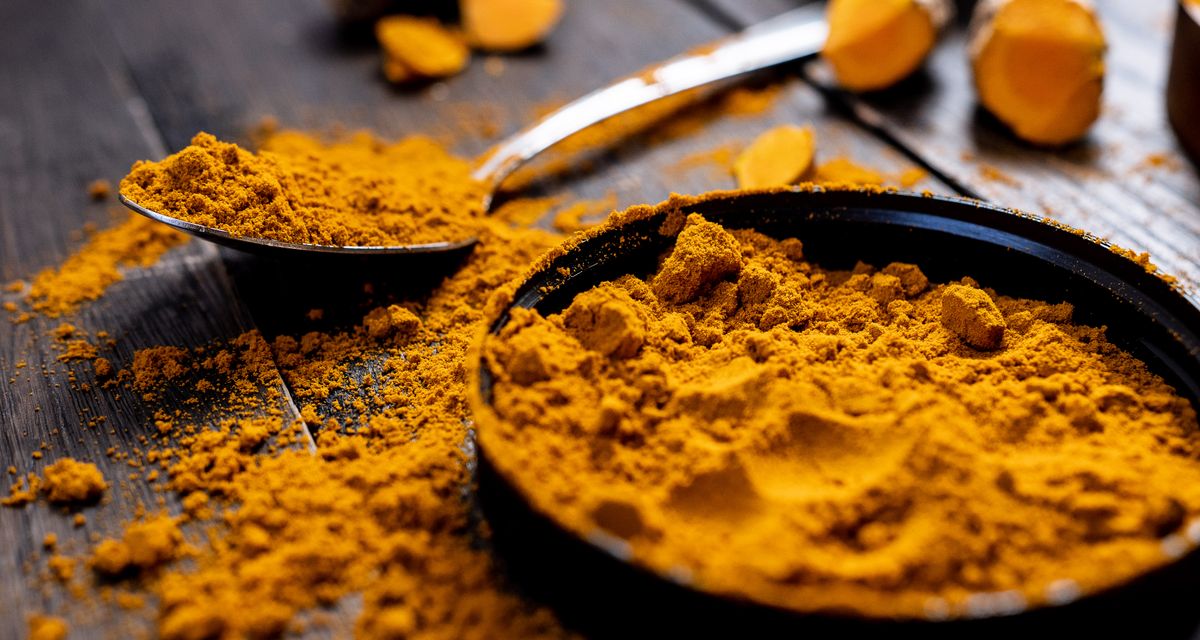
Turmeric's flavour is quieter than its colour. It is warm and earthy, faintly bitter and peppery, with a musky-woody depth and a distant kinship to its cousin ginger. Used with a light hand it mostly adds colour, body and a savoury background warmth; overdone, the bitterness comes forward, which is why most Indian cooks add just a careful pinch.
Two chemistries are at work, and they are largely separate. The colour comes from the curcuminoids — chiefly curcumin, alongside demethoxycurcumin and bisdemethoxycurcumin — which make up roughly 1–6% of the powder (averaging about 3% in commercial samples). These are the famous yellow polyphenols now central to turmeric's health research.
The aroma comes instead from turmeric's essential oil, rich in turmerones — especially ar-turmerone — along with zingiberene, germacrone and atlantone. Curcumin itself is nearly flavourless and odourless; it is these volatile terpenoids that give freshly ground turmeric its warm, slightly resinous smell, which is exactly why pre-ground turmeric sitting open for months tastes flat and merely bitter.
12Culinary uses
How to cook with it
In Indian cooking turmeric is foundational rather than showy — a base note added early, almost reflexively, to build colour and a savoury backbone before the louder spices arrive. The craft is restraint and timing: a little, bloomed in fat, early in the dish.
- Bloom it early in oil or ghee: The classic move: add a pinch of turmeric to hot oil or ghee with onions, ginger and garlic at the start of a curry or dal. A brief sizzle sets the colour and tames the raw bitterness — but don't let it burn, which turns it acrid in seconds.
- The everyday base of Indian food: Turmeric goes into nearly everything savoury here — sambar, rasam, dals, vegetable thorans, fish and meat curries, biryani and pickles — usually a quarter to half teaspoon, for colour and warmth rather than dominant flavour.
- Haldi doodh / golden milk: Turmeric simmered into warm milk with a little fat and black pepper — haldi doodh, now globally known as 'golden milk' — is a traditional Indian comfort drink. The fat and the pepper's piperine both help the body take up curcumin.
- Marinades and seafood: A turmeric-and-salt rub is the classic first step for Indian fish fry and prawns: it colours, lightly cures and cuts the fishy smell before the chilli and spice go on.
- Natural colour and rice: A pinch turns rice, lentils, doughs and even plant-based scrambles a clean gold. As food colour E100 it is the natural alternative to synthetic yellows in everything from mustard to cheese.
Turmeric is a team player. Its great culinary partner is black pepper — both in flavour and, as research shows, because pepper's piperine dramatically boosts the absorption of turmeric's curcumin (we go deeper on this in our black pepper guide). It loves the warm-spice family of cumin, coriander, ginger, chilli, mustard seed and curry leaf in South Indian cooking, and pairs naturally with fat — coconut, ghee, oil and milk — which carries both its colour and its curcumin. In golden milk it sits happily with cinnamon, cardamom, ginger and honey.
13Consumption & dosage
How much, how often
Turmeric is an everyday Indian kitchen staple, used far more as a base seasoning and natural colour than as a standalone flavour. A little goes a long way, and traditional cooking almost always pairs it with fat and heat.
- Everyday cooking: A small pinch to about a quarter or half teaspoon of ground turmeric per dish is added early to hot oil, or to dals, curries, sabzis and rice, for warm colour and earthy flavour.
- Cook it, don't just sprinkle: Turmeric is best bloomed in oil or simmered in the dish; raw, it can taste bitter and dusty, while gentle cooking mellows and rounds the flavour.
- Fresh rhizome & pickles: In season, fresh turmeric fingers are grated into chutneys and pickles (especially in winter) and juiced in some regional preparations.
- Traditional warm drinks: Turmeric is traditionally simmered with milk and a little pepper and fat as 'haldi doodh' (golden milk), a long-standing home practice rather than a remedy.
- Pair with black pepper & fat: Cooks traditionally combine turmeric with a pinch of black pepper and some fat, which is also a common way its compounds are carried in food.
- Who should go easy: People on blood thinners, those with gallstones or bile-duct issues, pregnant or breastfeeding women, and anyone considering concentrated supplements should keep to normal culinary amounts and check with a doctor before any high-dose use.
14Health & wellness
What the evidence says
The strongest themes in the research are below. Many studies use concentrated extracts, and the evidence is still developing.
- Curcumin is the focus of intense research: Almost all of turmeric's studied health interest centres on curcumin, a polyphenol with antioxidant and anti-inflammatory activity in laboratory and animal work. It is one of the most-studied natural compounds today, but most of that evidence is mechanistic or early-stage, and culinary turmeric contains only a few percent curcumin.
- Possible benefit in osteoarthritis: Among human conditions, knee osteoarthritis has some of the better evidence: several randomised trials and reviews report that curcumin formulations can reduce pain and improve function versus placebo, with a favourable short-term safety profile. Reviewers still caution about small studies, varied formulations and the need for larger, longer trials.
- The bioavailability problem: A central, honest caveat: plain curcumin is poorly absorbed and rapidly cleared. This is why piperine from black pepper is so often paired with it — a classic human study (Shoba et al., 1998) found 20 mg of piperine raised curcumin's bioavailability by about 2000%. Eating turmeric with fat and pepper is the everyday version of the same idea.
- Traditional and supportive uses: Turmeric has a deep traditional role in Ayurveda and home medicine — as a digestive, a wound and skin antiseptic, and a general tonic. Some of these uses have plausible mechanistic support, but they are not the same as proven clinical treatments, and we won't overstate them.
- Use concentrated supplements with care: Culinary turmeric in food is regarded as safe for most people, but high-dose curcumin supplements are a different matter: they can cause digestive upset, may interact with medicines such as blood thinners, and rare cases of liver injury have been reported with some concentrated extracts. Supplements are not interchangeable with the spice in your kitchen.
15Nutrition
By the numbers
Turmeric is eaten in small amounts, so it contributes little to daily calories — but per 100 g the powder is strikingly dense in some minerals, especially iron, manganese and potassium, plus vitamin B6. The figures below are USDA FoodData Central values for ground turmeric (Spices, turmeric, ground; SR Legacy, FDC ID 172231), per 100 g.
| Nutrient | Per 100 g |
|---|---|
| Energy | 354 kcal |
| Protein | 7.83 g |
| Total fat | 9.88 g |
| Carbohydrate | 64.93 g |
| Dietary fiber | 22.7 g |
| Calcium | 183 mg |
| Iron | 41.42 mg |
| Magnesium | 193 mg |
| Potassium | 2,525 mg |
| Manganese | 7.83 mg |
| Vitamin C | 25.9 mg |
| Vitamin B6 | 1.8 mg |
Values are approximate and vary by sample; source: USDA FoodData Central.
16Myths vs facts
Setting the record straight
Myth: The deeper and brighter yellow the powder, the better the turmeric.
Fact: Natural colour varies, and an unnaturally bright, uniform yellow can signal added colourants or adulteration; genuine quality is about curcumin, aroma and purity, not just a flashy shade.
Myth: All turmeric is basically the same, so any cheap powder will do.
Fact: Curcumin content varies widely between types and sources, and ground powder can be adulterated with starch, chalk or dyes; buying whole rhizomes or a trusted source gives more reliable quality.
Myth: Turmeric milk or turmeric water cures diseases and replaces medicine.
Fact: Turmeric is traditionally used and studies suggest it may have useful properties, but it is not a proven cure and should never replace medical treatment; this is food and tradition, not medicine.
Myth: Eating lots of turmeric or taking big supplement doses is always safe because it's natural.
Fact: Culinary amounts suit most people, but high-dose extracts can interact with blood thinners and may affect those with gallbladder or bile-duct problems, so concentrated use is a clinical matter.
Myth: More fertiliser and water always means a bigger turmeric crop.
Fact: Turmeric needs good drainage and balanced nutrition; over-watering and excess nitrogen can invite rhizome rot, lush leaf at the cost of rhizomes, and poorer keeping quality.
Myth: You can sow turmeric from seeds like other crops.
Fact: Turmeric is propagated vegetatively from healthy mother and finger rhizomes, not from true seed; using clean, disease-free seed rhizomes is the foundation of a good crop.
17In your kitchen
How to choose, use & store
Choose
Judge turmeric by colour and smell, not just the label. Good powder is a deep, even orange-gold (not pale lemon-yellow, which can signal age, low curcumin or adulteration) with a warm, slightly resinous aroma. Whole dried fingers should be hard and heavy, snapping cleanly with a bright interior. If you want high curcumin specifically, look for named high-curcumin origins like Lakadong; for a bright all-purpose colour, Erode and Sangli fingers are the classics. Beware suspiciously cheap, intensely day-glo powder — turmeric is a known target for colour adulteration, including illegal additives like metanil yellow and lead chromate.
Use
Use turmeric early and lightly: a pinch bloomed in hot fat at the start of a dish sets its colour and softens its bitterness. Pair it with black pepper and a little fat to get the most from its curcumin, whether in a curry or a cup of golden milk. Add it before the louder spices, and stop before it dominates — turmeric is a foundation, not a headline.
Store
Store ground turmeric in an airtight jar away from heat, light and moisture; it keeps its colour and aroma best for several months and will slowly fade after that. Whole dried fingers last far longer than the powder and can be ground fresh as needed. Keep it out of direct sun, which bleaches the colour, and well sealed — and remember it stains everything it touches, from worktops to fingers.
18FAQ
Frequently asked questions
Is turmeric native to India?
It's subtler than a simple yes. Turmeric (Curcuma longa) is a sterile ancient cultigen — a cultivated plant with no wild population at all, so it has no single native birthplace to point to. Botanists believe it arose from wild Curcuma species somewhere in South or Southeast Asia, and India is its centre of diversity, its cultural home and the source of roughly 75–80% of the world's crop. So while we can't honestly call it 'wild Indian', it is genuinely a plant India made indispensable.
Why can't turmeric grow from seed?
Curcuma longa is sterile — it produces no viable seed. It is propagated entirely by planting pieces of its rhizome, so every plant is essentially a clone. This is why turmeric depends completely on cultivation and why its spread across the world was always carried out deliberately by people moving rhizomes.
What is curcumin, and how much is in turmeric?
Curcumin is the main curcuminoid — the yellow polyphenol that gives turmeric its colour and is the focus of most health research. Curcuminoids make up roughly 1–6% of turmeric powder, averaging about 3% in commercial samples. High-curcumin types like Lakadong run much higher, around 7% or more.
Why are turmeric and black pepper used together?
Black pepper's piperine dramatically improves the absorption of curcumin, which on its own is poorly taken up by the body. A well-known human study (Shoba et al., 1998) found that 20 mg of piperine increased curcumin bioavailability by about 2000%. Adding fat and a little pepper — as in golden milk — is the everyday way to get more from turmeric.
What is golden milk (haldi doodh)?
It's the traditional Indian drink of turmeric simmered in warm milk, often with black pepper, ginger, a little fat and sometimes honey. Recently popularised worldwide as 'golden milk', it's both a comfort drink and a practical way to consume turmeric, since the fat and pepper help the body absorb its curcumin.
Which turmeric has the highest curcumin?
Lakadong turmeric from the Jaintia Hills of Meghalaya is widely regarded as one of the world's best, with curcumin commonly cited around 6.8–7.5% (some sources higher) — far above typical commercial powder, which averages about 3%. Erode and Sangli turmerics are prized more for bright colour and trade quality, with curcumin nearer 2–4%.
Why is Erode called the 'Turmeric City'?
Erode in Tamil Nadu sits at the centre of a huge turmeric-growing belt on fertile, river-fed land and hosts one of India's biggest dedicated turmeric markets. That combination of large-scale cultivation and major trade earned it the nickname 'Turmeric City'; Erode turmeric received a GI tag in 2019.
How is turmeric powder made?
After the rhizomes are lifted, they're cured — boiled or steamed in water — then sun-dried until hard, often polished to remove the rough skin, and finally ground into powder. The boiling step gelatinises the starch and spreads the colour evenly, which is why traditional turmeric is cooked before drying.
Why does my turmeric taste bitter or flat?
Turmeric's warm aroma comes from volatile turmerone oils that fade over months, while the bitterness stays — so old, open powder tastes flat and bitter. Burning it in the pan also turns it acrid. Use fresh, deeply coloured powder, bloom it gently in fat, and don't let it scorch.
Is turmeric good for you, and are supplements safe?
In normal culinary amounts it's a flavouring and colour, not a medicine, and is considered safe for most people. Its compound curcumin shows antioxidant and anti-inflammatory activity in lab and animal studies, and there's reasonable human evidence for modest benefit in knee osteoarthritis, but trials are often small and curcumin is poorly absorbed. High-dose supplements are different from the spice — they can upset digestion, interact with blood thinners and, rarely, have been linked to liver injury — so check with a professional before taking them. We keep our claims measured: turmeric is a food, not a treatment.
How much seed rhizome do I need and how long is the crop?
Turmeric is planted from healthy mother or finger rhizome bits (commonly a few quintals of seed per acre, depending on spacing and bit size) and is a long-duration crop, taking about 7-9 months from planting to harvest as a single annual crop.
How do I judge good turmeric when buying?
Look for natural, even (not artificially bright) colour and a strong earthy aroma, and ideally buy whole dried fingers or a trusted source, since ground powder is the easiest form to adulterate with starch or dyes.
Why is my crop yellowing and rotting in patches?
That pattern usually points to rhizome or soft rot driven by waterlogging; improve drainage with raised beds, use clean seed treated before planting, rotate crops, and add Trichoderma, turning to a registered drench only as per the local package of practices.
Sources & further reading
- Turmeric — Wikipedia (history, botany, processing, chemistry, curcumin content, production) en.wikipedia.org
- Curcuma longa L. — Plants of the World Online, Kew Science (cultigen status, sterility, hybrid origin, probable native range) powo.science.kew.org
- Lakadong turmeric — Wikipedia (curcumin content, region, 2024 GI tag) en.wikipedia.org
- Erode turmeric — Wikipedia (Turmeric City, GI tag 2019, Chinna Nadan cultivar) en.wikipedia.org
- Sangli turmeric — Wikipedia (Maharashtra trade hub, GI tag 2018) en.wikipedia.org
- Waigaon turmeric — Wikipedia (Maharashtra, GI tag 2016) en.wikipedia.org
- Kandhamal turmeric — Wikipedia (Odisha, GI-tagged regional turmeric, 2019) en.wikipedia.org
- Vasmat turmeric — Wikipedia (Hingoli, Maharashtra, GI tag 2024) en.wikipedia.org
- ICAR–Indian Institute of Spices Research — Turmeric (improved varieties and crop research) spices.res.in
- Spices Board of India — official site (regulation, standards, turmeric clusters) indianspices.com
- Shoba et al. (1998) — Influence of piperine on the pharmacokinetics of curcumin in animals and human volunteers, Planta Medica (PubMed) pubmed.ncbi.nlm.nih.gov
- Curcumin vs placebo for osteoarthritis pain — clinical evidence review (PMC) pmc.ncbi.nlm.nih.gov
- Efficacy and mechanisms of curcumin in osteoarthritis: a scoping review (PMC) pmc.ncbi.nlm.nih.gov
- USDA FoodData Central — Spices, turmeric, ground, per 100 g (SR Legacy, FDC ID 172231) fdc.nal.usda.gov
- India's Golden Revolution: turmeric production & exports — IBEF (India's ~75% share, output figures) ibef.org
- ETMA Turmeric Market Complex, Erode — Wikipedia en.wikipedia.org
Last reviewed: 23 June 2026 · Written by the AroWest editorial team (Western Crest Ventures LLP). Educational content, not medical advice.